I looking for advice on a good steel for stock removal. I’ve made a few knives out of 0-1 with mixed results on my heat treating using a mini brick forge with torch. Thinking about sending in to Peters heat treating. There’s a lot of options and any advice would be helpful.

-
The BladeForums.com 2024 Traditional Knife is available! Price is $250 ea (shipped within CONUS).
Order here: https://www.bladeforums.com/help/2024-traditional/
You are using an out of date browser. It may not display this or other websites correctly.
You should upgrade or use an alternative browser.
You should upgrade or use an alternative browser.
Blade steel
- Thread starter Nate Dog
- Start date


DeadboxHero
Knifemaker / Craftsman / Service Provider
- Joined
- Mar 22, 2014
- Messages
- 5,463
Use steels in the .60-.80 % carbon range for best results with low end HT gear. I recommend 8670 from @Alpha Knife SupplyI looking for advice on a good steel for stock removal. I’ve made a few knives out of 0-1 with mixed results on my heat treating using a mini brick forge with torch. Thinking about sending in to Peters heat treating. There’s a lot of options and any advice would be helpful.
Needs less processing to hit peaks and isn't as sensitive to putting too much carbon in solution due to lack of temp control but nothing beats having proper temp control in the end.
If your using Peter HT you should upgrade to ZAPP Z-Wear @Alpha Knife Supply. Pay for the cryo and ask for 62-63rc. They do an job on that steel.
Some of the stainless Steels could benifit from a faster quench rate than a vacuum gas quench used at Peter's. Also low alloy carbon steels won't get the TLC needed to really shine from Peter's either. So Z-Wear.

daizee
Knifemaker / Craftsman / Service Provider
- Joined
- Dec 30, 2009
- Messages
- 11,171
Yep, O1 really needs a controlled heat-treat to shine.
Also consider anything in the 1075-1084 range, including 80CrV2.
Carbon steels only.
What are you quenching in? For a basic setup without big investment, canola oil is usually a good choice. Pre-heat it to no more than 135F if you can. If your blades are small, you can even get by with room temp (in a reasonable climate). (please don't use motor oil - ick)
There's a pile of info in the stickies.
Also consider anything in the 1075-1084 range, including 80CrV2.
Carbon steels only.
What are you quenching in? For a basic setup without big investment, canola oil is usually a good choice. Pre-heat it to no more than 135F if you can. If your blades are small, you can even get by with room temp (in a reasonable climate). (please don't use motor oil - ick)
There's a pile of info in the stickies.

Willie71
Warren J. Krywko
- Joined
- Feb 23, 2013
- Messages
- 12,214
Use steels in the .60-.80 % carbon range for best results with low end HT gear. I recommend 8670 from @Alpha Knife Supply
Needs less processing to hit peaks and isn't as sensitive to putting too much carbon in solution due to lack of temp control but nothing beats having proper temp control in the end.
If your using Peter HT you should upgrade to ZAPP Z-Wear @Alpha Knife Supply. Pay for the cryo and ask for 62-63rc. They do an job on that steel.
Some of the stainless Steels could benifit from a faster quench rate than a vacuum gas quench used at Peter's. Also low alloy carbon steels won't get the TLC needed to really shine from Peter's either. So Z-Wear.
8670 is my go to recommendation now for backyard heat treat. Z-wear is my favorite steel. O1 at Rc60 is less tough than z-wear at Rc63. Hard to go wrong with z-wear, or the very similar v4e.
Last edited:
- Joined
- May 12, 2016
- Messages
- 221
80crv2 is a great steel for a home heat treater, it has a tad of vanadium to keep grains small and heat treats easily with a forge and canola oil. Cruforge V might be a tad better as it has a little more vanadium and doesn't seem to require any soak for it's much higher carbon content but the available thickness is a tad thick for just stock removal. I would also suggest looking at jtknives service of cutting your design in either 15n20 or AEB-L, heat treating and sending you a fully heat treated blank for you to do your stock removal on. I ordered a couple of kitchen blanks and 4 hunters, he does a great job on them. (he is taking a much deserved vacation currently though)
Willie71
Warren J. Krywko
- Joined
- Feb 23, 2013
- Messages
- 12,214
Ima throw 1095 in there as well, just to confuse you even more.
It's a great, tough steel that heat treats easily enough.
This is flat out wrong. 1095 is one of the least tough steels we have tested, and has a narrow range of optimum heat treat temp. Additionally, it needs brine or fast oil to quench. None of these principles make it a good choice for backyard heat treat.
Damn. I must be doing something wrong then. I have had great results with it.This is flat out wrong. 1095 is one of the least tough steels we have tested, and has a narrow range of optimum heat treat temp. Additionally, it needs brine or fast oil to quench. None of these principles make it a good choice for backyard heat treat.
I will look into this further though. Thanks for the heads-up.

Stacy E. Apelt - Bladesmith
ilmarinen - MODERATOR
Moderator
Knifemaker / Craftsman / Service Provider
- Joined
- Aug 20, 2004
- Messages
- 38,428
"Great Results" are only relative when compared to the optimal results and full potential. A better term would be Good Results.
1095 will harden even if done improperly in a quick and dirty backyard HT ... it just won't be any better than 1084, which is basically what you get when you do a backyard HT with 1095. You get a eutectiod steel with ferrite and cementite in the mix. It will cut, but some of the attributes of properly hardened 1095 will be left out.
If you went to a local knife club show, you might come home and say it was a "Great Knife Show". That wouldn't be the full potential of a Great Knife Show if you use Blade as the optimal show.
1095 will harden even if done improperly in a quick and dirty backyard HT ... it just won't be any better than 1084, which is basically what you get when you do a backyard HT with 1095. You get a eutectiod steel with ferrite and cementite in the mix. It will cut, but some of the attributes of properly hardened 1095 will be left out.
If you went to a local knife club show, you might come home and say it was a "Great Knife Show". That wouldn't be the full potential of a Great Knife Show if you use Blade as the optimal show.
Willie71
Warren J. Krywko
- Joined
- Feb 23, 2013
- Messages
- 12,214
For comparison from Larrin’s data:
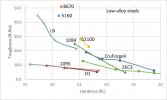
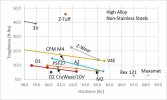
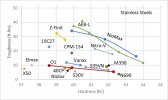
You can see that steels like 8670, 5160, 15n20 (not yet ground for testing), L6 offer a lot more toughness with easier, or more forgiving heat treat. 1095 wear resistance is minimally better than 1084, which is easier to heat treat. Z-wear/v4e strike a near perfect balance between wear resistance and toughness. Cruforge-v is the only simple carbon steel close. 52100 is finicky to heat treat if heavily spheroidized, Stainless steels seem to skip over that middle ground, leaving either high toughness, or high wear resistance.
You can see that steels like 8670, 5160, 15n20 (not yet ground for testing), L6 offer a lot more toughness with easier, or more forgiving heat treat. 1095 wear resistance is minimally better than 1084, which is easier to heat treat. Z-wear/v4e strike a near perfect balance between wear resistance and toughness. Cruforge-v is the only simple carbon steel close. 52100 is finicky to heat treat if heavily spheroidized, Stainless steels seem to skip over that middle ground, leaving either high toughness, or high wear resistance.
- Joined
- Dec 10, 2016
- Messages
- 199
For comparison from Larrin’s data:
View attachment 1185739
View attachment 1185740
View attachment 1185741
You can see that steels like 8670, 5160, 15n20 (not yet ground for testing), L6 offer a lot more toughness with easier, or more forgiving heat treat. 1095 wear resistance is minimally better than 1084, which is easier to heat treat. Z-wear/v4e strike a near perfect balance between wear resistance and toughness. Cruforge-v is the only simple carbon steel close. 52100 is finicky to heat treat if heavily spheroidized, Stainless steels seem to skip over that middle ground, leaving either high toughness, or high wear resistance.
1084 is a recent addition to the low alloy steel data? I hadn't seen it before Larrin's O1 write up. I may have missed it though.
Nonetheless, 1084 is right up there in toughness with 52100, and at approximately the same hardness. That's not too shabby.
Willie71
Warren J. Krywko
- Joined
- Feb 23, 2013
- Messages
- 12,214
1084 is a recent addition to the low alloy steel data? I hadn't seen it before Larrin's O1 write up. I may have missed it though.
Nonetheless, 1084 is right up there in toughness with 52100, and at approximately the same hardness. That's not too shabby.
Yes, it outperformed O1 and 1095 by a fair margin. I austenitized it at 1475f for 10 min.

- Joined
- Jun 11, 2006
- Messages
- 8,651
80crv2 is a great steel for a home heat treater, it has a tad of vanadium to keep grains small and heat treats easily with a forge and canola oil. Cruforge V might be a tad better as it has a little more vanadium and doesn't seem to require any soak for it's much higher carbon content but the available thickness is a tad thick for just stock removal. I would also suggest looking at jtknives service of cutting your design in either 15n20 or AEB-L, heat treating and sending you a fully heat treated blank for you to do your stock removal on. I ordered a couple of kitchen blanks and 4 hunters, he does a great job on them. (he is taking a much deserved vacation currently though)
Shhhhhhhh, keep it down I’m trying to vacation here, I could feel my ears burning. But yeah we heat treat any steel, we also will cut your designed with a cnc plasma cutter. And to top it all off we will surface grind the blades if that’s something your wanting. Ok back to my vacation and looking on eBay for shop stuff, facepalm.
- Joined
- Dec 3, 2017
- Messages
- 75
Anyone else noticed 26c3 being as tough at 63hrc than 1095 at 59hrc(according to Larrin's graph). Man, I just started doing some tests with 26c3 and it looks very promising!!

- Joined
- Oct 19, 2011
- Messages
- 5,044
When you ask "what steel to use?" you will get a thousand different suggestions. If you are sending the knife out to be professionally heat treated you can use just about anything. I would stay away from high vanadium steels like S90V. Don't ask. Start with the purpose for the knife. Make a list of some basic questions. The answers will suggest which direction to go with the steel.
What will the knife be asked to do? This leads to questions about blade geometry, fine cutting, heavy chopping, stabbing, prying, etc.
How big will the blade be?
Who will be using the knife?
In what environments will the knife be carried and used?
Will the user be close to or carrying sharpening supplies?
Will the user prefer edge holding or toughness?
There are many more questions to ask and answer to narrow down the choices. There is no one perfect steel. Shoot for a well chosen steel for the job with excellent heat treat and proper geometry.
What will the knife be asked to do? This leads to questions about blade geometry, fine cutting, heavy chopping, stabbing, prying, etc.
How big will the blade be?
Who will be using the knife?
In what environments will the knife be carried and used?
Will the user be close to or carrying sharpening supplies?
Will the user prefer edge holding or toughness?
There are many more questions to ask and answer to narrow down the choices. There is no one perfect steel. Shoot for a well chosen steel for the job with excellent heat treat and proper geometry.