Blownnova's Custom in the Works.

Joined
Nov 29, 2012
Messages
232
After much discussion Blownnova and I have worked out a plan of action for the custom knife he won in my recent GAW.

As this is a large field knife I am building it from L6 and will austemper for lower bainite.

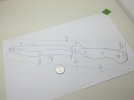
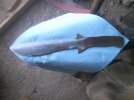
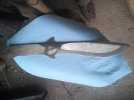
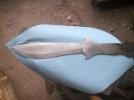
Here is the sketch he provided me, and the forged blank.

It's projects like this that make me consider getting a power hammer....
This blade started off as 10" by 2" bar stock and is now 14" overall and 3" across the integral guard.... Working this bar out by hand was painstaking but fortunately for me with blade-smithing the journey is the destination.

After primary forging she was put back in the HT oven to thermal cycle (stress relieved) 3 times for 15 minutes each at 1200 degrees, and then annealed at 1450 and into the vermiculite bin to cool over the next few hours.

will post additional updates as we move forward.
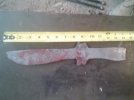
IMG_20150405_121339.jpgsketch.jpg
 
Looks great, sorry for the extra work. I am excited, this is my first experience with a hand forged blade as well as L6 steel. Thank you for the opportunity.
 
Looks great, sorry for the extra work. I am excited, this is my first experience with a hand forged blade as well as L6 steel. Thank you for the opportunity.

No need to apologize. gives me a reason to forge my first integral guard. have been thinking about doing one if these for a while but hard to justify the labor just for kicks... glad i finally got a reason to do it.
 
We are going with black canvas micarta, which will be fastened with epoxy rivets and loveless bolts.
Can't get any tougher.
 
can you give bigger photos after you finish them? i am waiting

o.png
 
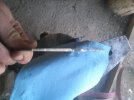
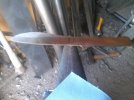
Here she is profiled and rough ground with the distal tapers set... she is .225 at what will be the ricasso, .90 at the butt, and .110 at the tip.... I could take the tip down a little more but as this blade has a false edge on the spine I find it is better to leave just a little more meat up there.

Note that the integral guard is also tapered, will make for a lot more filing and hand sanding later but this was a necessity of drawing out the guard and also removes that much more weight... and I just think it looks better than a block square edged guard.

.... was asked recently in regards to this knife why I didn't use a bigger piece of steel and a stencil and cut it out with a bandsaw... for anyone else wondering the same thing. I equate it to asking a painter why he didn't use a camera... would it be a more identical copy... undoubtedly but that's not all that it's about.

... oh and obviously the areas that are still rough will be worked out in further sanding.

IMG_20150407_102415.jpg
IMG_20150407_102450.jpg
 
The blade is really starting to take shape and look good. How does the balance feel at this point? I think leaving more material toward the tip is a good idea. My opinion is it's important to keep weight at the end of the recurve where it gets wide for a faster, more powerful swing.

I think it's great that you forged it from a smaller piece rather than just cutting it out, you posess a talent that many others do not. This being my first forged blade I am not familiar with the steel characteristics you end up with but I imagine it makes for a very strong blade when forged properly. The whole process is fascinating to me. If you ever make videos of your forging process while you are doing it I would enjoy seeing it.
I think it is going to be a fantastic knife and great companion. Thanks for the update and all your hard work.
 
Last edited:
The balance at this point is great. Right where it should be at this phase a little high... when we ad the handle it will come back down a little to just above the guard... once she is finish ground I will temporarily fit the grips and check her again. If need be I can add more taper in the handle to keep the balance just above the guard (which is where I find a blade feels most "alive"

View attachment 532073
 
Ok, well my plan for the day was to profile and set the tapers on this blade and then move on to another order, but this one being particularly unique and challenging has coaught my attention and I wasn't able to walk away... SO, I went ahead and set the bevels, and then spent about 3 hours hand sanding one side to 220 grit....
Yes that is a lot of time to hand sand one time... Usually I don't even go to hand sanding till past 220 but with this blade, with it's compound curves and underground edge I decided to go to hand sanding at 80 grit so that I didn't risk over grinding.
FYI. the underground bevel while one of the most common in production blades, is actually the most difficult in hand-crafted blades... the problem is that the bevel is small. It's a small flat to try and stay on as you grind down the length of the blade and maneuver around the compound curves (by hand). I could write a book on this so I'm going to start another thread about bevel profiles.

So here she is ... one side rough beveled, the other hand finished to 220grit.... since I didn't get to other knives today, I probably won't work on her tomorrow to stay on task with others.

Two points of note...
- the false edge on mine is longer than the original schematic... that's a failing I have..... I like a false edge to not be false... so they tend to end up longer but the last inch or so of the false edge will be sharpened... this serves two purposes: 1) it makes for better penetration when stabbing, 2) it gives a secondary edge to use for small camp task (like shaving kindling for fire starter, or if raking against a magnesium rod without dulling your primary edge)
- and yes... at this moment one plunge is at this moment about 1/8 longer than the other... I'll fix this on the grinder before I go to hand sanding.

IMG_20150407_175408.jpgIMG_20150407_175436.jpg
 
Looks great, you have made a lot of progress in a very short time. I admire how passionate you are about your work, it really comes through everytime we speak or you add an update.

I am happy to see you are adding your own touches knowing what works well In a blade.
 
Almost there... Got both sides hand polished up to 400 grit and the holes for the loveless bolts and lanyard tube drilled this morning.... And in to heat treat she went.

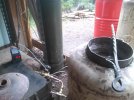
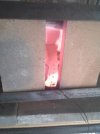
Soaked her at 1550 (once she came to color) for 10 minutes, and then quenched in salt at 450.... You might be able to see in the picture that quenching brought the salt up into the 460s.... perfect... just above the martensite point. Held her there for an hour (which according to my IT diagram should bring her to right at 50% bainite) before pulling her out and letting her air cool and transform the remainder of austentite to martensite...

My new Ames model 4 rockwell tester will arrive next week and I'll do a RC test on her to verify her temper is where I want it before putting the handle scales on.

My set up isn't fancy or high tech but using a two stage burner it holds very precise temps and so is good enough for me.
 

Attachments

  • IMG_20150411_134139.jpg
    IMG_20150411_134139.jpg
    64.9 KB · Views: 31
  • IMG_20150411_133047.jpg
    IMG_20150411_133047.jpg
    26.1 KB · Views: 25
Looking good.
Love watching this knife come together. Also get to learn a little :D
 
Back
Top