Bluing a blade, a cable damascus blade?

Joined
Aug 5, 2007
Messages
748
I was thinking about experimenting and bluing a cable damascus blade I made and then wet sanding (would sand the high spots) to really show the etched design in the blade. The more I think about it the more interesting it sounds.

What do you think?
Also any suggested methods for bluing?

Thanks
 
Stefan- there are a few different ways to get at what you're looking for (if I understood you correctly).

The easiest and cheapest method is to etch the blade as you would any damascus blade, then thoroughly clean it with baking soda and a toothbrush. I use Windex with Ammonia to neutralize the ferric chloride, but the baking soda helps get any loose oxidation out of the "valleys."

Clean it real well with hot water and dish soap. Once dry, you can coat the blade with Birchwood Casey Super Blue and a Q-tip.

Let it do its thing for a minute, and then run it under cold water.

Then clamp it down firmly to a secure sanding fixture. Sand with LOTS of water, a steel block/bar, and 2000x paper. Lots of water!

Another option, is to prep the blade the same way, but then preheat it with a heat gun/hair dryer, then spray it with baking laquer from Brownells. Then you cook the blade in the oven to help cure the laquer. Once done, finish the same way as with the cold blued blade. You really have to use lots of water and move the paper frequently, or the laquer will build up on the paper and pull it out of the low spots.

We could get into stuff like Oxynate7, a TRUE gun blue (DARK blue, almost black)... but that's caustic and pretty tricky. I've got the stuff to do it here, but I rarely do as it's kind of a pita!!!

 
Last edited:
Cold aka rust blue is one of the best and the most wear resistant blue methods available - it's been used on VERY high end guns for years.........best part - no high heat needed - hottest thing is boiling water......
Brownell's sells two brands with instructions
http://www.brownells.com/aspx/NS/store/catsearch.aspx?k=RUST BLUE&ps=10&si=True

It's basically browning the metal first and then boiling it in hot water to change from brown to blue.
This is a quicky I did a few years ago just to see how it would look on a blade - not the best pic but it will give you an idea.....
cold-blue-002.jpg
 
Since I'm very visual... my post above (even to myself) just looks like a lot of blah blah blah.

Maybe these links will help clarify a little :)

Birchwood Casey Super Blue

http://www.brownells.com/aspx/NS/store/ProductDetail.aspx?p=24770&title=SUPER BLUE


Brownell's Baking laquer (I think this works better on pattern welded steel than cable, but that's just my opinion)

http://www.brownells.com/aspx/NS/store/ProductDetail.aspx?p=1143&title=AEROSOL BAKING LACQUER


Oxynate 7 from Brownell's (the real deal) lol

http://www.brownells.com/aspx/NS/Store/ProductDetail.aspx?p=1066
 
Thanks for the info Chuck! I've never tried that product, but I'll add it to my basket next time I punch in an order to Brownells.


For those of you that don't have one, you should book-mark their web-site and order a catalog too. The title may be gunsmiths.... but they have LOTS of cool stuff for knifemakers too! :)
 
Nick - FWIW - the piece I did was done using BC Plum Brown for the browning part and then boiled in distilled water - as I said it was a quicky job but I had the Plum Brown on hand and it works pretty fast and since it was just an experiment to see what it would look like.........

When I get the time (yaah shoor :rolleyes: ) I'd like to do a comparison of the two methods to see how the BC PB holds up compared to the slower method which I've used on guns quite a bit (I've used both products from Brownell's as well as LMF and my own homemade concoctions) - it's IMO the by far best blue/most durable for guns, but fairly time consuming - also it's for my muzzlestuffers and that's the way it was done "back then" plus no hot, caustic salts and their tanks to deal with - at most a simple humidity box (generally not needed on the wet side of Wash State or any place else with high humidity but here in Durango humidity averages 20%))and some fumes when using the chemicals that good ventilation and a good mask handles easily.....
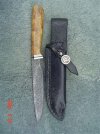
 
Stefan, here's oneI did with cold blue and lightly sanded with 2000 gr paper. Afterwards oiled it well and it has held up pretty good.
 

Attachments

  • cablespaltedoak.jpg
    cablespaltedoak.jpg
    49.1 KB · Views: 128
Thank you everyone!!! I am getting excited just thinking about how this might or might not turn out! Experimenting can be fun!
 
I have toooooo many candy stores!!!! Just not enough time!!

I've got almost a month and a half before I start my school and then deploy again.
 
FWIW - Appears some folks consider hot bluing as the one TRUE bluing - well slow rust/cold blue (not the bottled "cold" blue) has been around since at least the late middle ages and has been used on firearms since the late 1600's albeit not extensively until the late 1700's.

Hot/Salt bluing on the other hand was a method developed around either the end of the 19th century or around WW 1 (depends on who you read) for use by the military to speed up production and lessen expense - the best gun builders continued to use slow rust bluing and still do to this day on their high end guns especially doubles where higher heat can be a problem - I'm talking folks like H & H, Rigby, et al........

Other methods of bluing that have been used on firearms are: heat, carbona, and charcoal. IMO the advantage of cold/rust for knives in particular are none of the high heat related problems that can happen with the hot/salt method and it's more durable than even hot/salt blue and compared to so-called bottled "cold" blue there is no contest! ........Dependent on how the metal is finished and what chemicals are used you can get anywhere from a dark/black blue to a brighter more blue/blue.......and cost is negligible - something to boil hot water in and then place your metal is about all that is really needed..

as always others mileage will vary.......
 
Cold aka rust blue is one of the best and the most wear resistant blue methods available - it's been used on VERY high end guns for years.........best part - no high heat needed - hottest thing is boiling water......
Brownell's sells two brands with instructions
http://www.brownells.com/aspx/NS/store/catsearch.aspx?k=RUST BLUE&ps=10&si=True

It's basically browning the metal first and then boiling it in hot water to change from brown to blue.
This is a quicky I did a few years ago just to see how it would look on a blade - not the best pic but it will give you an idea.

Chuck,

I've got a good friend who builds the high-end rifles. He has used a bunch of different rust blue formulas and techniques. He uses this http://www.brownells.com/aspx/NS/store/ProductDetail.aspx?p=8795&title=EXPRESS%20BLUE%20#1%20EXPRESS%20BROWN%20#2 exclusively now for both quality and ease... well, the quality is in the pre bluing finish but you know what I mean.

Mike
 
You're 100% correct, Chuck.
I have a book that I bought at a gun show for $8.00. A hardback book copyrighted in 1936 - "Firearm Bluing and Browning" by R.H. Angier.
It has 230 bluing and browning recipes!
Nobody could pry it out of my hands with a 10 foot crow bar.
 
I'm ordering some NaOH (lye) and Sodium Nitrate for hot bluing. Do anyone have tried this method? They are cheap and easily found materials. I wish to know which percentage of this solution works best to have a good blue for carbon steels...
 
Back
Top