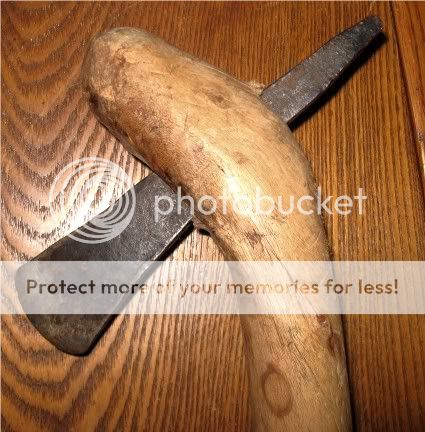
Boarding axe or tomahawk?

Joined
Feb 20, 2010
Messages
61
Someone mentioned that the tomahawk was native only to the America's, but I don't think that's entirely true. Aside from the almost identical hand axes used by man through the rest of the world, the standard tomahawk shape has the most in common with a naval boarding axe. I'm guessing the axes on the ships were then traded for goods. So does this mean that the natives did not design the tomahawk at all, but European sailors?
 
Someone mentioned that the tomahawk was native only to the America's, but I don't think that's entirely true. Aside from the almost identical hand axes used by man through the rest of the world, the standard tomahawk shape has the most in common with a naval boarding axe. I'm guessing the axes on the ships were then traded for goods. So does this mean that the natives did not design the tomahawk at all, but European sailors?

Tomahawks are not native to North america at all. First nations people used stone and copper but were not iron workers. There is a theory that the Inuit may have traded iron through trading networks Prior to the white invasion:D
however tomahawks were strictly trade items brought by the whites.
Red stone Pipes were used prior to white contact, That is where the pipe tomahawk came from, the traders thought the "indians" would like hawks with pipe bowls. In spite of what you may have read, Native peoples did NOT use pipe tomahawks for Sacred ceremony.

Very best regards

Robin
Regards

Robin
 
SnowmanBob01 So does this mean that the natives did not design the tomahawk at all said:
tomahawk (n.)

1.weapon consisting of a fighting ax; used by North American Indians

We might have coined the word, Toma is a Polynesian prefix for burial, The Hawk is the messenger, maybe the word meant to seen you to your burial ground. And also the term "tomahawk" is a derivation of the Algonquian Indian words "tamahak" or "tamahakan". The earliest definitions of these words (early 1600's) applied to stone-headed implements used as tools and weapons. The Algonquians MAY have been the first to trade with the French.
The metal heads that we call Native American Tomahawks were originally based on a Royal Navy boarding axe and used as a trade-item with Native Americans for food and other provisions and as Robin said I think the "Pipe 'Hawks" were made as a novelty for trade. But who knows who was the first to stick metal threw a limb, maybe the Celts during the Bronze age. Probably looked something like this...........Randy

celttomahawk.jpg
 
Excellent points, Robin. I've always thought that historical tomahawk design had as much to do with the features of the trading arrangements as much as tactical or utilitarian value. In other words, if youre the white guy planning to trade axe heads, youre going to make the axe heads small to maximize your return.

Also, some of the native people apparently wanted these things for 'looks' for lack of a better word according to http://www.amazon.com/American-Indian-Tomahawks-Harold-Peterson/dp/1578986281/ref=sr_1_3?s=books&ie=UTF8&qid=1300371817&sr=1-3
I'm thinking of the ungainly Missouri War Axe specifically.

As something of an aside, on the northwest US coast where I live, Asian coins and other processed metal objects have been found that predate the invasion.
 
Excellent points, Robin. I've always thought that historical tomahawk design had as much to do with the features of the trading arrangements as much as tactical or utilitarian value. In other words, if youre the white guy planning to trade axe heads, youre going to make the axe heads small to maximize your return.

Also, some of the native people apparently wanted these things for 'looks' for lack of a better word according to http://www.amazon.com/American-Indian-Tomahawks-Harold-Peterson/dp/1578986281/ref=sr_1_3?s=books&ie=UTF8&qid=1300371817&sr=1-3
I'm thinking of the ungainly Missouri War Axe specifically.

As something of an aside, on the northwest US coast where I live, Asian coins and other processed metal objects have been found that predate the invasion.


Hi bud
Ya, the ethnographers keep telling us we're Chinese :D Most west coast first nations people I know reject that theory. I'm 1/2 Cree which is one of the Anishnabec tribes in the algonkian linguistic group. According to "scientists"
our DNA is europein:(:D

As far as trade items are concerned' the big traders (HBC and NW Co) traded the cheapest stuff they could for very valuable Beaver skins. The trade knives were all made by low end butcher knife cutlers. Some really high Chiefs were gifted with silver gorgets and other trade silver and the odd very high end (now) silver inlaid hawks but these were not your average trade piece. I would think that later in the settlemen era that local blacksmiths would have made hawks and simple knives for barter.
Re: the Look:D
Yes, this is true,especially when photographs were being taken (Curtis), they would dress up with all their gear on, trade pipehawks are seen in many early pictures as well as trade silver, trade medals (usually gifts). In Curtis's early photos you see many more trade hawks than actual Sacred Pipes, before the reservation period they were thought of as much too Sacred to be shown.
I have seen many later photos (1890s) with a Lakota wearing and Ojibwa medicine bag, never happen, ever. Many of the early photographers collected their own props, so you have people wearing another tribes stuff.
Out your way the People had some pretty scary war clubs, some with copper, these were pre contact. West coast tribal art is the very best on earth, love the work.

Very best regards

Robin
 
Hi bud
Ya, the ethnographers keep telling us we're Chinese :D Most west coast first nations people I know reject that theory. I'm 1/2 Cree which is one of the Anishnabec tribes in the algonkian linguistic group. According to "scientists"
our DNA is europein:(:D

Out your way the People had some pretty scary war clubs, some with copper, these were pre contact. West coast tribal art is the very best on earth, love the work.

Very best regards

Robin

I just take it a step further and say we're all African. As far as NW tribal art, eye of the beholder my friend. I think it's :barf:.:D Now the war clubs. Those are pretty cool. Made out of whale bones. They have one in the Portland art museum. Very cool.
 
I just take it a step further and say we're all African. As far as NW tribal art, eye of the beholder my friend. I think it's :barf:.:D Now the war clubs. Those are pretty cool. Made out of whale bones. They have one in the Portland art museum. Very cool.

Hi there shotgun
North west art is not to everyones taste but the best of the best is considered to be the greatest tribal art. Bill Reids stuff sells in the millions, a couple of the early known makers bring huge prices at auction as well. For me it is the simplicity of line (all arches) and the strong connection to nature.
Just wish I had the bucks to get some:D

Best regards

Robin
 
The axe has been used for a long time america, take a look at these examples from the Mayan and Zapotec cultures.

www.precolumbianweapons.com/axe.htm

I don't know if such examples exist that come from north american tribes. But there are a lot of them in some of the museums down hear and in the use that do resemble the tomahawk.
 
Hi bud
Ya, the ethnographers keep telling us we're Chinese :D Most west coast first nations people I know reject that theory.

I can imagine so, that's pretty far fetched, unless what is meant is a basic genetic connection to the Asia region, just as I, someone of euro descent, has an essentially african set of genes.

But anyway on the topic of early use of metal on the NW coast, best theories I've read include 1) stuff traded its way around the land mass from Asia over Alaska and down the coast and 2) Asian vessels floated over here on purpose or not. There are early 20th century news reports of Japanese fishing vessels being blown out to sea and ending up on the Washington coastn no hands aboard or all dead. The more far-fetched accounts, IMO, are those suggesting successful voyages by Asian ships to the American coast and back. Not that they didnt have the technology, its that we dont have records of that and I think they were focused on exploring Malaysia and India.

Re: Pacific NW First People and weapons, actually I've always been struck by the limited presence of much warlike gear out here, according to what records I know of. I'm not saying they didnt go to war, just that relative to the people on the plains, doesnt seem to have been as much emphasis. By necessity, I'm sure, plains people had a heck of a lot of pressure as the white westward expansion picked up steam.

 
I vote :thumbup: on pacific coast native art, stuff blows my mind. The University of BC in Vancouver Anthropology Museum has some amazing new and old stuff there.

By forget the art, what about the woodcrafting those people could pull off, 50 person canoes from massive cedar logs, lodges big as football fields, etc? With stone and bone tools no less.

Hey Robin, the 'posing' done by those early photographers explains why those people look so ticked off in the pictures eh? ha ha
 
Last edited:
Many of the 18th century hawks were a spike design..A little longer and leaner than later models..Similar to boarding axes but faster..We actually have a 18th century style spike we are going to be posting tonight..
Hammer poll hawks were pretty uncommon really..Pipe hawks didnt come along until later..Trade axes made up the bulk and they were simple wrap&weld axe heads, some with steel bit, some not...Can you guess who ended up with a lot of the axe heads without the steel cutting edge ;)
My great mamaw was a shawnee, some say cherokee..Hard to say now..There are still folks around here that carry strong Melungeon blood...East, Ky was one of the places they ended up..
 
I can imagine so, that's pretty far fetched, unless what is meant is a basic genetic connection to the Asia region, just as I, someone of euro descent, has an essentially african set of genes.

But anyway on the topic of early use of metal on the NW coast, best theories I've read include 1) stuff traded its way around the land mass from Asia over Alaska and down the coast and 2) Asian vessels floated over here on purpose or not. There are early 20th century news reports of Japanese fishing vessels being blown out to sea and ending up on the Washington coastn no hands aboard or all dead. The more far-fetched accounts, IMO, are those suggesting successful voyages by Asian ships to the American coast and back. Not that they didnt have the technology, its that we dont have records of that and I think they were focused on exploring Malaysia and India.

Re: Pacific NW First People and weapons, actually I've always been struck by the limited presence of much warlike gear out here, according to what records I know of. I'm not saying they didnt go to war, just that relative to the people on the plains, doesnt seem to have been as much emphasis. By necessity, I'm sure, plains people had a heck of a lot of pressure as the white westward expansion picked up steam.

I've read that the tribes in the region I'm in believed that if you were to kill a man that the spirit would come back to haunt you so they adopted more club like weapons in the attempt to incapacitate rather then kill.
 
I've read that the tribes in the region I'm in believed that if you were to kill a man that the spirit would come back to haunt you so they adopted more club like weapons in the attempt to incapacitate rather then kill.

Interesting. Probably also in there somewhere was the more prosaic fact that some dude's posse might be less likely to come after you if he was just knocked around a bit. I dunno. Clubs are also easier to manufacture and materials are cheap.

On the other hand, in the book I linked earlier, the author noted that tomahawk usage wasnt as common among plains people because they favored a club with a long flexible handle for bashing people from horseback. That wouldnt qualify as easy to make, IMO.
 
I've read that the tribes in the region I'm in believed that if you were to kill a man that the spirit would come back to haunt you so they adopted more club like weapons in the attempt to incapacitate rather then kill.

Hey Shotgun
The Sioux (Lakota, Dakota, Hunkpapa etc and the Cheyenne) Warriors used to have a thing called "counting coup. They felt that it was much more of a victory to Not kill their opponent but to humiliate them by smacking them with what was called a coup stick. After the battle they would sit around and "count coup" which was bragging abut their exploits. Native wars were almost always skirmishes and life was respected. Until Custer really pissed them off:D.

Best regards

Robin
 
Interesting. Probably also in there somewhere was the more prosaic fact that some dude's posse might be less likely to come after you if he was just knocked around a bit. I dunno. Clubs are also easier to manufacture and materials are cheap.

On the other hand, in the book I linked earlier, the author noted that tomahawk usage wasnt as common among plains people because they favored a club with a long flexible handle for bashing people from horseback. That wouldnt qualify as easy to make, IMO.

Some plains war clubs
http://www.icollector.com/Lakota-War-Club-C-1860-Good-condition-dolomite-head_i9271009
http://www.lithiccastinglab.com/gallery-pages/2007januaryplainswarclubspage1.htm
 
Native wars were almost always skirmishes and life was respected. Until Custer really pissed them off:D.

I just read The Last Stand by N Philbrick and Stephen Ambrose's "Custer and Crazy Horse" both awesome books. Philbrick focuses on Sitting Bull and Custer. Highly recommended. Philbrick does a good job of showing the buffoonery of the army of that day. Both highlight what you mention .... this was a new type of warfare for both sides.

Love the link to those war clubs ... just bad-ass.
 
War on the plains and south west was a way of life. Part of this was tribal politics some survival. Several plains tribes were raiders as a way of life. (think Norseman/Saxon) The Comanche became the prominent tribe on the plains (thanks to the horse and a warrior/revenge mind set) and were very Territorial.

All of the Native American tribes had the ability of extreme violence, beyond what most of us can comprehend or excuse. (though all histories are very bloody) We can't judge with out context, this was a different culture.

When the Europeans showed up they walked right in the middle of turf wars that had been going on for ever. To call this war fair respectful you have to understand the mind set of the times. I will respect your right to torture me to death because I plan to do the same to you.....unless I enslave you or forcibly adopt you after brutaly killing all your family that did not escape.
 
Back
Top