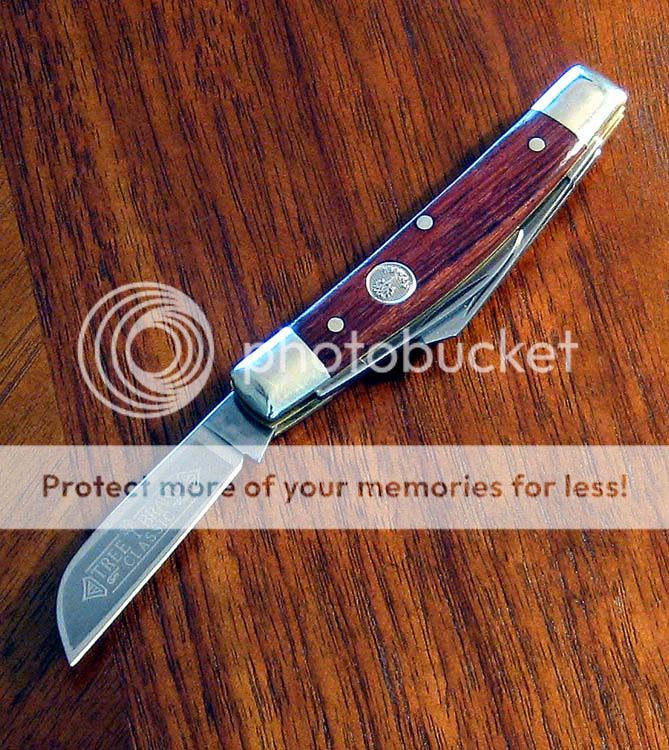
Hi everyone. This is my first post to the site and I think I have a simple question, but Ill give you a little (or a lot) of background first.
For years Ive had an old pocket knife knocking around my workbench in the basement. I vaguely recall it winding up in my possession after my grandfather died a decade ago. No story behind it, just an old pocket knife we found in a desk drawer. I would use it from time to time when I didnt have my regular knife on me, and every time I was impressed with how sharp it was, and how it had never seemed to dull.
So last week I was up late at night making wooden whistles out a ¾ square poplar as a whittling project for my sons Cub Scout den. I decided to make an extra, and then whittle it to use as an example of what it could look like when they are done. I was too lazy to trudge up two flights of stairs to my bedroom to fetch my good knife out of my nightstand, so I grabbed this old knife and dug in. I shaves wood SO much better than any other knife I have. I keep all of my knives sharp, but this one seems so much sharper. My son really enjoys whittling, so I bought him a decent Victoronox knife when he earned his whittling chip. It doesnt come even close to cutting as well as this tarnished old blade. Neither my old Victoronox nor my Leatherman are any better or worse than my sons knife. Ive also let him buy a couple of other decent, small, locking, single blade knives, and they are just the same. I started thinking maybe Im buying the wrong type of knife and I need to search for something specific to whittling.
The next morning I google for reviews of whittling knives, and I quickly zero in on the Boker Congress. Its a nice looking knife, lots of great feedback for whittling, and not outrageously priced. Then I started wondering who made the old knife on my workbench. That evening I pop open the blade and notice for the first time a little tree stamped on the tang. Ill be darned! I start digging around and as best I can tell it was made in Germany between 1924 and 1935. If this knife is still solid 80-90 years later, Im willing to spend a little more on a purpose built knife for the task.
https://www.flickr.com/photos/8797126@N04/17259057876/
https://www.flickr.com/photos/8797126@N04/17259056176/
So now I come to my question. Id like to get the Boker Congress for my son for his birthday. There are two seemingly identical knives listed on the Boker website, but one is almost twice the price of the other. I cant figure out what the difference is between the two. Neither is a plus or a magnum, so both should be made in Germany. Can anyone here enlighten me on what Im missing?
$85:
https://www.boker.de/us/pocket-knife/boker/classic-pocket-knife/115465.html
$44:
https://www.boker.de/us/pocket-knife/boker/classic-pocket-knife/110721.html
Thanks in advance for the help!
For years Ive had an old pocket knife knocking around my workbench in the basement. I vaguely recall it winding up in my possession after my grandfather died a decade ago. No story behind it, just an old pocket knife we found in a desk drawer. I would use it from time to time when I didnt have my regular knife on me, and every time I was impressed with how sharp it was, and how it had never seemed to dull.
So last week I was up late at night making wooden whistles out a ¾ square poplar as a whittling project for my sons Cub Scout den. I decided to make an extra, and then whittle it to use as an example of what it could look like when they are done. I was too lazy to trudge up two flights of stairs to my bedroom to fetch my good knife out of my nightstand, so I grabbed this old knife and dug in. I shaves wood SO much better than any other knife I have. I keep all of my knives sharp, but this one seems so much sharper. My son really enjoys whittling, so I bought him a decent Victoronox knife when he earned his whittling chip. It doesnt come even close to cutting as well as this tarnished old blade. Neither my old Victoronox nor my Leatherman are any better or worse than my sons knife. Ive also let him buy a couple of other decent, small, locking, single blade knives, and they are just the same. I started thinking maybe Im buying the wrong type of knife and I need to search for something specific to whittling.
The next morning I google for reviews of whittling knives, and I quickly zero in on the Boker Congress. Its a nice looking knife, lots of great feedback for whittling, and not outrageously priced. Then I started wondering who made the old knife on my workbench. That evening I pop open the blade and notice for the first time a little tree stamped on the tang. Ill be darned! I start digging around and as best I can tell it was made in Germany between 1924 and 1935. If this knife is still solid 80-90 years later, Im willing to spend a little more on a purpose built knife for the task.
https://www.flickr.com/photos/8797126@N04/17259057876/
https://www.flickr.com/photos/8797126@N04/17259056176/
So now I come to my question. Id like to get the Boker Congress for my son for his birthday. There are two seemingly identical knives listed on the Boker website, but one is almost twice the price of the other. I cant figure out what the difference is between the two. Neither is a plus or a magnum, so both should be made in Germany. Can anyone here enlighten me on what Im missing?
$85:
https://www.boker.de/us/pocket-knife/boker/classic-pocket-knife/115465.html
$44:
https://www.boker.de/us/pocket-knife/boker/classic-pocket-knife/110721.html
Thanks in advance for the help!
Last edited: