bolster handle mating gap help!

Joined
Mar 20, 2012
Messages
141
I don't know how this happened, I was very careful. Maybe it warped? How would you guys fix it? I'm thinking I pull the scales back off and add a red g10 liner underneath and between the bolster and handle.
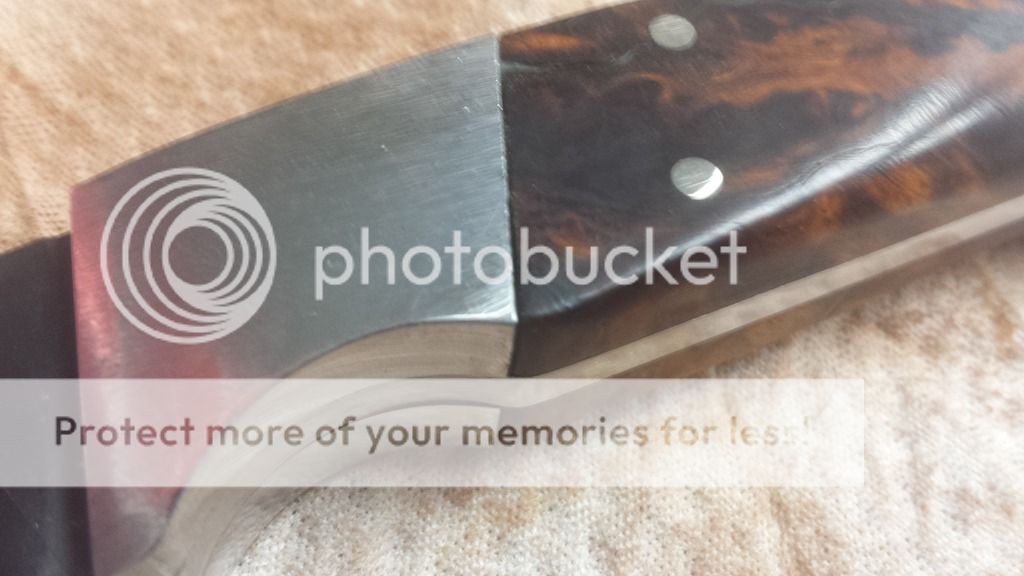

20150516_103736.jpg
 
I'd think that removing the scales would ruin them.
Look - you're not the first person to have improper fit-up, or possible shrinkage after such.
Mix up some epoxy and dye and fill the gap.
Learn and move on.
Spend your time making the next one.
That said - sometimes fixing things is a good way to learn.
Your knife - your call.
 
I see a crack in the wood where the reflection is . Is the wood stabilized ? If not has it shrunk from drying ?
 
It won't ruin the scales, they are not epoxied yet, just shaping and dry fitting. As for the "crack" I think that's just an inclusion. There were several hollow spots like that in the desert ironwood scales. They are stabilized
 
Not sure of your process but did you attach the bolsters before you drilled the scales for the pins?
 
Yes the bolster were attached first, then the scales were butted up to the bolsters and clamped. Then drilled, I didn't see any gaps after the initial fit up, which is why I was thinking warping.
 
I've never worked with ironwood, but I doubt it would warp or shrink that way, that much. Maybe heat while shaping?
 
slot the tang holes to allow the scale to float a little. If you are really worried about the pins carrying the shear load you could also add some hidden pins.
 
Not a knife maker, but I'm going to spitball a little bit here. You might have done too much finishing, before the fit. I think you should have also epoxied it when it was tight. Providing you didn't do the fitting & finishing before heat treat. You could bore out the pin holes in the tang, to butt the handles closer. And you will most likely have to regrind your current work to smooth off the lips & hangs I see. Then touch up what you messed up.

It looks like you used aluminum for the bolsters as well. You could have over heated the bolsters. Causing some of the issues you see. Aluminum like to hold on to heat and you need to work at it very cool & slow.

Typically I see most knife makers shape the bolsters "nose" (where it meets the ricasso) first. Same goes for the butt of the scales if you have an exposed tang knife. Then epoxy scale & bolster to one handle side. While leaving over hang for both on the handle profile. Keep working before the epoxy dries. Clamp that mess together for stable drilling. Drill the holes for the handle, using the tang holes as pilots. Then epoxy the second scale & bolster on. Clamp that mess together now. Use the pre made pilot holes to finish the pin holes on the other side. Throw more epoxy in the hole, then the pins. Keep it all clamped till it's fully dry. Then grind the scales & bolster to final fit. Then buff and stain to final finish.
 
The bolsters are nickel silver, never heard of anyone using aluminum. As for the lips and hangs, this is not a finished knife, I took the picture as soon as I noticed the gap. I'm not even done shaping the handle yet.

Hugo, the opposing side has no gap, so if I slot the pin hole and shift the scale forward wouldn't that make the pins go diagonal? Or is it so small of a move that it is not noticeable? I like the idea I just want to make sure before I do it.
 
That would give you a noticeable half moon by the pins, I wouldn't advise that route.

Aluminum is a long time material for bolsters and such.
 
Wouldn't making the tang holes slightly larger allow you the wiggle room to slide them forward, then clamp?
 
I was thinking we were talking about the pin holes in the scales, my bad. I suppose if you made sure the pin had enough epoxy that would work.
 
It's so easy to get a less than straight, matching line between the bolster and scale.
A couple things that help are, making the bottom side (that glues onto the tang) perfectly flat so when you lay them on your perfectly flat tool rest and push the mating edges up against your perfectly flat platen or disk, it will make a perfectly straight face perfectly square to the bottom surface (top doesn't matter much at this point.) Whatever you rest it on has to be perfectly square to the abrasive.
Might also help to have a side guide of some kind on your tool rest to keep things square.
 
slot the tang holes to allow the scale to float a little. If you are really worried about the pins carrying the shear load you could also add some hidden pins.

I like this idea. Just make the tang holes slightly oversized. The epoxy will fill the gaps and it will be just as strong.
 
The bolsters are nickel silver, never heard of anyone using aluminum. As for the lips and hangs, this is not a finished knife, I took the picture as soon as I noticed the gap. I'm not even done shaping the handle yet.

Hugo, the opposing side has no gap, so if I slot the pin hole and shift the scale forward wouldn't that make the pins go diagonal? Or is it so small of a move that it is not noticeable? I like the idea I just want to make sure before I do it.

Ahhh crap. So only one side bad. Yes that would cause an angled pin. You would have to sand down the other scale where it meets the bolster to shift if forward as well.
 
Occasionally I have this...as most makers do. Solutions I use:
1) On a small separation, run in thin CA and repeat until it is built up to an excess. Let it cure overnight before sanding. Hand sand to make even. This works 90% of the time.
2) On a larger separation. dyed epoxy will work the same way as above. Let it fully cure for a few days before sanding.
3) A really bad problem is when one side is dead snug and the other has a gap. This never seems to happen on a cheap knife, only on ones in damascus with high price burl handles :)
The above two fixes will mitigate that to a small degree, but there will be a noticeable side to side difference. That won't work on a show knife or one you plan on selling for a good price.
To the rescue comes a thin slit saw ( AKA - razor saw), like the ones make by X-acto. Carefully slice down between the bolster and scale to make an even slit. Do both sides. Once the slits are made, pick some spacer material ( G-10 is good) and sand it to a good fit. Make the pieces a good bit larger than needed to make handling and installation easier. Put some slow set CA in a slot and tap in the spacer. Run a few drops of thin CA along the joint if there is any doubt that the spacer is well glued in. Repeat for the other side. Let dry overnight, trim off excess material, use a file to bring to flush, and hand sand to finish. Red or black G-10 look best for this. The saws come in different thickness. If your blade is .010", use .010" material and this is a pretty simple and good looking repair.
 
Thanks Stacy that's along the lines of what I was considering. I think I'm going to go that route. I can imagine the panic that would ensue on a knife with that much sunk into materials.
 
I knew it wasn't finished. I read what you wrote & clearly see the work that needs to be done. My point was to the level of finish some parts seem to have gone through, before 100% of the fitting was done. Those handle scales look nearly perfect & finished. While the bolsters look like they were ruffed out. I'm just worried that you're creating excess work for yourself. Not to mention irritation from going back over your work. Looks nice so far, & good luck.
 
Ok, I see what your saying. I do things differently than most. I hand sand my scales and handles with 220 grit, no rough shaping on the grinder. I know it takes longer but I enjoy the shaping, it's probably my favorite part. And I'm not under pressure to go quickly because I don't really sell my knives.

The reason it looks finished is periodically while hand shaping I will hit the scales with the buffing wheel to get an idea of what the finished product will look like and see where I need to do more shaping. That was when I noticed the gap and snapped the pic
 
Last edited:
Back
Top