Boning knife

Joined
Jul 31, 2015
Messages
3,118
What would you all consider a "boning knife"? I had someone ask about one. He is looking for a 12" blade. I was under the impression that is similar to a filet knife but thicker (less flexible) and maybe a little bit of curve towards the tip. Blade length in the 5-7" range. If you've made one, what kind of dimensions work for you?
 
I too would like to know as I've had a similar request.
 
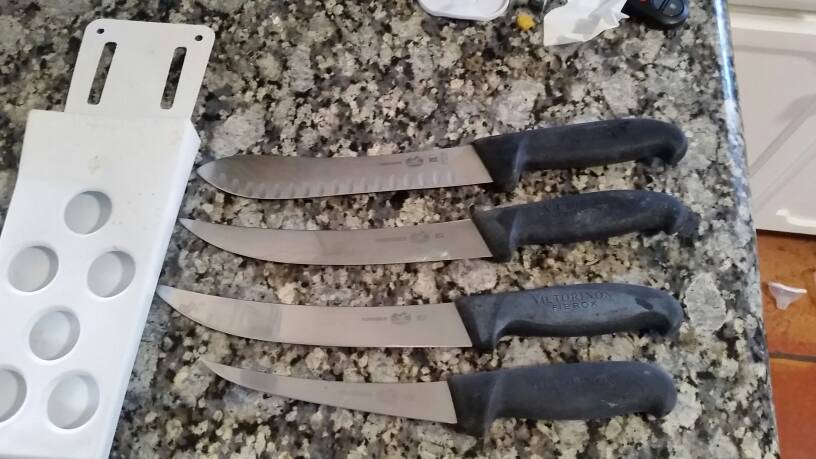
Here is a typical meat cutters set up. The boning knife is the bottom one with a 6" blade. If he is wanting a 12" blade, he is probably really wanting a breaking knife like the middle two.
31608528c74ccd4ab883f7390c49fd74.jpg
 
See I was thinking of the top one, but I think the middle is what is wanted in my case. Thanks. What is the top profile called?
 
Just a plain old butchers knife with a Granton edge.
The boning and breaking knives are more flexible but not fillet flexible.
 
What would you all consider a "boning knife"? I had someone ask about one. He is looking for a 12" blade. I was under the impression that is similar to a filet knife but thicker (less flexible) and maybe a little bit of curve towards the tip. Blade length in the 5-7" range. If you've made one, what kind of dimensions work for you?

I think your definition of a boning knife is correct, a stiffer filet knife. Maybe he is confusing Bowie with Boning?
 
I don't think so, but who knows? I sent him a template of a fillet knife and he said he liked it. I wasn't sure about stock thickness and distal taper.
 
Similar to a filet knife- many if not most have a fairly slim blade (edge to spine) and are not particularly flexible. The whole idea is to have a very nimble, controllable blade that can ride close to bone.
Another thing is, you don't want to give it your most intensely razor thin fine edge- it's hitting bone all day, and the edge needs to be comparatively robust (convex works well), so it doesn't chip and go dull.

But hay....don't ask us, ask a butcher or a chef! Seriously- those guys know exactly what works, though you may get a range of answers from different ones.
 
Hi all. The bottom is typically the boning knife . Yes usually a little stiffer than a fillet but a little shorter. So 3/32 would be a reasonable material to go with and a distal taper with a flat ground with a 6"-7" blade would probably work best. Less curve in the blade will also work well but that's sort of the traditional amount of shape. A non slip handle would also be good.
Frankl
 
This is an 8" Breaking/Butcher's knife that I make. I first made it for a fella that processes his own wild game and was looking for a larger knife to "break" down larger animals. The blade is roughly 7/8'' edge to spine. Its .100'' at the spine with minimal distal taper so to retain its rigidity. He has been very pleased. I can take a pic with some measurements if you would like. It's Aeb-l at 61rc. If he's looking to break down large hunks of meat this is what he is probably talking about. Ask him what specific tasks he is going to use it for and we can better figure out what he's looking for.
 
This is an 8" Breaking/Butcher's knife that I make. I first made it for a fella that processes his own wild game and was looking for a larger knife to "break" down larger animals. The blade is roughly 7/8'' edge to spine. Its .100'' at the spine with minimal distal taper so to retain its rigidity. He has been very pleased. I can take a pic with some measurements if you would like.

I have a guy that does a bit of Charcuterie and butchering that I'm buddies with. If you could take that pic with measurements I know I would appreciate it.

Great design.
 
Thanks Matt, That is exactly the type of information I was looking for. Beautiful knife by the way. Is that G-10?
 
At 12" he's probably wanting it to break down whole animals. I de-bone my fair share of pork shoulders (carnitas is one of my best recipies) and I use a regular old 7" fish fillet knife.

It works pretty good but a tad stiffer would be nice. Stiffer would be really important for a longer blade and bigger animal.
 
Last edited:
You should be able to get s good idea of the dimensions from this pic. Thanks for the comments! I will add that a more "toothy" edge works well on meat. I finish the edge at 400 and then strop.
 
If it's for a professional butcher, remember that he may have it in his hand all day, and doesn't want too much weight. A friend of mine just had an order for one and the feedback he got from the butcher was that it was too stout/heavy.
~billyO
 
If you check the Dexter-Russell catalog you'' get a good idea. The basic things are blade length and stiffness .I like 5" straight and stiff for typical deer to 300 lbs . 6"for elk or bigger if desired. Stiffness is a function of thickness NOT HT ! Some you have photo'd are not "boning knives ".
Some of the deer can be boned easily with a good 4" hunting knife ,Fallkniven TK-1 as I used to bone a hind quarter as I'm eating right now !! Ooops , too late for photos ! This was fine Catskill Mtn deer , processed immediately after taking .NO strong gamey taste .Dress, skin, and cool, NOW.
 
I've never made a boning knife (not yet anyway) but I've used them a lot.

Each Thanksgiving Day my church hosts a charity Thanksgiving Day lunch serving 1,200 people or so and I'm the guy who debones more than 100 turkeys. Takes about four hours. Been doing this for more than six years now.

For poultry the spine of a good boning knife is perfectly straight from the tip of the blade to the butt of the handle. The blade is maybe 5" to 7" long and narrow from edge to spine maybe 5/8" at the plunge line, pointy at the tip and the blade narrows from edge to spine as it gets closer to the tip of the blade.

The blade needs to be able to turn very short corners as you follow the bone, hence the blade thats narrow from egde to spine.

Also steering the blade is important, hence the spine bieng straight from the tip of the blade to the butt of the handle.
If there's any upsweep at the tip of the blade the blade wants to fight you while you're steering it. If there's any drop to the handle you have trouble judging where the blade is in the animal.

Like I mentioned above I mostly debone poultry so for other animals the boning knife may need to be different.
 
Back
Top