Boy do I feel stupid.(an exercise in futility with stropping)

Joined
Jul 22, 2009
Messages
11,409
So I've been further practicing my stropping today, and upon realizing that I'm not getting anywhere and that my stropped edge seems duller than the factory edge of my CRKT Eros, I went backwards and raised another burr on my Sebenza with my 360MX belt on my Work Sharp.

After doing that and progressing to my 1200MX belt and THEN hitting the strops again, I was able to tree-top my leg hairs with little difficulty.

So that is more or less why stropping never seems to have made my edges any sharper in the past 2 years. I've been stropping a well used edge where both sides of the edge no longer met at an apex, and even stropping on 6 micron diamond paste wasn't enough to bring it back.

I suppose that shouldn't have been surprising given that I cut up cardboard when I'm bored.

But boy, I wish I found that out sooner rather than waste 2 years wondering why over $200 worth of stropping equipment wasn't doing me any good:thumbdn:.
 
You're not alone.

I've been 'discovering' this too, recently. For example, today I pulled a knife out of storage that I'd previously stropped (& stropped, & stropped) some time back, with disappointing results. It's a nice knife, a customized Buck 110 with stag handles, nickel bolsters/frame, and damascus blade. It had what I assumed to be Buck's pretty-darn-good 'factory' edge on it. When I first bought it (2 or 3 years ago), I hadn't learned all the neat stuff that I now know about sharpening (I wasn't a BF member at the time), and I'd just 'discovered' stropping in general. So, I was at least doing THAT, quite a lot.

Today, after I dug it out, I once again stropped it a bit, and confirmed that it just wasn't 'quite ready' for that yet. So, almost instinctively, I reached for a couple pieces of wet/dry sandpaper (1000 & 2000 grit), laid each upon my strop block and 'stropped' the edge with the sandpaper. Maybe 5 minutes work with the sandpaper, to make it 'ready' for the green strop. That's all it needed. Now it's wicked sharp, and I've found a new 'favorite' knife that I'd previously been disappointed with.
 
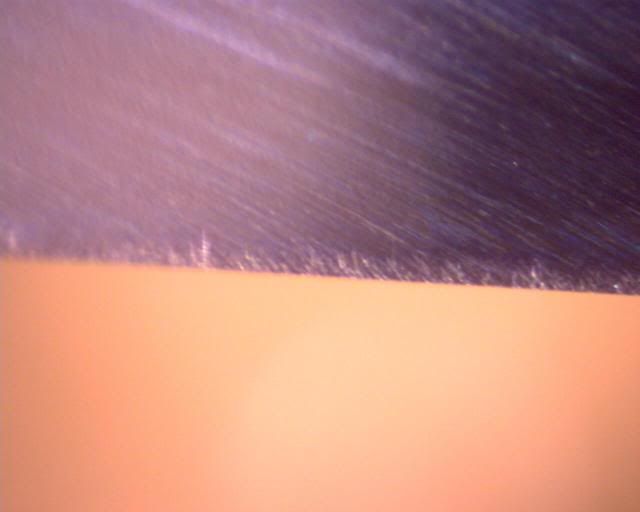
Here is a picture of a similar issue. Sometimes you can miss by just a hair and everything will look good but won't be sharp like it should.

Kitayama stone finish

Picture1709.jpg


At 200x the reason for the edge not being razor sharp is revealed.
PIC115.jpg
 
And THAT is the name of the tune! Stropping should be the very last stages of the sharpening process. When I hear people talking about spending 2-3 hours with a strop it makes my eyes spin! I've been saying this over and over, but I guess people don't want to believe it. If the blade is ready for a strop, it shouldn't need more than 20-30 strokes... STROKES... not minutes. If you're spending more time than than, you need to use more stone!

Stitchawl
 
And THAT is the name of the tune! Stropping should be the very last stages of the sharpening process. When I hear people talking about spending 2-3 hours with a strop it makes my eyes spin! I've been saying this over and over, but I guess people don't want to believe it. If the blade is ready for a strop, it shouldn't need more than 20-30 strokes... STROKES... not minutes. If you're spending more time than than, you need to use more stone!

Stitchawl


I agree :thumbup:
 
Another thing that might be worth mentioning is the relationship between various compounds and the grinding grit values that they match up best with.

Disclaimer: Although this is opinion based on my observations, others may not agree, but your compound should be in the range of your finishing grit (whatever that may be). Jumping to an extremely fine compound following a comparatively coarse grind will not give best results, you're better off with a fairly rough compound. For example, at 800-1000 grit you'll likely get much better results using black emery over green CrO. Jumping too far up the scale increases the likelihood that all you're doing is wiping the grind pattern off the edge without making the cutting edge any smaller across. This will indeed feel like you've "dulled" the edge because you really have. By going very, very light it's possible to make a slight improvement to the edge, but beware - the finer compounds will not remove a burr with this kind of pressure or reduce the cutting surface area to any meaningful degree. On several occasions I've observed small burrs being polished up nice and bright on some of the harder steels without being removed. Even working your way up through a range of compounds is problematic because they don't remove enough metal to shrink the cutting edge without creating a micro-convex edge - they're not abrasive enough to remove metal evenly from the entire edge bevel - very easy to round it over using this method. Ideally you should have a stropping compound for every grinding grit you might choose to stop at, even if this is a bit impractical. IMO, there's not much point in pulling out the finer compounds unless you've refined the edge well into the x,000 - 1x,000 grit range.

Just putting this thought out there. I know there are plenty of people that do go straight to a white, yellow, or even green compound from a fairly rough grind and feel they get good results. From reading the forums, there's also no shortage of people having issues with stropping and until fairly recently I was one of them. Since I've started matching my strop grit more closely to my grinding grit, my strop results have become much better and very consistent and repeatable. This also markedly increases the number of times you can refresh your edge on the strop without having to go back to a firm grinding media, and practically eliminates the likelihood of "over-stropping" your edge.

HH
 
Another thing to keep in mind, besides the relationship of compound size to previous grit size is the fact that when really getting down to the small numbers, not a hell of a lot of metal is getting removed! A bare horsehide strop has a grit size of LESS than .1 micron, and more likely .05 mic. That is REALLY, REALLY small. It does NOT hog off metal. It hardly removes any metal at all. Just the very smallest 'kiss.'

Compared with horsehide, Chromium Oxide at .5 mics is like rough sandpaper. But even that doesn't remove a lot of metal. It's not supposed to. That's what stones are for. It's for finishing metal. For finishing sharpening. We wouldn't take a piece of rough cut lumber and try to finish it with a piece of 2,000 grit sandpaper. Not even 400 grit. Everybody knows this. So why do so many people not apply the same reasoning to their knife sharpening? It boggles the mind!

Stitchawl
 
Just wanted to update:

Following the 12000 AO belt on my Worksharp, I took my 581 Barrage to a 1 micron strop, did about 20-30 strokes total, then took it to my 0.5 micron strop, repeat, then finished off on bare horse butt leather.

Now my edge(slightly convexed) can cut free-hanging hair clean!

Haven't had a knife this sharp since Ankerson got through with my Manix 2:thumbup:.
 
Your learning curve with leather hones (strops) appears to be typical!:D:D

I do wish that I had been able to find a "hands-on" mentor at the beginning. He/she would have saved me countless hours of learning "the hard way." :o:o
 
Back
Top