CapitalizedLiving
Basic Member
- Joined
- Dec 1, 2007
- Messages
- 3,799
The Bravo Necker 2 was purchased as a discreet yet sturdy hiking knife that could be carried and used on public trails but still function as a do-it-all knife in case the need should arise. Having opted for the 3V steel version, I ended up with more knife than I expected.
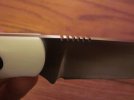
This model is 7” long, with a 3 1/2” handle and a 3 1/8” cutting edge. The remaining 3/8” is a guard/choil area which adds a lot to the versatility of the knife. Pinch grips are easy and, for full fist grips, my first finger easily covers this area and the cutting edge is positioned right above my hand. For such a short handle it is actually a very comfortable knife to use. I initially felt that the jimping would compromise this, but since I rarely ever put any part of my hand where the jimping is located, it’s a non-issue. It’s an annoyingly useless feature for me but as long as it causes no problems I see no reason to complain about it.
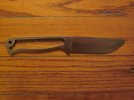
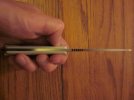
The knife weighs less than 2 ounces without handles and not much more with them. This is pretty nice as I feel like I have a decent-sized cutting edge in a very small, sturdy, and ergonomically friendly configuration. This weight is achieved by four main factors – the overall length is fairly short, the thickness is only a hair over 1/8”, the tang is completely skeletonized, and the blade has a full height grind. In other words, BRK optimized the design in every way possible to decrease its weight, and pulled it off quite nicely.
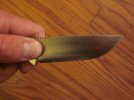
The full-height blade grind is, to put it simply, an awesome and beautiful thing. This is a full-height convex grind with no secondary bevel, meaning it is an insanely efficient slicer and incredibly easy to strop back to maximum sharpness with leather, cardboard, sandpaper, rocks, or whatever else you can get your hands on. This blade grind is my new favorite and I now wish Bark River would make a full size Bravo in 1/8” steel with a full height convex grind. That thing would be an absolute monster and would pretty much eliminate my need for any other full-size knife. That would be both a blessing and a curse, but since I don’t think it would happen I won’t worry too much about it.
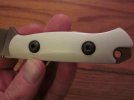
About the whole with-or-without handles thing… the handle scales are removable and are optional, meaning you have to buy them separately if you want them. I cannot imagine not having them, as it is by no means a comfortable knife without them. For those who like cord-wrapped handles or can tolerate handling the naked tang, “optional” may mean exactly that. For me, I snagged the cheapest handles I could as I planned to use this thing and didn’t care about its look. Interestingly, the cheapest option was a set of white G10 slabs, which I’d never seen before and actually look very nice. I wouldn’t mind picking up other BRK models with the same stuff, assuming they ever use it again.
One thing I discovered was that moisture gets between the slabs and the tang quite easily and, without regular maintenance, could cause some serious corrosion. After discovering some rust spots after this knife’s first outing, I wiped down the tang with Marine Tuf Cloth to prevent further issues, and after its last trip (where it was wet for about two days straight) I saw no issues when I returned home.
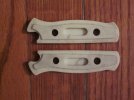
I believe one of the main reasons BRK make removable slabs is so people could buy several sets and switch them out. That way you could change the slabs to match whatever shirt you’re wearing, or something. They also cut a slot into the inside of the slabs for stashing things, which is a concept I’ve never utilized and don’t plan to. My plan is to epoxy the slabs onto the tang so I won’t have to deal with stripped screws, rust, and other such inconveniences, which far outweigh the benefits of removable slabs for my personal tastes and uses.
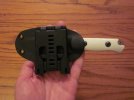
This leaves one final topic: the sheath. BRK was kind enough to supply two kydex sheaths with the knife – one for just the knife and another for the knife with slabs attached. Both sheaths provide good retention and the knife slides out easily without too much work, but both also scratch the living daylights out of the blade. This normally doesn’t bother me as I can usually scratch up a knife far quicker than any sheath can, but this sheath is the grand champion of blade chafing. I’m trying to ignore it but since I was stupid and got pine sap in my sheath, I may end up having to find another option anyway. I do prefer kydex, as I can carry the knife horizontally on my belt using a large Tek Lok, but BRK offers leather options as well, in case I have to resort to that.
My parting thoughts are that the Bravo Necker 2 in 3V is basically a full scale do-everything-and-not-break-a-sweat knife and that the "Necker" designation is a misnomer. If I was stuck in the woods and had to survive with this knife, I wouldn’t feel sorry for myself at all. I mean, I might end up dying, but the knife would be perfectly fine. Now all I need is an Aurora Necker 2 in 3V and I’ll be all set.
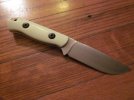
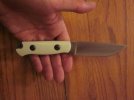
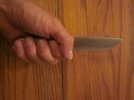
This model is 7” long, with a 3 1/2” handle and a 3 1/8” cutting edge. The remaining 3/8” is a guard/choil area which adds a lot to the versatility of the knife. Pinch grips are easy and, for full fist grips, my first finger easily covers this area and the cutting edge is positioned right above my hand. For such a short handle it is actually a very comfortable knife to use. I initially felt that the jimping would compromise this, but since I rarely ever put any part of my hand where the jimping is located, it’s a non-issue. It’s an annoyingly useless feature for me but as long as it causes no problems I see no reason to complain about it.
The knife weighs less than 2 ounces without handles and not much more with them. This is pretty nice as I feel like I have a decent-sized cutting edge in a very small, sturdy, and ergonomically friendly configuration. This weight is achieved by four main factors – the overall length is fairly short, the thickness is only a hair over 1/8”, the tang is completely skeletonized, and the blade has a full height grind. In other words, BRK optimized the design in every way possible to decrease its weight, and pulled it off quite nicely.
The full-height blade grind is, to put it simply, an awesome and beautiful thing. This is a full-height convex grind with no secondary bevel, meaning it is an insanely efficient slicer and incredibly easy to strop back to maximum sharpness with leather, cardboard, sandpaper, rocks, or whatever else you can get your hands on. This blade grind is my new favorite and I now wish Bark River would make a full size Bravo in 1/8” steel with a full height convex grind. That thing would be an absolute monster and would pretty much eliminate my need for any other full-size knife. That would be both a blessing and a curse, but since I don’t think it would happen I won’t worry too much about it.
About the whole with-or-without handles thing… the handle scales are removable and are optional, meaning you have to buy them separately if you want them. I cannot imagine not having them, as it is by no means a comfortable knife without them. For those who like cord-wrapped handles or can tolerate handling the naked tang, “optional” may mean exactly that. For me, I snagged the cheapest handles I could as I planned to use this thing and didn’t care about its look. Interestingly, the cheapest option was a set of white G10 slabs, which I’d never seen before and actually look very nice. I wouldn’t mind picking up other BRK models with the same stuff, assuming they ever use it again.
One thing I discovered was that moisture gets between the slabs and the tang quite easily and, without regular maintenance, could cause some serious corrosion. After discovering some rust spots after this knife’s first outing, I wiped down the tang with Marine Tuf Cloth to prevent further issues, and after its last trip (where it was wet for about two days straight) I saw no issues when I returned home.
I believe one of the main reasons BRK make removable slabs is so people could buy several sets and switch them out. That way you could change the slabs to match whatever shirt you’re wearing, or something. They also cut a slot into the inside of the slabs for stashing things, which is a concept I’ve never utilized and don’t plan to. My plan is to epoxy the slabs onto the tang so I won’t have to deal with stripped screws, rust, and other such inconveniences, which far outweigh the benefits of removable slabs for my personal tastes and uses.
This leaves one final topic: the sheath. BRK was kind enough to supply two kydex sheaths with the knife – one for just the knife and another for the knife with slabs attached. Both sheaths provide good retention and the knife slides out easily without too much work, but both also scratch the living daylights out of the blade. This normally doesn’t bother me as I can usually scratch up a knife far quicker than any sheath can, but this sheath is the grand champion of blade chafing. I’m trying to ignore it but since I was stupid and got pine sap in my sheath, I may end up having to find another option anyway. I do prefer kydex, as I can carry the knife horizontally on my belt using a large Tek Lok, but BRK offers leather options as well, in case I have to resort to that.
My parting thoughts are that the Bravo Necker 2 in 3V is basically a full scale do-everything-and-not-break-a-sweat knife and that the "Necker" designation is a misnomer. If I was stuck in the woods and had to survive with this knife, I wouldn’t feel sorry for myself at all. I mean, I might end up dying, but the knife would be perfectly fine. Now all I need is an Aurora Necker 2 in 3V and I’ll be all set.
Last edited: