
- Joined
- Nov 2, 2010
- Messages
- 172
Question on the image provided:
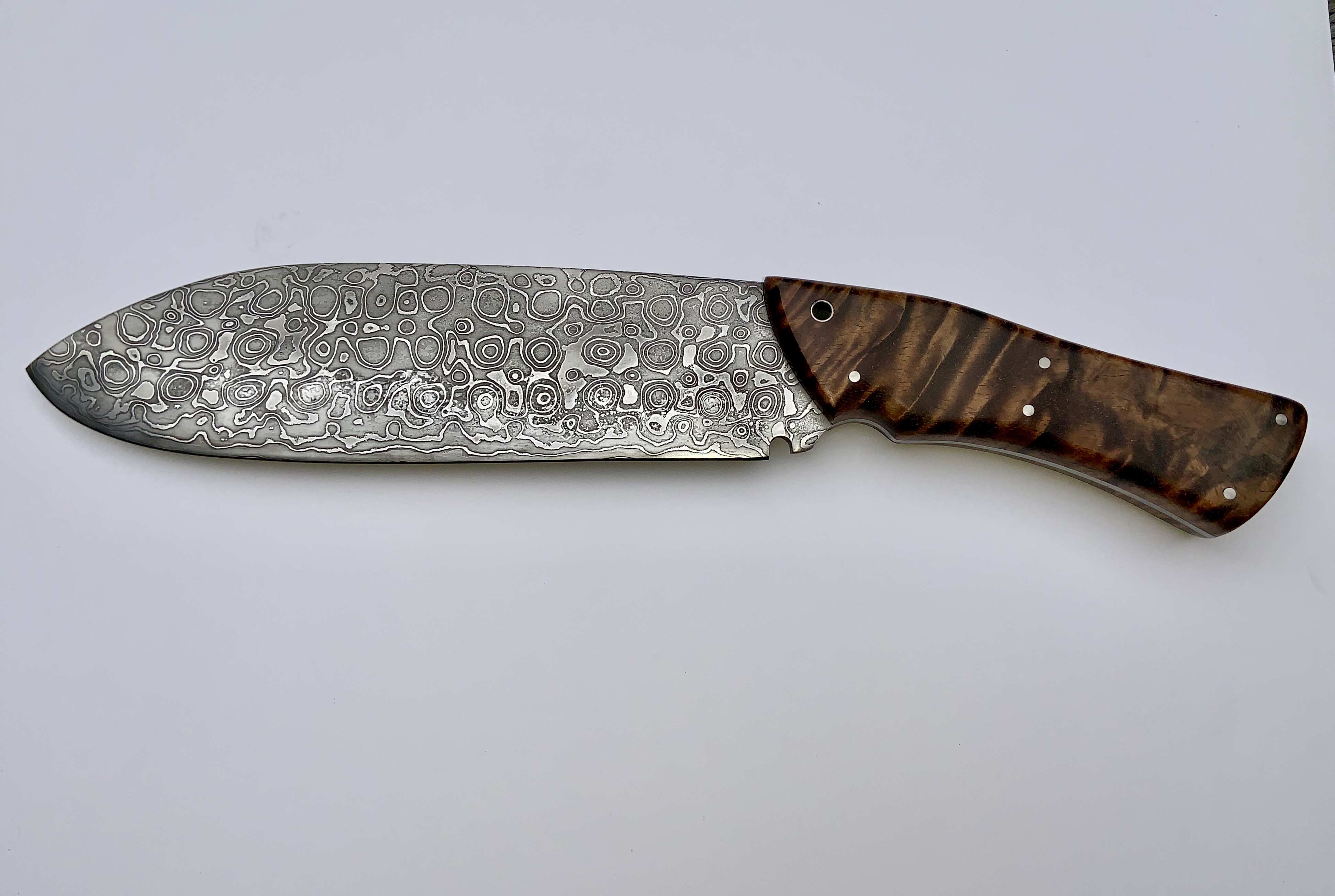
There are odd 'flecks' of brightness at various spots. Especially 1/4 up from the cutting edge, inside the raindrop circles.
They seem quite regular and repeated, which makes me think it's not just irregular welds.
Any ideas on what causes this? My preliminary guess is that 'pocks' occurred during forging or heat treat, which exposed lower areas of 15N20.
Technical stuff:
26 layer 15N20/1084, with a 1095 core.
Hand welded/hammered over many forging cycles. Propane forge used. Decarb is likely, but a lot (~15%) was ground off the outer layers.
Stress relieved (1600, 1495, 1465) with a thin wash of satanite.
Rutland's black furnace cement was applied from the spine to about 2/3rds of the way down to the blade, terminating in a wave. Done to protect some thin regions that gave concern. The line is lightly visible in the picture.
Austenitized @1485, parks 50 quenched.
A test etch was done before hardening, and I don't recall seeing these 'flecks' at the time.
There are odd 'flecks' of brightness at various spots. Especially 1/4 up from the cutting edge, inside the raindrop circles.
They seem quite regular and repeated, which makes me think it's not just irregular welds.
Any ideas on what causes this? My preliminary guess is that 'pocks' occurred during forging or heat treat, which exposed lower areas of 15N20.
Technical stuff:
26 layer 15N20/1084, with a 1095 core.
Hand welded/hammered over many forging cycles. Propane forge used. Decarb is likely, but a lot (~15%) was ground off the outer layers.
Stress relieved (1600, 1495, 1465) with a thin wash of satanite.
Rutland's black furnace cement was applied from the spine to about 2/3rds of the way down to the blade, terminating in a wave. Done to protect some thin regions that gave concern. The line is lightly visible in the picture.
Austenitized @1485, parks 50 quenched.
A test etch was done before hardening, and I don't recall seeing these 'flecks' at the time.


