Building a forge--couple questions

Joined
Dec 14, 2010
Messages
403
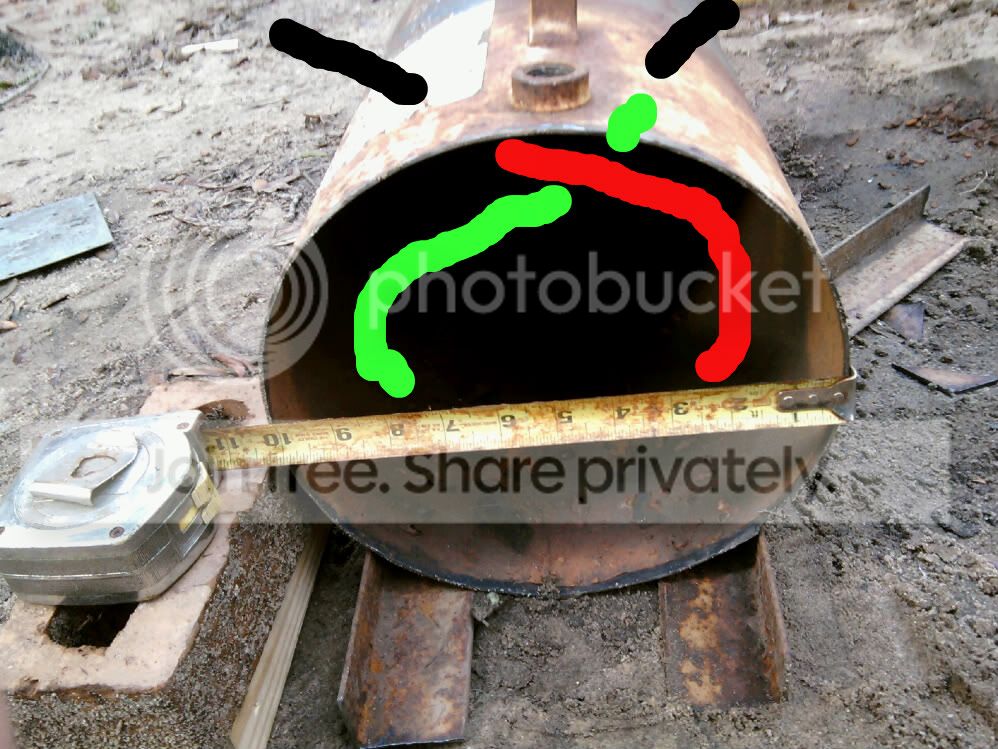
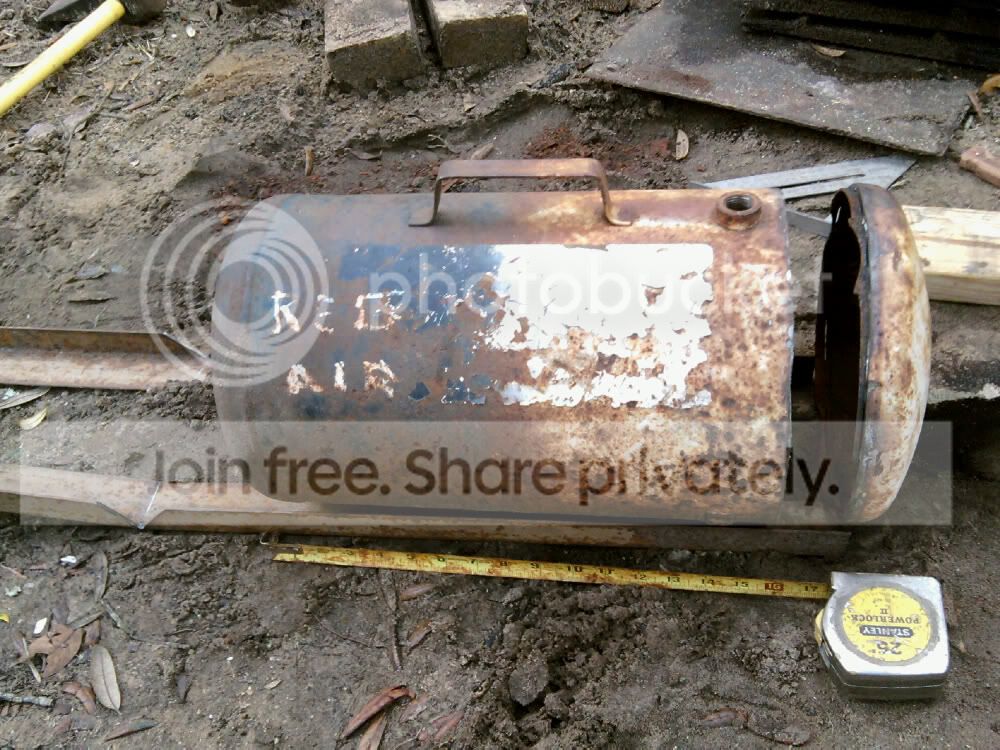
I'm getting prepared to build a small forge. This is an old spare air can. It is about 17" long from opening to end of the tube and about 10" across. Under it are a couple of pieces of old bed frame angle iron. I want to weld or braze them there in place. Then bend the back sides up 90 deg to make a frame for holding brick.

I have one burner made and working, I think it's a 1/2" burner. I made it a few years ago. I have another burner still under construction, think it's a 3/4". I was thinking about rigging the forge to accept the two burners so I can use just the one or both if need be. I have seen pictures of forges with two or three burners off on the same side, but never one on each side.

Ok, some questions
1) The old bed rails, when I go to bend them up, should I heat them up first then bend them or does it matter?

2) I only have an oxy/acet. torch, no arc or mig welder. Would brazing the bed rails in place be good enough (after being cleaned up)? Or should I tack them in place and have them arc/mig welded?

3)Burners-- In the pics I did a little drawing on them, the top view pic, I was thinking about putting the burners in like this. One on each side spread
apart about 4 or 5 inches. In the front view pic, I was thinking that if at the correct angle, one flame would swirl clockwise while the other would go counter clockwise. Think this would work ok or should they both be on one side?

4)I was thinking about it being horizontal. Any benefit of it being vertical instead?

5) Should I weld on a hinge and keep the front part I cut off as a door? Cut a slot in it and put refractory in the cavity? If you think I should connect the top back on, I was thinking about having the hinge on the side. See any problems with that?

Any other thoughts?

Thanks with any help / opinions offered
Rob


top view, pipe placement
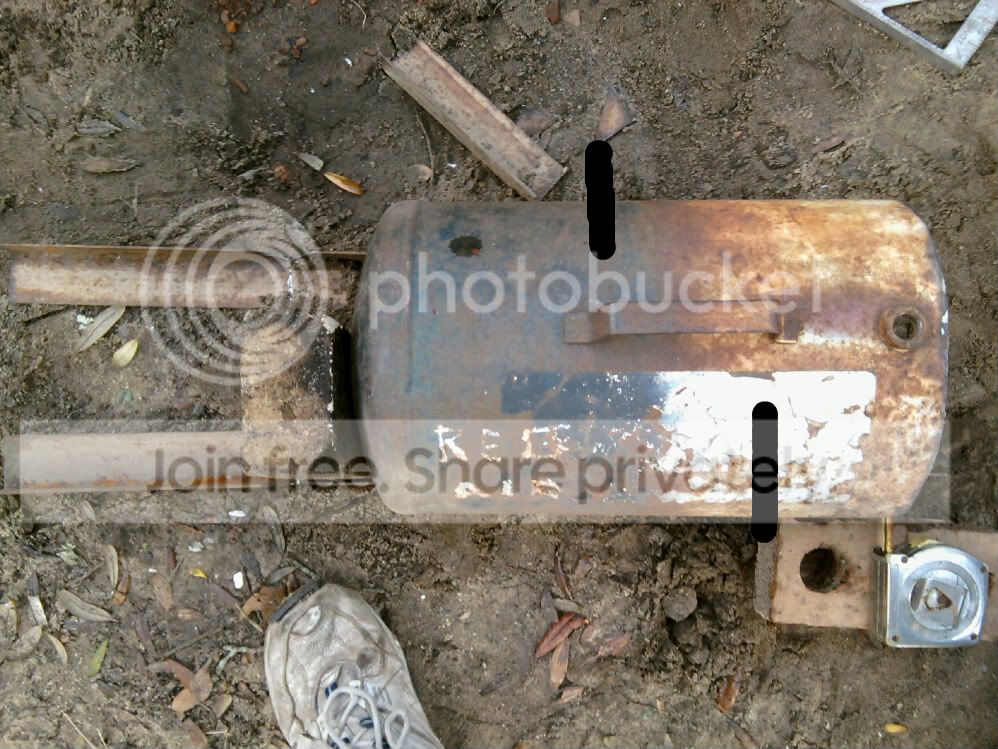
Photo0360-1.jpg


front view
Photo0359-1.jpg


side view w/ lid
Photo0358.jpg
 
On the rails, you can just clamp them in a vise and bend them.Since you have oxy-acet just weld them on with it.Get a can of flux and steel welding rod and weld them up.I've even used coat hanger for rod.
You can put the front back on or just stack fire brick in front of it.The hinge on the side is not a problem.
Stan
 
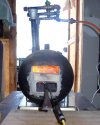
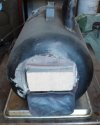
You will definitely want it horizontal... Vertical will make it difficult to work with in my Exp. This is very similar to my forge set up, I have 3 burners. I placed a piece of 2x4 Box tubing through the length of the forge to diffuse direct heat from the burners then fire bricked / Mortared (High Temp) the ends up.

So from the front of mine I see an open box tube a half width fire brick and then an open section above that to light the forge and allow for direct access to burners if wanted, I can slide another half brick in the hole to block it off if temporarily. From the back my forge you can see the closed end of the Box tubing (I can remove the Plate so that I can pass longer pieces of Steel (18"+) through the forge, and fire bricks completely closing the rest of the back end. Good Luck!
 
Thanks Stan.

Ryan, thanks for the explanation of yours. Any chance of seeing a pic of it? Or drawing? I have seen one that is vertical. I don't remember exactly what the gentleman said, but I think it was something like a horizontal one could possibly create hot spots on the steel. That may not be exactly what he said. I forgot to write it down.
Thanks again guys
 
Vertical forges are great for bladesmithing for the most part. They allow stock of unlimited length to pass through. The flame does not directly contact the work, which limits scaling, helps eliminate any "hot spots," and allows the flame to burn more completely before exhausting. Vertical is the way to go if you are planning to do much pattern welding, as it lends itself to an easily replaceable floor. You want this since flux KILLS refractory.

I find horizontal to be better for general work, such as forging tools, jewelry, hardware, etc. By nature, the vertical design does not provide a floor for the work to rest on. Having a brick floor that you can set work onto can be very convenient. It works great for general bladesmithing and heat treating, and it's easy to set a piece of pipe onside the forge on the floor to use as a baffle when heat treating.

A vertical forge will usually necessitate that your work be attached to a handle, as in a billet, or a long pair of tongs clamped to the tang. This works along with either a free standing adjustable work stand in front of the forge, or some sort of
platform/hook/extendo work rest welded to the front of the forge body. The vertical forge is most often used with a single, fairly large blown burner at least a couple inches below door level. I have built two of them with venturi burners, was able to get welding heat, but enjoyed much more success with the latest, which is converted to blown. I really only use it for welding.

The forge I use the most by far is my horizontal pipe forge. It has a single venturi burner, is very efficient, and with a baffle is very good for HT'ing. It works well to weld with, but I never do anymore. I hate replacing the floor bricks.

I don't see much benefit of having the burners run opposite. It will be more tidy to have them both come in from the left.

As for the frame rails- yep, bend 'em cold, and as Stan says just weld them with the torch. You do not need flux to gas weld with- coat hanger would be fine here, and the flame by nature keeps oxygen off of the weld pool.

I've built them with hinged doors front and back, and with just firebrick stacked. While insulated steel doors work well, right now I have brick doors. They are easy to rearrange as necessary so that I have a big enough door to work through, but not too big of a door, which will be inefficient.

Hope any of this helps.
 
Place a fan on the table and let it blow a ribbon. Now place two fans on the table, side by side, and let them both blow a ribbon....Good,more air. Now, place one on the table and place the other facing it....Bad,the ribbon won't blow very well. This is called turbulance, and you don't want it in your forge.
Have both burner flames going the same way.
 
Yes Salem, it all helped. Thanks. I went ahead and tried to bend the frame and it snapped. Oh well. Not incredibly important. I got out the torch and the o2 regulator took a dump on me. Now I'll have to get that replaced. Anyone know if the o2 reg. they have at harbor freight is as much crap as most of the other stuff they have?

Thanks Stacy, That makes sense.
 
Burners should be 10 to 15 degrees off of top dead center 4 inches apart. a 1/2 burner will work well for 60 cubic inches, a 3/4 burner will work well for 300 cubic inces. Your tube if lined with 2 iinches of Kaowool back and sides might be around 360 ci...If two burners were used put them 4" apart. Another good forge resource is Ron Reils sit or Larry Zoller( just googl them)
Hope this helps...
 
No problem hope it helped. Forges are a funny thing. Ive built 3, 1 vet w/pass through and kitty litter bottom, a long two burner self igniting for long blades or fence pickets, and a quick and dirt 10 gallon bucket one for forge welding with a replacable brick floor... Ive been running the zoller style burners for ever, I can replace the orrfice to double its size add a blower and I could do crucible work....
Have vun, Hit it while its hot..
 
Sorry RailRider... I finally got some photos of the forge uploaded one is front one is the back. let me know if you have any questions.
Ryan
 

Attachments

  • Forge Front.jpg
    Forge Front.jpg
    41.9 KB · Views: 27
  • Forge Back.jpg
    Forge Back.jpg
    38.2 KB · Views: 25
Back
Top