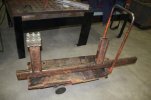
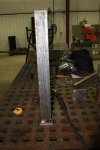
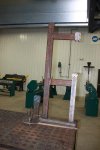
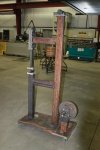
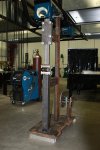
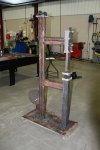
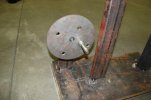
Building a power hammer WIP

Joined
Nov 30, 2009
Messages
157
I am building a power hammer at school for my personal project. I am really close to welding it all together. I have one week left and then I will have to finish anything else at my shop. I want to get all the parts cut and the thick stuff welded together before then, being as my welder is not capable of welding that this of steel.
The question is about the dies. I am basing this hammer off of a Rusty. It is going to have dies that are welded to a half inch plate, that I can bolt on, so I can replace them. I need some suggestions on what kind of dies to make and what to make them out of. At school I have access to mild steel and some thick stainless. I would like to go 4140 but I don’t have any that thick and I don’t have time. Any recommendations would be wonderful.
 
Last edited:
Maybe see if you can find some cast off or scrap-price forklift fork to make dies out of. I'd start out with a flat pair and some medium drawing dies. Or just one pair of all-purpose lightly crowned dies. That's what I'm going for in the hammer I just got.
 
How would mild steel work? would it deforme too fast? Or is there enough mass for it to work for a bit?
 
Southclaw I know that Plainfield classics (scrapyard) has forklift forks laying around, saw them there a couple
of weeks ago. Also R&R Liquidators in Waupaca (intersection of cty trunk K and Hwy 22 south)
Ryan usually has a fair amount of 4140
Ken.
 
You can make the dies from nearly any steel, but how long they last will depend on the steels toughness. As said by the others, 4140 is a good choice. If it is not available right now, use the mild and/or stainless you have on hand. You can (and will) make more dies later. Make and drill many extra backing plats at the beginning, so you have them when making future dies.

I would recommend using as thick a backing plate as available. I use 1" thick backing plates on my press, which holds dies similar what you are building.

A set of flat dies is first.
A set of drawing dies is the next. A 1" or 2" wide die with about an 8-10" radius curve will work fine.
If you are building dies for drawing out tangs, a piece of 1" round bar welded to the plate makes a good fuller.

OK, now lets talk safety:
Tune the power hammer well before using it. Those Rusty/Crusty hammers can hop all over the place if out of tune.
Always think safety and consider the worst case - "What will happen if this or that part breaks in use?"
Not the least of concerns is a die shattering and shooting steel like bullets. I would temper all welded dies well before use. Welds that look great can still be brittle. When welding dies, do it under compression. Clamp the die to the plate with strong clamps, and weld with top grade welds, matching the rod to the steel.
 
Maybe see if you can find some cast off or scrap-price forklift fork to make dies out of. I'd start out with a flat pair and some medium drawing dies. Or just one pair of all-purpose lightly crowned dies. That's what I'm going for in the hammer I just got.

What Salem said. I made my dies from forklift fork and made them all purpose and haven't looked back. I have about a 1" flat area in the center of the dies, then they have a slight radius out from there. They will draw plenty fast for me, but also work great for forging bevels. Lets see pics when you are finished.

-Mike
 
Thank you guys. I am on my last week of Production Welding class.
I will try to cut out several backing plates for the dies so I have some extras around. I also made the flywheel so I have 5 different stroke lengths. It will not be done this week. I am going to have to order the flat leaf springs. Any ideas on where to order those from? I also still need a motor for it.
I will try to get some photos of where it is at so far, tomorrow. I am using 1” thick base and a 3”x3” x 30” anvil stand. The die plates are 1/2". I may be able to use some Armor plating for the die plates. Do you think I should use that?:cool:
 
ph3.jpg This is how far I got today. I should have it almost all together tomorrow. Minus the motor and spring. Any more suggestions?
 
That's cool that you can build this in class. Does the cost of the class cover all your supplies for the hammer too?

I am going to have to order the flat leaf springs. Any ideas on where to order those from?

I was in a Tractor Supply store a week or two ago. They had leaf springs for sale in there. Not sure if they will work for what you are doing, but I guess it can't hurt to check if there is one by you.
Store locator:
http://www.tractorsupply.com/StoreLocatorSearchAndResultsView
Leaf springs:
http://www.tractorsupply.com/trailers-towing/trailer-parts/other-trailer-parts/trailer-springs/

If not there, maybe some place that sells parts for boat trailers or utility trailers?
Hope this helps,
Rob
 
Railrider1920 Yes as long as they have the steel there and it is not being used for something. I have to buy the hardware and such. The leaf spring I am looking for is flat with not curve. If I were to get one off of a vehical I would probably go with a older Dodge Dakot because they are the closest to straight that I know of.
 
I can tell you right now the ram guide length is too short, the throat looks WAY big too. IMO a good rule of thumb is atleast as much guide for as much throw, IE 12" of guide for 12" of throw meaning a ram length of 24". You might end up with a front to back side load that tears the front plate off the ram guide, throwing the ram into your chest. I might sound like i'm being a jerk but i've done alot of thinking about building powerhammers, seen many designs and talked with alot of folks who have built they're own.
 
No you don't sound like a jerk at all Sam. This is the kind of stuff I want to hear. I am just glad it is not welded all together yet. hehe. I should be able to fix that. Right now I have six 1/2" grade 5 bolts holding the guide plates together. Would that be enough with a longer guide or should I put more holes in there too?

The Ram is 23", but the top 1 1/2" will have steel welded to it for the spring guide.
 
your guides should then be 11 1/2", with 6 bolts that would make about a 2" spacing and should be fine.
 
As Sam said, the guide needs more length to channel all the energy down...not sideways. I would use two guide arms to hold the guide if possible, as the one arm will be taking a lot of stress.

Also, when you get it made and are ready to place it in your shop - Make a base as big and heavy as possible.
Bolt 4 foot long 8X12 timbers together with 1" thread-all rod and bolt the hammer to the base with 1" bolts made from the same rod. The more the whole unit is locked rock solid to the base, the better it will hit. A massive base may absorb some of the harmonic issues that may cause the hammer to want to shake/jump in use.

The max setup would be to pour a 3'X4' concrete pad about 12-18" deep with the bolts cast in place. This will take about half a yard of concrete. Put a 4" thick wooden base plate over the pad to set the hammer on. The bolts go through the base plate,too. The base plate can be made from 4X8 timbers bolted together with thread-all rod. The simplest way to do all this is to make the base plate and set the hammer on it. Drill the bolt holes through the wood and check that all bolts go through properly. Use 18" long pieces of 1" thread-all rod for the bolts. Use a washer and nut on each side of the plate to lock the bolts in place, leaving 12" sticking out the bottom, and 4" sticking out the top. Weld some re-bar back and forth across the 12" side to lock them all together and make a stronger bond to the concrete. Pour the hole/mold full of the concrete and place the base on top, with the bolts/re-bar in the proper place. Vibrate the concrete to make a good seat to the base and remove any voids around the bolts/re-bar. This will make a perfect fitting slab-base-bolt pattern for your hammer.
 
Last edited:
Stacy, to late for two guide arms, but I am going to put 1/2" gussets on the guide arm to beef it up a bit.
I can't really make a concrete pad for it right now because it is not MY shop.

Here it is as of tonight. I fixed the guide but I misunderstood Sam. There are only 8 bolts total on the guide. It is still mostly just tacked together. I still need to make the roller arm on the shaft for the spring. The good news is they want me to stay on as an intern after school, and I can still work on it there, when I am not working.:thumbup:

Power Hammer 001 scale.jpgPower Hammer 003scale.jpgPower Hammer 005scale.jpgPower Hammer 006scale.jpg
 
Yes, triangular gussets above and below the arm will add a lot of strength.
Looks good.

Make the base from bolted up timbers. That way it can be disassembled and moved at a later date. The base can be added to a concrete footing in a future shop.
 
Back
Top