
-
The BladeForums.com 2024 Traditional Knife is available! Price is $250 ea (shipped within CONUS).
Order here: https://www.bladeforums.com/help/2024-traditional/
You are using an out of date browser. It may not display this or other websites correctly.
You should upgrade or use an alternative browser.
You should upgrade or use an alternative browser.
Busse Forge?
- Thread starter Lycosa
- Start date


mymindisamob
Platinum Member
- Joined
- Feb 1, 2005
- Messages
- 15,199
I think forging is illegal.

Don't tell Fiddleback I said that, I have to get a good Nessmuk somewhere.
Don't tell Fiddleback I said that, I have to get a good Nessmuk somewhere.
mymindisamob
Platinum Member
- Joined
- Feb 1, 2005
- Messages
- 15,199
LOL! Very good, Bro!
I heard FB is now a Grinder!! :0
:thumbup::thumbup:

- Joined
- Feb 19, 2006
- Messages
- 14,607
I hear from those in-the-know, that a forged blade is superior to Stock Removal.
That happens NOT to be the case. Fine blades can be made by both methods; lousy blades can be made by both methods. Some forgers try to ascribe some magic mystical properties to hammered steel, spouting nonsense about edge packing and grain alignment. Don't believe it.

- Joined
- Jan 20, 2008
- Messages
- 653
I have a silly question for all of you who know better...
What is the difference, on a molecular level, between heat-treating a stock removal knife and hand-forging a knife?
Busse knives far surpass my hand-forged Japanese swords and knives, and I have no idea if it's the steel, the heat-treat, or both. But in my opinion, if Jerry Busse lived in feudal Japan, he would have been the highest paid man on the Shogun's payroll.
What is the difference, on a molecular level, between heat-treating a stock removal knife and hand-forging a knife?
Busse knives far surpass my hand-forged Japanese swords and knives, and I have no idea if it's the steel, the heat-treat, or both. But in my opinion, if Jerry Busse lived in feudal Japan, he would have been the highest paid man on the Shogun's payroll.
I personally don't care one way or the other about forging, since with only a couple of exceptions Busse's are the only fixed blades I am interesting in acquiring, and because they aren't forged it is a moot point with me. However, I heard a rather amusing and strongly expressed viewpoint at Blade this year.
I was standing at Bob Dozier's booth when another browser picked up a Dozier knife and asked the lady behind the table "are these knives forged?" Bob, at the rear of the booth, overheard the question and immediately went into a rant, saying that the reason people years ago forged blades was because that was what the equipment they had available limited them to doing, and that if they had better equipment they would have been making knives the right way. Suffice it to say, he had rather strong feelings about it!
I was standing at Bob Dozier's booth when another browser picked up a Dozier knife and asked the lady behind the table "are these knives forged?" Bob, at the rear of the booth, overheard the question and immediately went into a rant, saying that the reason people years ago forged blades was because that was what the equipment they had available limited them to doing, and that if they had better equipment they would have been making knives the right way. Suffice it to say, he had rather strong feelings about it!

- Joined
- Mar 19, 2007
- Messages
- 2,433
Hopefully someone like Mete can chime in with the specifics. I'm still a novice and don't want to misquote or provide misinformattion. The AK's and Rucks are totally overlooked in that class of short swords especially with the proper grind and edge but then again it's nice to know that they are rare and really quite remarkable and so much further from the traditions of the sword community (which I really appreciate Jerry having the know how and the juevos for making possible). Back to the post, I suppose if you were to get a billet of INFI you may be able to forge it but I don't know or even think it would really improve the performance of a blade of any length especially when compared to the cost of doing so. It's hard to make something great better and even harder to produce it on a large scale or even get right if more variables are added. Besides who knows how it would react at what temperatures (some steels are difficult to forge at a certain temp like 3V from what I've heard) and if great results are being had without forging than why bother to complicate the process of making a great tool. Mike H's point is right on to me IMO. The modern equipment, tools, metallurgy, and know how, can limit impurities in the steel and help refine the desired attributes sought by a maker when used in a knife and HT'd properly; i.e. wear resistance, corrosion resistance, toughness, etc. That's why we are fortunate enough to have steels that allow us to choose more of one quality or less of another or like in the case of INFI a good balance of most qualities.

Last Visible Canary
actively parsing hurf durf
- Joined
- Nov 28, 2006
- Messages
- 4,577
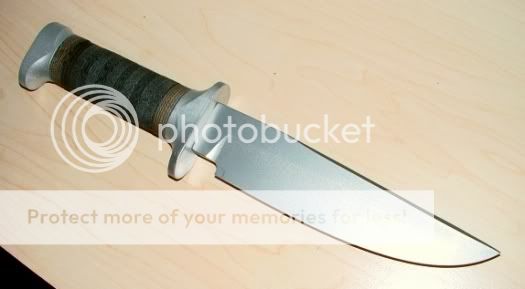
infi can be forged, and has been.
forging is 2 things - a heat cycle process, and a mechanical working of the steel.
1: the heat cycle process
this can be achieved without the forging process through controlled oven backing and cooling processes
2: mechanical working of the steel
this only helps if the steel needs to be mechanically worked. if you have a lot of large carbides and a chunky steel matrix that needs to be mooshed and have it's grain refined in that manner, then great. if the steel is already fine and won't change when mechanically worked, the all forging does is change the process in which you shape the knifes geometry.
simple carbon steels like 1055, 1095, 5160, and 52100 do very well with forging, but it isn't necessary. that said, I've never heard of anyone getting the type of performance out of 52100, modified steel mix or not out of forging as swamp rat has gotten out of it through stock removal.

Bigfattyt
Gold Member
- Joined
- Jun 23, 2007
- Messages
- 19,262
It's been said, either method will give you great blades (or crappy ones depending on the control). It really all comes down to the heat treat process, and tempering process too. With the control possible with modern Metallurgy, the process control is hard to beat.
One thing going for forging, is the additional control of the shape, and form, and creativity involved. It also allows smaller amounts of raw material to be shaped into almost the exact shape desired, with much less stock to remove. It is labor intensive also. So a trade off.
One thing going for forging, is the additional control of the shape, and form, and creativity involved. It also allows smaller amounts of raw material to be shaped into almost the exact shape desired, with much less stock to remove. It is labor intensive also. So a trade off.

- Joined
- Mar 26, 2000
- Messages
- 14,444
Wish these would come out.
Holy crap, that was one of the best feeling blades I ever held.
This debuted a few years ago at Blade....
Out into the light...back to from wherever it came.... :grumpy:
Last Visible Canary
actively parsing hurf durf
- Joined
- Nov 28, 2006
- Messages
- 4,577
Out into the light...back to from wherever it came.... :grumpy:
my busse image folder if so large at this point, that it's almost as hard as trying to find stuff in the archives here on the forum :grumpy:

- Joined
- May 28, 1999
- Messages
- 2,606
Forging ceased to be an inherently superior method of making a knife around the time industrialization gave us steel mills that could produce high purity steel. It's a whole lot more romantic than stock removal though, and you can do stuff with damascus and patterns that's impossible with stock removal alone.
Bigfattyt
Gold Member
- Joined
- Jun 23, 2007
- Messages
- 19,262
Forging ceased to be an inherently superior method of making a knife around the time industrialization gave us steel mills that could produce high purity steel. It's a whole lot more romantic than stock removal though, and you can do stuff with damascus and patterns that's impossible with stock removal alone.
that is true. But unless I am mistaken, I think you can even get Damascus billets, that are factory produced, and use stock removal on them (probably much more expensive that way).

Cobalt
Platinum Member
- Joined
- Dec 23, 1998
- Messages
- 17,908
what resinguy and yoda said is pretty much right on. Forging was once beneficial because the quality of steels supplied was horrible, with internal stress risers such as voids and cracks. Todays steel being provided from quality mills is hot rolled, which in of itself is a mild form of forging.
Think about this when you forge a knife, you start with a bar maybe an inch and half thick and you hammer it down to a blade. A hot rolling press starts with an ingot typically 8 to 12 inches thick which is reduced via a series of hot rolling mills until it gets down to desired thickness of 1/4, 5/15, 3/8, or whatever is ordered. This mostly eliminates any voids or cracks much in the same way forging does.
The big difference is that a forged steel does not go through a heat treat after forging, the forging process is the heat treat, so IMO, a properly HT's knife from stock removal can be superior to a forged one, especially if the HT is done like Busses are.
Think about this when you forge a knife, you start with a bar maybe an inch and half thick and you hammer it down to a blade. A hot rolling press starts with an ingot typically 8 to 12 inches thick which is reduced via a series of hot rolling mills until it gets down to desired thickness of 1/4, 5/15, 3/8, or whatever is ordered. This mostly eliminates any voids or cracks much in the same way forging does.
The big difference is that a forged steel does not go through a heat treat after forging, the forging process is the heat treat, so IMO, a properly HT's knife from stock removal can be superior to a forged one, especially if the HT is done like Busses are.
- Joined
- May 28, 1999
- Messages
- 2,606
that is true. But unless I am mistaken, I think you can even get Damascus billets, that are factory produced, and use stock removal on them (probably much more expensive that way).
Yeah, but with forging you can further manipulate the pattern and make it stretch and curve to match the shape of the blade, it's another creative outlet

The big difference is that a forged steel does not go through a heat treat after forging, the forging process is the heat treat, so IMO, a properly HT's knife from stock removal can be superior to a forged one, especially if the HT is done like Busses are.
I was nodding along with you right up till here
 All knifemakers will do a proper heat treat after forging. Generally after the blade profile is forged the smith gives it a normalizing and maybe anneals it. Then it's off to be stock removed Once the blade is cleaned up and ground to finished shape it goes through a few normalize cycles to relieve the stress incured during forging and stock removal. After all that then it's treated just like any other steel, harden then temper to taste. So, for all that extra work involved you end up with a blade that (if you're good and didn't mess something up during forging) at best will be as good as a stock removal one with the same steel and HT.
Last edited:
Cobalt
Platinum Member
- Joined
- Dec 23, 1998
- Messages
- 17,908
Yeah, but with forging you can further manipulate the pattern and make it stretch and curve to match the shape of the blade, it's another creative outlet
I was nodding along with you right up till here
Exactly. Real forging uses normalizing and annealing cycles to complete the job. In real forging you do as little stock removal as possible. Todays forging with all the automated parts and heavy stock removal is not really forging anymore, no more than hot rolling is forging. That was my point. You gain nothing and potentially loose more due to lacking HT from the misconception that forging is so great.
The knifemakers that do forging as an art, try not to do stock removal hardly at all.

- Joined
- Apr 10, 2005
- Messages
- 8,808
Yes, yes you can.that is true. But unless I am mistaken, I think you can even get Damascus billets, that are factory produced, and use stock removal on them (probably much more expensive that way).
