

- Joined
- Dec 31, 2005
- Messages
- 2,984
Well it is not often I come across a blade in the bigger range which interests me ..... my thoughts are usually that in the larger range of knives .... Infi is at it's best .... :thumbup:
However I was checking out a site in Japan which I have used to buy some of my smaller custom blades and came across this knife by Kiku Matsuda ....
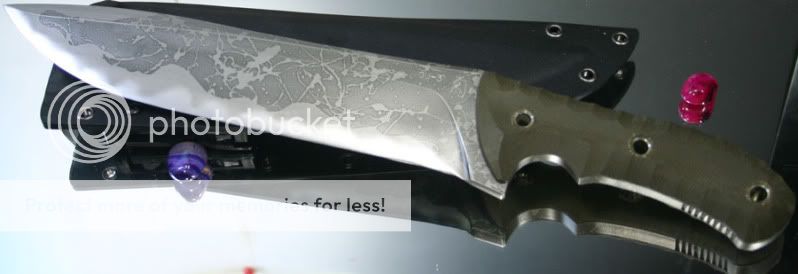
Here is the spec on the knife -
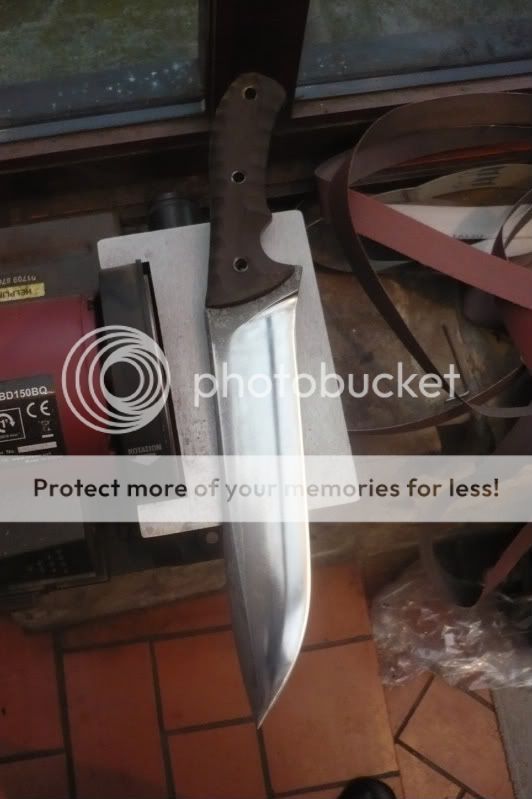
KM-730 Daruma Heavy-duty drop-point Machete type knife of 10" OU-31 Hamaguri-ba ground broad (2" wide) blade with long false edge on back.. Oversized 5-3/4" hand contoured O.D. Green Canvas Micarta handle with thumb and finger notches.
OU-31 blade in 7.0mm thick, 250mm blade, 390mm overall, weight 730g
I kept coming back to this pic checking out the hamon .... "hamaguri-ba" ground means it is a "fully convex zero grind" .... the type of grind done on their Samauri swords .... so I figured it would be a worthy bit of competition to my Busse's and decided to get it ....
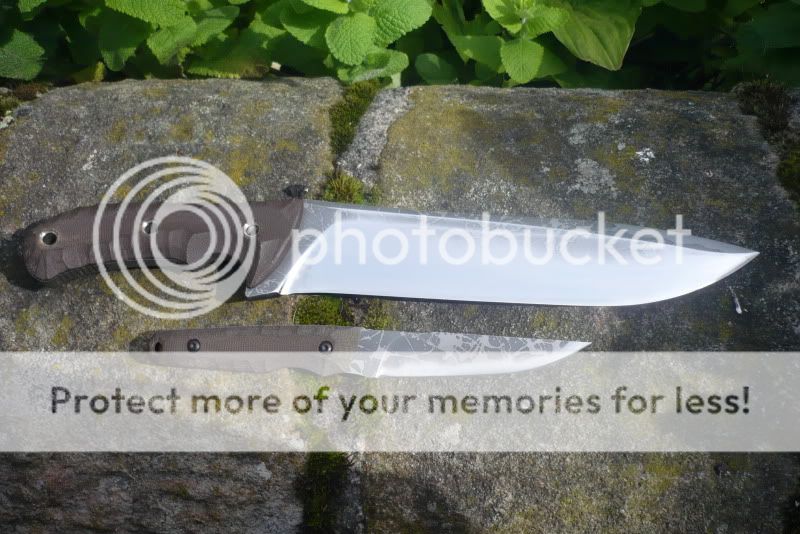
It certainly got here quickly .... the postal service from Japan must be as efficient as their Railway system .... it only took four days to arrive and this Sunday I lined it up with some competition ....
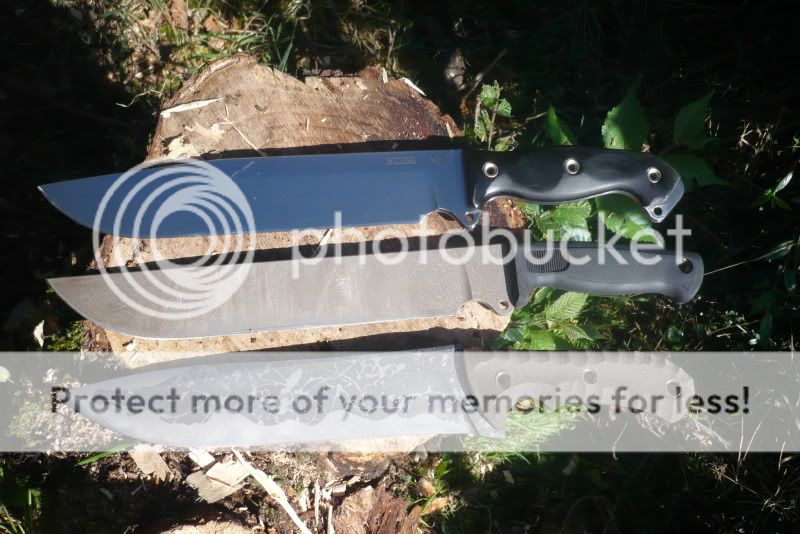
The weight of the knife for those of us who think in ounces is 25.75 oz's so the nearest comparable blade is my BWM LE .... which is perhaps my favourite Mistress .... it and my NMFBM are a tie really as they are both "superb" .... and to give it another favourite to measure up to I added the Basic 11 .... an amazing knife on the "performance v weight" category and perhaps the best Busse for comfortable chopping that I own ....
Some of you may remember this pic of a tree which has died where I took the missing limb down with the Basic 11 and the TTKZ ....

Well the remaining limb overhung the dry stone wall at the rear ( not easy to see in the above pic but it is there ) so this weekend I decided to bring it down safely. To drop it where I wanted I need to use a chain saw with a very deep slanting cut to get it to fall back against the natural lean .... I managed to do it and then sectioned up the trunk .... this left a fair old bit of wood needing chopping up .... which is pictured below ....
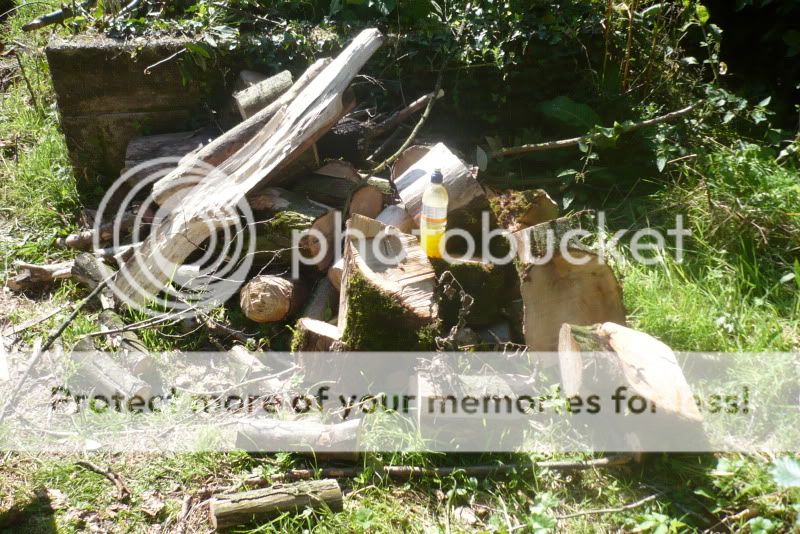
Cutting down the remaining limb with a chainsaw also enabled me to flatten off the stump to give me a long wanted proper chopping block ....
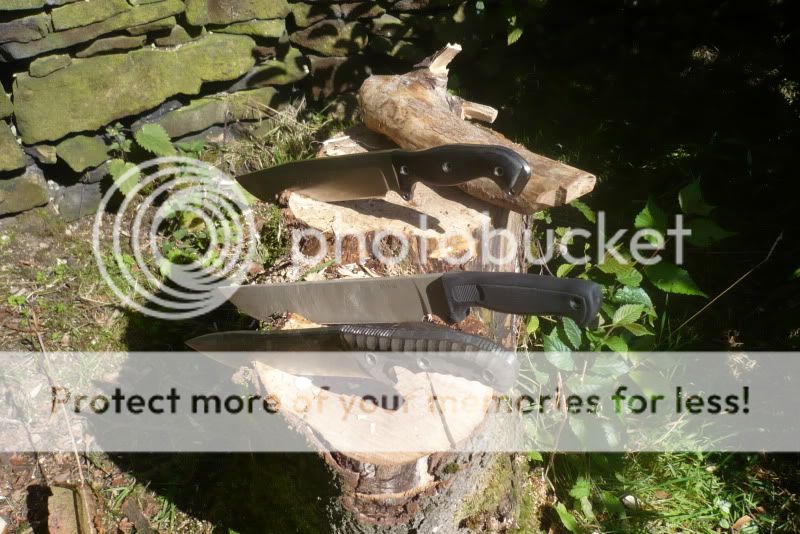
Interestingly when I was putting the knives into the stump for the pic the BWM LE and the Basic 11 sunk into the wood with just the lightest of flicks .... the Daruma when using the same sort of motion just did'nt bite as deep and would'nt stick .... it needed a fairly hefty swing to get it to bite deep and that had me "concerned" ....
Bringing the knife out of the stump after the pic and holding the edge up to the sky to silouette the grind .... the first thing I noticed about the shape of the convex grind was that it was "pear shaped" .... meaning that the convex curve to the edge was quite obtuse starting from where the acid etching finishes on the pattern and giving the knife a lot of thickness behind the shoulder of the main slope to the edge ....
This is exactly the same issue that the TTKZ's had when they were received .... the thickness and low down steep curve would stop the blade from biting as deep into wood as a more acute "appleseed" shaped convex grind can do .... and whilst perhaps being "tougher" if you wanted to put the edge through a breeze block etc .... was not ideal for working with wood.
The knife in general though is a thing of beauty .... the use of the tube rivets reminds me very much of the Busse style and that was perhaps what caught my eye ... the grips needed a little bit of sanding to round off some of the sharper edges ... but once done the forefinger curve gives the knife a similar "rocking ability" when chopping to maximise power to the handle on the KZII when held in the lower grip ... and the KZII can deliver some "serious" power ....
Anyway .... a little put off by realising this potential problem I started getting stuck into doing some serious "log splitting" .... using a baton it was'nt long before we had a large cardboard box full of firewood for storing for the winter ....
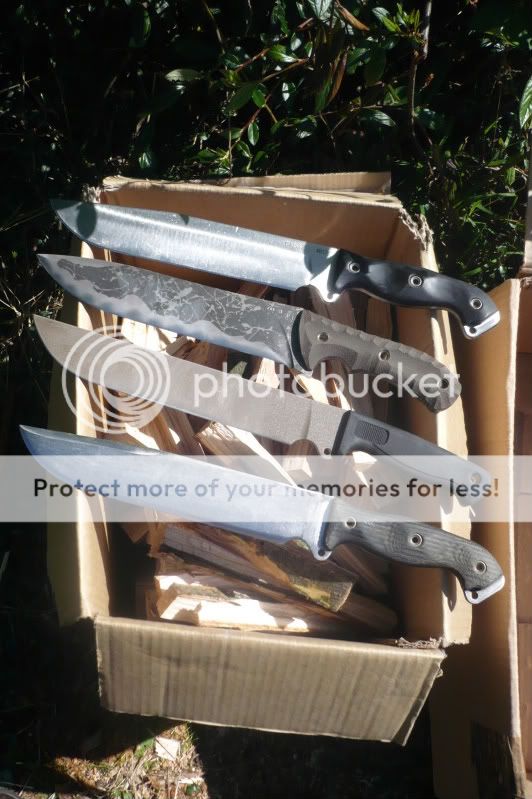
You can see in the pic above my BWM CG ... the reason for adding this one to the equation was that as I was getting into this splitting .... and I must have been going for a good few hours by then .... was that I was becoming conscious that the shape of the grind seemed to dominate "performance" .... or so it seemed ... with the BWM LE being the best out of the Basic 11 and the Damura .... but I knew it was also the thinnest of the three at .220" and therefore brought out the thinner still BWM CG at .187" to see how things compared .... the Basic 11 is .25" and the Damura is .275" ....
The BWM CG was interesting to use ....
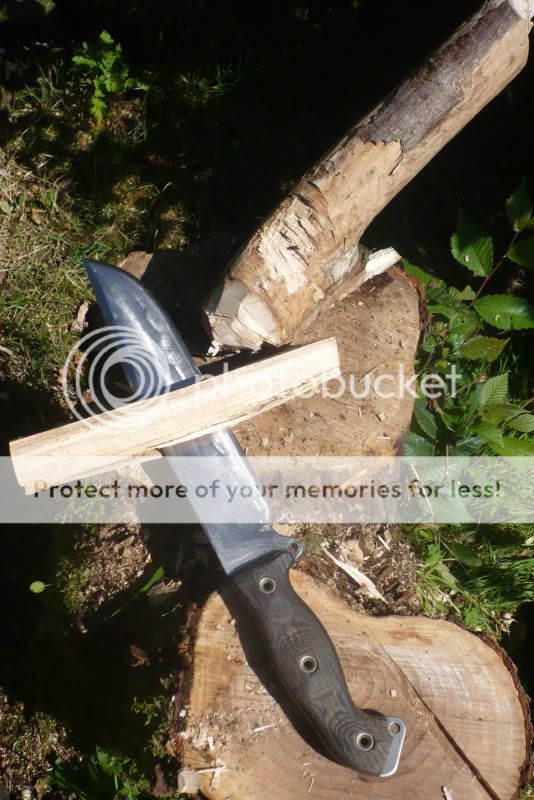
In splitting the thinner sticks it was at it's best, very quick and able to benefit from it's thinness ... but with the thicker logs it tended to stick more midway .... this was when the advantage of the sabre grind on the BWM LE with a wider spine seemed to help open up the log .... the Basic 11 at .25 thick was equally good but I think the painted finish seems to offer up more resistance than a satin finish and the depth of the BWM LE also seemed to make for a more gradual taper which whilst things were very close .... definately gave the BWM LE an edge .... you need to do a lot of batoning to tell .... a lot of it back to back using the same piece of wood ... but you do notice the differences when you do it for hours.
The Damura at .275" thick at the spine was pretty good on the bigger stuff but it needed a few more initial whacks to get it going .... it is suprising how much it reminded me of the TTKZ grind when I first got it .... and unlike the TTKZ which with a satin finish was easy to tweak on a belt sander .... the lovely finish on the Damura has me scratching my head a little as to what to do
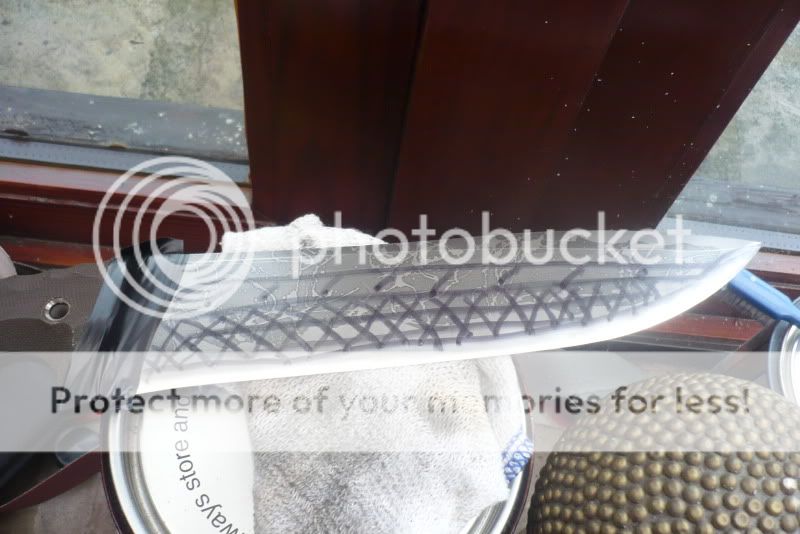
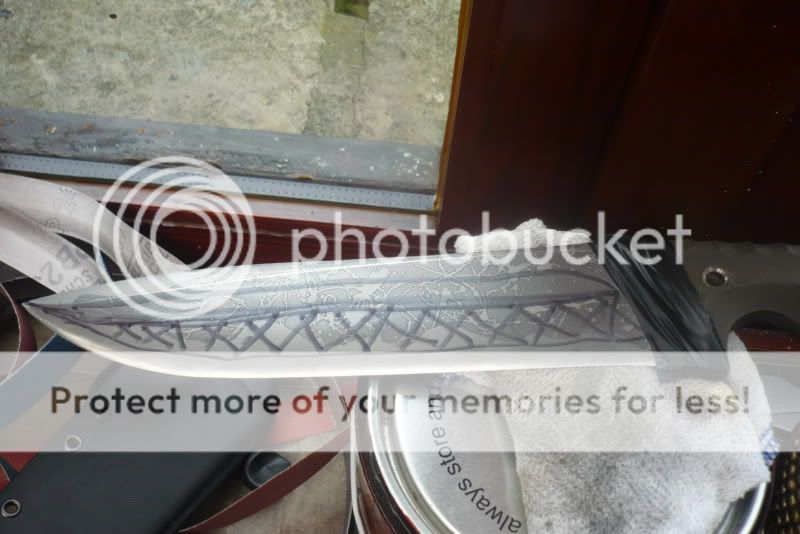
It is a complicated grind to alter .... the grind line at the choil is sloping and not vertical and the area where you would want to thin the sides down is more or les right where the darker etching ends .... this would lead to a bit of a bright transition from etching to satin created by the belts .... the only option I can think of being to double cut the finish and have a uniform but less pretty look to the knife .... or simply leave it as is .... but that hardly appeals to me at all .... or to send it back to Japan to try to explain the modifications I would like .... and again I cannot see that being a success either ....
It would cost a lot of money for what is a relatively quick job compared to the travel time etc with the knife ....
I guess I will just do the job and see what I end up with .... I much prefer a knife to work really well than worry about it's looks ....
On the plus side with the Damura is the steel it is made from and the edge it can take .... the OU31 steel is hardened to Rc64 and has a high carbon content .... one of the few Japanese powdered steels to be specially made for cutlery .... it is similar to R2 and Cowry X on the type of edge you get. Very hard to alter and tweak but incredibly long lasting and very much able to take a thinner edge without rolling. It will not be as maleable as Infi is if I were to hit a stone when chopping .... but on wood it is likely to out last my Infi blades on keeping a razor sharp edge. Useful properties if you are careful with the knife ... and want one knife for fine fuzz sticks etc as well as chopping .... but potentially time consuming though if you use it to clear scrub and catch a rock and put a nick in the blade .... anyway .... at least it is different and can give an alternative set of benefits ....
However, if you were to ask me whether I would prefer it to my BWM LE the answer would be "No" .... certainly not "as is" at the moment and if tweaked I would need to compare them again ..... but the BWM LE needs nothing doing to it ..... aside from smoothing the grips and convexing the edge to what I wanted, it is pretty much "perfect" straight out of the box. One of the few Busse's I have had like that .... the Basic 5, 9 and 11 with their ASM grinds also being the same. The grind shape and comfort of the grips on the LE are really "ideal" for me and the Basic 11 is more comfortable still, it just needs stripping I reckon to match the BWM LE.
However I was checking out a site in Japan which I have used to buy some of my smaller custom blades and came across this knife by Kiku Matsuda ....
Here is the spec on the knife -
KM-730 Daruma Heavy-duty drop-point Machete type knife of 10" OU-31 Hamaguri-ba ground broad (2" wide) blade with long false edge on back.. Oversized 5-3/4" hand contoured O.D. Green Canvas Micarta handle with thumb and finger notches.
OU-31 blade in 7.0mm thick, 250mm blade, 390mm overall, weight 730g
I kept coming back to this pic checking out the hamon .... "hamaguri-ba" ground means it is a "fully convex zero grind" .... the type of grind done on their Samauri swords .... so I figured it would be a worthy bit of competition to my Busse's and decided to get it ....
It certainly got here quickly .... the postal service from Japan must be as efficient as their Railway system .... it only took four days to arrive and this Sunday I lined it up with some competition ....
The weight of the knife for those of us who think in ounces is 25.75 oz's so the nearest comparable blade is my BWM LE .... which is perhaps my favourite Mistress .... it and my NMFBM are a tie really as they are both "superb" .... and to give it another favourite to measure up to I added the Basic 11 .... an amazing knife on the "performance v weight" category and perhaps the best Busse for comfortable chopping that I own ....
Some of you may remember this pic of a tree which has died where I took the missing limb down with the Basic 11 and the TTKZ ....
Well the remaining limb overhung the dry stone wall at the rear ( not easy to see in the above pic but it is there ) so this weekend I decided to bring it down safely. To drop it where I wanted I need to use a chain saw with a very deep slanting cut to get it to fall back against the natural lean .... I managed to do it and then sectioned up the trunk .... this left a fair old bit of wood needing chopping up .... which is pictured below ....
Cutting down the remaining limb with a chainsaw also enabled me to flatten off the stump to give me a long wanted proper chopping block ....
Interestingly when I was putting the knives into the stump for the pic the BWM LE and the Basic 11 sunk into the wood with just the lightest of flicks .... the Daruma when using the same sort of motion just did'nt bite as deep and would'nt stick .... it needed a fairly hefty swing to get it to bite deep and that had me "concerned" ....
Bringing the knife out of the stump after the pic and holding the edge up to the sky to silouette the grind .... the first thing I noticed about the shape of the convex grind was that it was "pear shaped" .... meaning that the convex curve to the edge was quite obtuse starting from where the acid etching finishes on the pattern and giving the knife a lot of thickness behind the shoulder of the main slope to the edge ....
This is exactly the same issue that the TTKZ's had when they were received .... the thickness and low down steep curve would stop the blade from biting as deep into wood as a more acute "appleseed" shaped convex grind can do .... and whilst perhaps being "tougher" if you wanted to put the edge through a breeze block etc .... was not ideal for working with wood.
The knife in general though is a thing of beauty .... the use of the tube rivets reminds me very much of the Busse style and that was perhaps what caught my eye ... the grips needed a little bit of sanding to round off some of the sharper edges ... but once done the forefinger curve gives the knife a similar "rocking ability" when chopping to maximise power to the handle on the KZII when held in the lower grip ... and the KZII can deliver some "serious" power ....
Anyway .... a little put off by realising this potential problem I started getting stuck into doing some serious "log splitting" .... using a baton it was'nt long before we had a large cardboard box full of firewood for storing for the winter ....
You can see in the pic above my BWM CG ... the reason for adding this one to the equation was that as I was getting into this splitting .... and I must have been going for a good few hours by then .... was that I was becoming conscious that the shape of the grind seemed to dominate "performance" .... or so it seemed ... with the BWM LE being the best out of the Basic 11 and the Damura .... but I knew it was also the thinnest of the three at .220" and therefore brought out the thinner still BWM CG at .187" to see how things compared .... the Basic 11 is .25" and the Damura is .275" ....
The BWM CG was interesting to use ....
In splitting the thinner sticks it was at it's best, very quick and able to benefit from it's thinness ... but with the thicker logs it tended to stick more midway .... this was when the advantage of the sabre grind on the BWM LE with a wider spine seemed to help open up the log .... the Basic 11 at .25 thick was equally good but I think the painted finish seems to offer up more resistance than a satin finish and the depth of the BWM LE also seemed to make for a more gradual taper which whilst things were very close .... definately gave the BWM LE an edge .... you need to do a lot of batoning to tell .... a lot of it back to back using the same piece of wood ... but you do notice the differences when you do it for hours.
The Damura at .275" thick at the spine was pretty good on the bigger stuff but it needed a few more initial whacks to get it going .... it is suprising how much it reminded me of the TTKZ grind when I first got it .... and unlike the TTKZ which with a satin finish was easy to tweak on a belt sander .... the lovely finish on the Damura has me scratching my head a little as to what to do
It is a complicated grind to alter .... the grind line at the choil is sloping and not vertical and the area where you would want to thin the sides down is more or les right where the darker etching ends .... this would lead to a bit of a bright transition from etching to satin created by the belts .... the only option I can think of being to double cut the finish and have a uniform but less pretty look to the knife .... or simply leave it as is .... but that hardly appeals to me at all .... or to send it back to Japan to try to explain the modifications I would like .... and again I cannot see that being a success either ....
It would cost a lot of money for what is a relatively quick job compared to the travel time etc with the knife ....
I guess I will just do the job and see what I end up with .... I much prefer a knife to work really well than worry about it's looks ....
On the plus side with the Damura is the steel it is made from and the edge it can take .... the OU31 steel is hardened to Rc64 and has a high carbon content .... one of the few Japanese powdered steels to be specially made for cutlery .... it is similar to R2 and Cowry X on the type of edge you get. Very hard to alter and tweak but incredibly long lasting and very much able to take a thinner edge without rolling. It will not be as maleable as Infi is if I were to hit a stone when chopping .... but on wood it is likely to out last my Infi blades on keeping a razor sharp edge. Useful properties if you are careful with the knife ... and want one knife for fine fuzz sticks etc as well as chopping .... but potentially time consuming though if you use it to clear scrub and catch a rock and put a nick in the blade .... anyway .... at least it is different and can give an alternative set of benefits ....
However, if you were to ask me whether I would prefer it to my BWM LE the answer would be "No" .... certainly not "as is" at the moment and if tweaked I would need to compare them again ..... but the BWM LE needs nothing doing to it ..... aside from smoothing the grips and convexing the edge to what I wanted, it is pretty much "perfect" straight out of the box. One of the few Busse's I have had like that .... the Basic 5, 9 and 11 with their ASM grinds also being the same. The grind shape and comfort of the grips on the LE are really "ideal" for me and the Basic 11 is more comfortable still, it just needs stripping I reckon to match the BWM LE.

 :thumbup:




 :thumbup:
