Calling on the Wooden Wednesday Crowd for Help

Status
Not open for further replies.
Joined
May 26, 2010
Messages
2,872
Alright all you ebony lovers, help me out here please. I have quite a few Cattle patterns and have seen countless more but rarely do I see them in ebony. They must be somewhat rare as a search of the Wooden Wednesday thread turned up none. I know they are out there as they are not difficult to find in the old catalogs. GEC has some offerings I believe but I am primarily interested in antique or custom. I own none :( so I cannot get this started. Thanks!
 
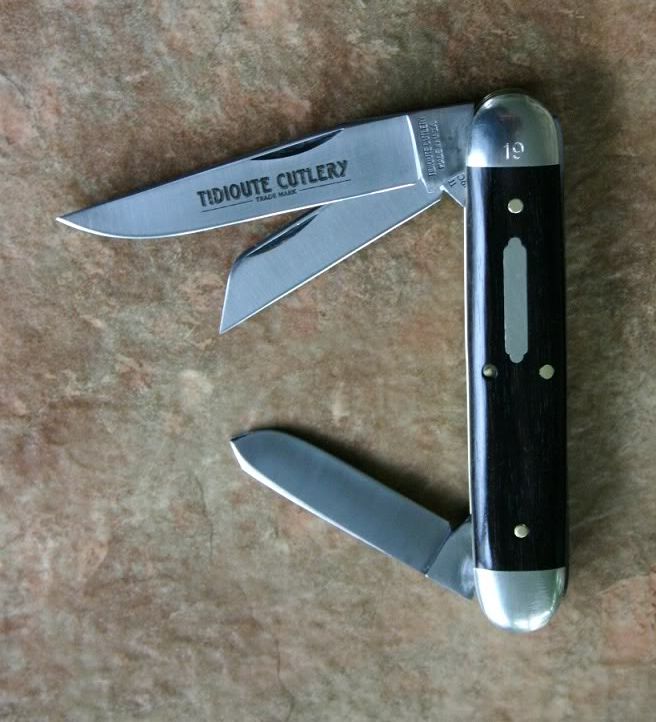
Among recent manufacture, the only two I'm aware of are the GEC Tidioute shown here, and one by Queen/Schatt & Morgan.

EbonyCuban.jpg


The GEC is 4-1/8" closed, while the S&M models are remakes of older patterns, and are 3-5/8" closed with spear main, sheepfoot and pen blades.
 
Doesn't the Schatt&Morgan Heritage series count too? They come in bone or ebony.
 
Will, that's the one I was refering to . . . I forgot the Heritage Series name.
 
If you want antique cattle knives with ebony scales, watch the 'bay. They show up occasionally.
 
Well, looks like it is a bit of a rare combination. So many knives were ebony scaled back in the day you would think more Cattle knives would be around. Maybe it is the bone connection to cattle, which I doubt. Ebony being so durable you would think it a good fit on a hard use knife. Maybe BRL will have some insight as to why these are scarce.

Thanks for looking.
 
Buck used Ebony on their 110's and 112's for a while in the 70's. Plenty of pictures in the Buck area of the forum as this was brought up often.
 
Buck used Ebony on their 110's and 112's for a while in the 70's. Plenty of pictures in the Buck area of the forum as this was brought up often.

Indeed but those are not Cattle patterns.;) Wish they had made them back then.
 
Could it be that cattles are rarer than stockmans in general, and harder to find in a specific handle material for that reason? I think I have two, both bought within the past year or so, and I'm not aware of having passed any up. (Pal and Imperial or Colonial, both with synthetic handles)
 
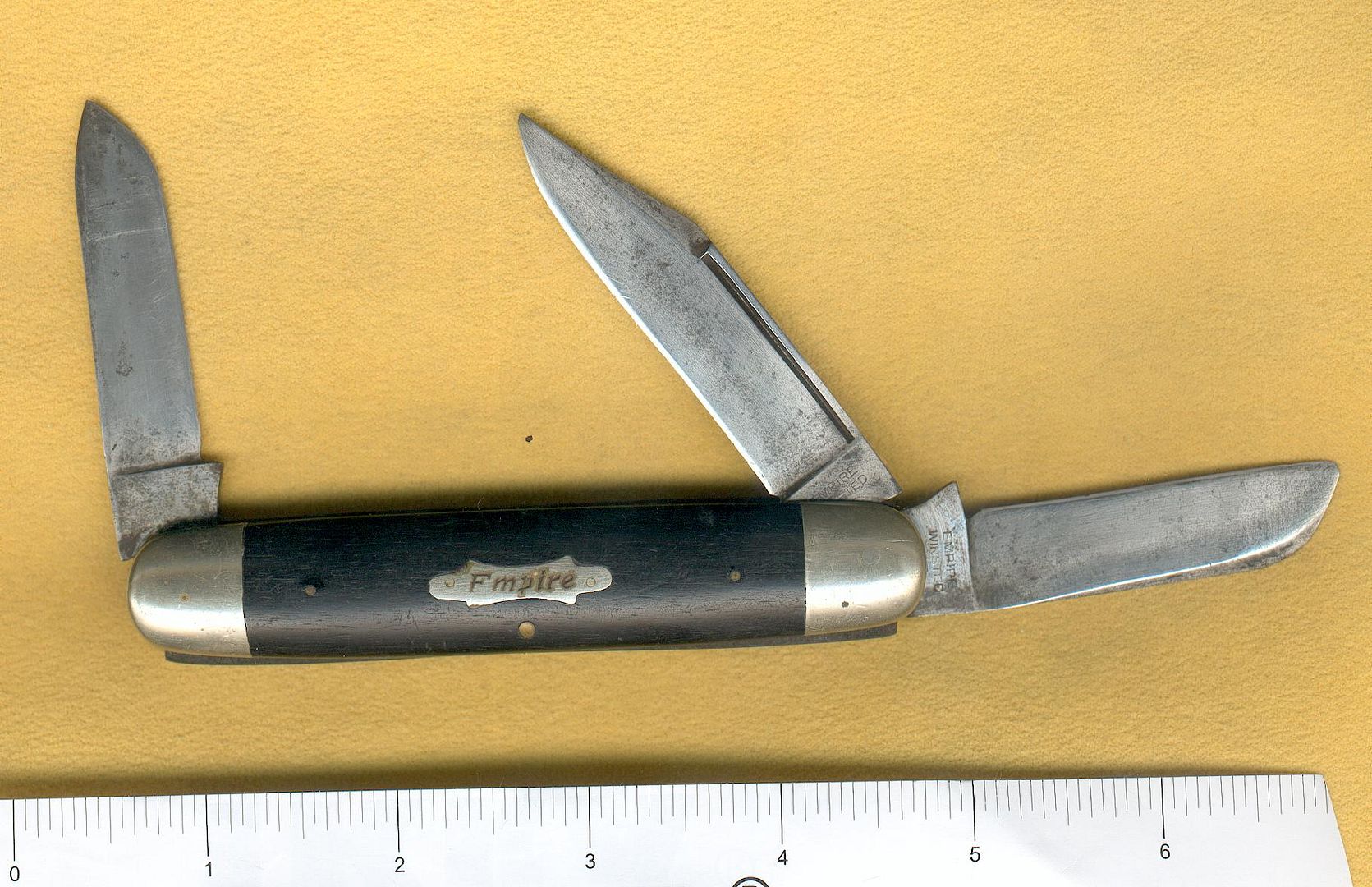
Definitely more than 70 years ago, here's an old Empire that's done a lot of Cattling!
EmpCattleEbony1.jpg


4 3/16" long, despite the wear, this is a robust knife with impressive walk and talk. Someone oiled the joints regularly for 100 years or so!!! The Ebony is in fine shape also.
My guess with all the blades marked, and that nice shield script this is easily pre WWI. Maybe pre-1900!!
 
Last edited:
I just wandered through some of my collection, and couldn't find another Ebony Cattle Knife.
Maybe they did get used up!
Thanks Jeff!
 
Among recent manufacture, the only two I'm aware of are the GEC Tidioute shown here, and one by Queen/Schatt & Morgan.

Definitely more than 70 years ago, here's an old Empire that's done a lot of Cattling! 4 3/16" long, despite the wear, this is a robust knife with impressive walk and talk. Someone oiled the joints regularly for 100 years or so!!! The Ebony is in fine shape also.
My guess with all the blades marked, and that nice shield script this is easily pre WWI. Maybe pre-1900!!

Thanks for posting these guys.

I am beginning to think some kind of plague wiped out all the ebony Cattles:eek: As I stated earlier many examples are to be found in old catalogs and books. Makes me wonder if ebony was popular, and being purchased by those that tended to use their knives hard, they were used up and discarded or it was not popular and few were made. Price points are similar in the catalogs between bone and ebony but it is hard to keep in perspective the difference between 10, 25 and 50 cents!
 
Another bump as I sure would like to see more!!

Charlie, that Empire cattle knife is just splendid. I don't even see many Empire's around.
 
I just wandered through some of my collection, and couldn't find another Ebony Cattle Knife.
Maybe they did get used up!
Thanks Jeff!


Charlie I wondered through thousands of antique knives today at the GAKC annual show and found exactly 1 ebony Cattle. I did not procure it as it was in terrible shape and way overpriced. So I guess I am finally getting the message:grumpy:
 
Maybe Oregon will give one up - it's been known to turn up some gems.
The western states didn't get "combed" like the east coast in the 70s-80s.
 
A collector friend has come to the rescue! In a big way as well. First his comments about these:

"What I find most remarkable is the quality of ebony used 100+/- years ago. Incredibly tight grained and pure black as black can be. This came from original old growth dense forest trees. Tight grain = Slow growing. Today's ebony is farmed, open space, lots of water, fast growth = big xylem cells, so, wide rings, which means open grain. Old ebony furniture maybe should be used as a source for knife handles today.

Concerning scarcity of ebony Cattle knives my bet is that ebony was just not as popular among those who were likely to purchase a Cattle knife. Would need old sales records to confirm. Maybe the 'Cattle types' saw ebony as more gentlemanly and the ethos of the time was to differentiate yourself from these perceived less physical men?"


Interesting take concerning rarity.


Now the pictures: First three are all Robeson Suredge at 3 5/8" and the last is a NY Knife Co. at 3 3/4". If only they could talk!

Jan2012008.jpg

Jan2012010.jpg

Jan2012007.jpg

Jan2012009.jpg
 
Nice score! Those have some quality ebony.

Looking at old catalogs, it seems that cocobolo was used more often on working knives than ebony. And a lot of old knives that many people (even on this forum) call ebony are most likely cocobolo, which darkens to almost black with use and age.

Without sales figures we'll never know for sure how many were produced. But working knives were used up and not many survived.
 
Nice score! Those have some quality ebony.

Looking at old catalogs, it seems that cocobolo was used more often on working knives than ebony. And a lot of old knives that many people (even on this forum) call ebony are most likely cocobolo, which darkens to almost black with use and age.

Without sales figures we'll never know for sure how many were produced. But working knives were used up and not many survived.
 
Status
Not open for further replies.
Back
Top