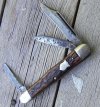
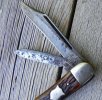
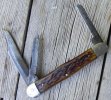
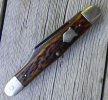
Prior to 1946, Camillus made a true split-spring whittler. It was 3-5/8" long closed and was a swell-center frame. That knife was discontinued during the WWII shutdown while they made knives for the military. In 1946 the #72 was introduced. The #72 was 3-5/8" long closed and was a swell-center frame. I think it's safe to assume the #72 took the place of the true whittler.
If you find a Camillus split-spring true whittler that you can prove was made post 1946 or a #72 you can prove was made pre-1946, I'll eat my words in the middle of main street at high noon.
Camillus named the new #72 pattern "Carpenter's and Whittler's knife". Note the full name. In my mind it's akin to GEC naming (one of) the #15 pattern(s) "Boy's Knife". They did not name it "Whittler", it was named "Carpenter's and Whittler's knife". Not to put too fine a point on it but I think there's a distinction there.
Sometime between the 1965 catalog and the 1972 catalog, Camillus changed the name of the #72 from "Carpenter's & Whittler's knife" to just plain "Whittler". The company named it "Whittler". What are you going to do, call it a "Muskrat"? (being completely ridiculous to make a point)
Using the knife book of definitions, is it a Whittler? NO! It isn't. But even though the blade configuration resembles a Stockman, IT'S NOT A STOCKMAN EITHER. A stockman has spey and sheepsfoot secondary blades. The #72 has a coping blade (for whittling) and small clip blade (for whittling) as secondary blades, so I'm willing to and do call it a Whittler.