I categorize camp knives as mid-sized blades (6-8"), belt knives as smaller blades (3.5-5.5"), necker/pocket knives (1.5-3") and choppers (>8"). These categories are a bit arbitrary but tend to fit with how I use them.
In terms of size, a camp knife to me should fit comfortably on your belt. This places an upper limit on the size and weight. The camp knife will be called to do a variety of jobs like firewood prep, food prep, making tent stakes and pounding them in the ground, some bush craft chores (e.g. stands for billy pots) etc. The food prep and firewood prep (batoning and splitting) require a bit more length than typical of a bushcraft or belt knife. It is the latter two chores where I distinguish a camp knife from my belt knife used for day hikes or bushcraft type chores.
When I am base camping or car camping, I prefer to have a good size knife to do the chores I want. As a knife fanatic, I tend to like using my knife for more things than most people do. For instance, I will hang around the fire and carve things etc. Albeit, I like a smaller knife for whittling. Still, I will tend to use a knife where many others will seek a devoted tool. My choice isn't always the most effective, but that is just something I like to do. For example, in most cases I split wood by batoning with a knife rather than using an axe. The axe is faster and more efficient. For me, the knife is more fun.
When I'm hiking or moving about, I might opt for a lower weight, smaller belt knife. Here weight, and ease of carry will trump the functions of the mid-size knife. In this case I prefer a 4" knife or sometimes a knife as large as 5" but not any bigger than that. I do have some lighter 6" knives that I use for this purpose as well though.
For steel, I really prefer carbon steels. My two favorites are O1 and 1095. I also have a knife in A2. There are lots of charts comparing these steels across different properties. In all honesty, I really can't tell a difference between O1, 1095 and A2. As is often mentioned, if you are getting a custom knife from a knifemaker, you steel choice is best based on what the knifemaker is most familiar with. Heat treat is everything.
The main reason I like 1095 and O1 so much are that they are really easy to sharpen and maintain a really fine edge. Sure, they can rust on you if you don't maintain them but I like the way these steels perform. They get super sharp, can be readily touched up and maintained in the field. They also tend to be quite tough, being able withstand impacts. So chopping might at worst roll the edge, but does not cause chips. I've also grown to like the patina that forms on carbon blades. In my view they give a knife character.
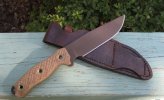
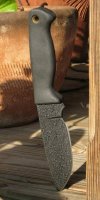
So a couple of recommended camp knives. I have an Rat cutlery RC-6 which has excellent balance. The coating on the blade isn't something I really like, but the balance if this knife and mircata grips are top notch. Very well worth the money and I find myself using this one often as a camp knife. I also have a custom Bryan Breeden peacemaker that is lighter weight than the RC-6 and could pass for a belt knife. It is less proficient at chopping, but still a great all round user. I have an Scrapyard SOD which I think is too heavy for a camp knife and while it is indestructable and excels as a chopper, it is best used as a chopper. I don't want that beast hanging on my hip. Most of my other knives fall in the bushcraft size so I wont talk about them.
Below is a picture of my Breeden Peacemaker (6", 1/8" thick, O1 steel with osage orange handle) along side a JK Kephart (4", black mircata, 1095 steel). Both excellent knives, the peacemaker can pass as both a camp knife and a bushcrafter due to its light weight.
Here is a shot of my RC-6






 I currently use a big knife small knife combo, sometimes I leave out the small knife and bring a multi-tool in its place.:thumbup: