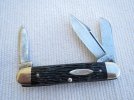
I don't think it's Staminawood; looks 'blacker' than any of that I've seen, and I'm also thinking Case didn't use Staminawood prior to 1965, at the earliest. The tang stamp on this knife indicates the prior period, from 1940-'64. If the knife actually has a stamped pattern number, that would indicate 1950 or later (Case didn't stamp pattern numbers on blades until 1950 (maybe late '49).
One of the collecting guides I often refer to (*1) shows that Case used bone on some of the 6445R knives in the 1940-'65 period; the guide refers to just 'Bone' (don't know what color) and 'Red Bone' for those. The same guide also lists both 'Rough Black' and 'Black Composition'*2 handles in 1940-'50 period for this knife. Case might've been experimenting with a couple or more synthetic materials then, but I don't know. Case didn't start using true Delrin until 1967 (on the original 2138 Sod Buster), so earlier synthetics might not respond the same to 'melt tests' and such.
The pics look like synthetic to me, as I don't see any visible pores or grain usually seen with bone. I don't think I've ever seen bone as dark or uniformly colored either; bone is almost always sort of blotchy or uneven, in how it takes a stain/dye. Examining it under very, very bright light might help, as bone will usually show some depth (as if looking into glass or polished stone), and this will also reveal more variation in color/darkness, whereas synthetics usually are more opaque and still look like uniformly-colored 'plastic' under bright light.
*1 = 'Official Price Guide to Collector Knives', Fourteenth Edition, by C. Houston Price (2004)
( Edited to add: )
Looking online at Google Books search results, there's a pic of a 6445R on page 159 of Steve Pfeiffer's book (*2), with what appears to be identical 'jigged black composition' handles. Even the jigging appears to be the same. If I were betting, I'd think that's what they are.
*2 = 'Collecting Case Knives: Identification and Price Guide'
David