Case Bolsters. Is it just me?

Joined
Sep 10, 2010
Messages
474
Has something change in the metallurgy of Case's bolsters?

I find that all the current made stuff scuffs and scratches really easy and pretty quickly at that. I've also got a few made in the 70's that were essentially new when I got them recently and the bolsters hold up much better...not a lot of scratching etc. going on.

Am I crazy or has something changed? Granted, I know I could use a pocket sheath or something but that's really not what this is about. I don't mind the scratches...they just seem to form so much more quickly on current production than compared to the older ones I have. Only thing I can think of is that maybe the metal they're using now is a little softer? Just curious.
 
In all honesty, I have been thinking just the opposite.

I have a Humpback Stockman made in 2010 that I have carried everyday since 12/25/10. Not a long time but the bolsters are holding up much better than I expected. Some very minor scratches that I have to look closely to see.

I also have a Pocket Hunter made in 2007 that I carried for a good 16 months or so. The bolsters on it were scratched worse within just a few weeks of carry than my Humpback is after 2 1/2 months.

My level of knife usage is pretty consistant and my carry method is the same as always.

I don't have any older Case knives that I carry so I cannot comment on those.
 
Ive been carrying a humpback whittler for almost a year and its bolsters have held up pretty well. I have a 97 mini trapper and a mini copperlock from 98 I think that havent been carried much (but have been sweated up in my hands) that have pitting or something where the bolsters are permanently dingy. They wont polish up.
 
Interesting thread. Probably you can only really compare pattern to pattern as the bolsters vary say between a Peanut or a Medium Stockman.

I do notice that Queen knives seem to have tougher bolsters and don't usually show pivot ghosting through them either. They are likely made differently from CASE.

I never carry my pocket knife with keys or change, don't like the jangle, but I don't sport any of them damn purses or sheathes either........
 
My new 5347 Stockman seemed to scratch up easy while my humpback whittler is the opposite. It seems to be more in the design to me. I can't comment to much on the older ones since I've only had one halfway good one years ago. It was an old dot 47 and some moron had messed up the back spring to the main blade causing it's blade to travel to far forward. If I could have experienced a normal 47 at that time my whole Case collection would be 47 series Stockmans right now I'm pretty sure!
 
I have had some what the same experience. I carry an older Uncle Henry 885, a Buck DW 301 and a Case Old Red PW stockman and they have become my daily carry. Have the most pocket time on the Uncle Henry (close to seven years) and its bolsters look bright and ding free, my 301 and Old Red Pocket Worn both show scratches. Not complaining because I enjoy them all and they get pushed in a pocket with keys, coins, crescent wrench, screwdriver, nuts, bolts and screws from the day’s job. It’s all part of using them.
Bob.
 
Interesting thread. Probably you can only really compare pattern to pattern as the bolsters vary say between a Peanut or a Medium Stockman.

I do notice that Queen knives seem to have tougher bolsters and don't usually show pivot ghosting through them either. They are likely made differently from CASE.

I never carry my pocket knife with keys or change, don't like the jangle, but I don't sport any of them damn purses or sheathes either........

I believe that Queen bolsters are formed, in other words a die is used to shape a cube of nickel silver into the final shape. I know that Case bolsters are stamped from sheets of nickel silver then welded directly to the liners. The Queen bolsters may benefit from the extra cold working of the metal which may make it harder. Just a theory.
 
I believe that Queen bolsters are formed, in other words a die is used to shape a cube of nickel silver into the final shape. I know that Case bolsters are stamped from sheets of nickel silver then welded directly to the liners. The Queen bolsters may benefit from the extra cold working of the metal which may make it harder. Just a theory.

Very good theory though, perhaps that's the way Case used to do things?

I've got Canoes made by Case from both current production and the 70's. The one I actually carry from the 70's just doesn't seem to scuff much no matter what's in my pocket with it. My current run amber bone canoe though is scuffed like crazy. Gotta be something different.

Not a big deal, scratches don't bother me, just curious is all.
 
Very good theory though, perhaps that's the way Case used to do things?

I've got Canoes made by Case from both current production and the 70's. The one I actually carry from the 70's just doesn't seem to scuff much no matter what's in my pocket with it. My current run amber bone canoe though is scuffed like crazy. Gotta be something different.

Not a big deal, scratches don't bother me, just curious is all.

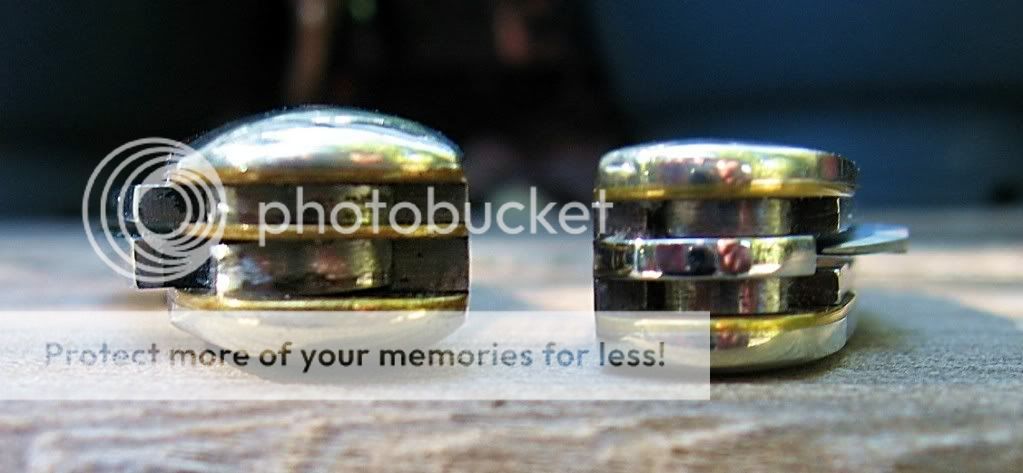
Yes until the mid 80's Case did it the old fashioned way, by forming. You can tell the difference by looking at how rounded the older bolsters are as compared to the newer knives with flat bolsters.
 
Yes until the mid 80's Case did it the old fashioned way, by forming. You can tell the difference by looking at how rounded the older bolsters are as compared to the newer knives with flat bolsters.

Yep - old Case XX from the '50s on the left; recent Case on the right:

Caseprofiles.jpg
 
Well, I dunnnnno about this. I haven't noticed any difference in bolster wear and tear (scratches, pitting, dings, etc.) on Case knives over the years -- formed, pressed, or otherwise.

Here's a Case Folding Hunter manufactured in late 1964 or early 1965 and I carried it almost daily from Aug 1965 through Jul 1989 while in the Navy.

casefoldinghunter.jpg


Here's a Case Trapper manufactured in 2004 and carried frequently. 95% of the time it is carried in a pocket with change and keys. It has been dropped in the dirt, stepped on, kicked, etc. and the bolsters seem to be none the worse for it -- certainly no worse than the knife above.

casecvtrapperyellowderl.jpg


Me, I just buy a knife, look it over when I get it, carry it mixed in with keys and change as the whim hits me and don't concern myself with scratches or other dings to the bolsters or the knife in general.

This has been a good thread. Thanks for posting it.
 
Yes until the mid 80's Case did it the old fashioned way, by forming. You can tell the difference by looking at how rounded the older bolsters are as compared to the newer knives with flat bolsters.

Looks like I got my answer and I thank you. I knew something had to be different.

And in examining my 70's canoes vs. the current ones the bolster difference/design is pretty obvious...surprised I didn't notice it sooner.

Again though, the scratches truly don't bother me, they're tools and they're going to take some abuse. This was one of those things that was bugging me and I knew something had to have changed.

Thanks again knifeaholic.
 
Back
Top