

Planterz
Іди на хуй Путін!
- Joined
- Mar 26, 2004
- Messages
- 24,763
Having received my federal income tax refund last week, naturally it was time to splurge on some new knives. 3 of them were Case Chesnut CV bone that I've been itching to get my hands on. One is great, but unfortunately the other two are being returned to the dealer.
The knife that's great is the Sway Back Jack. This shouldn't be a surprise to anyone here, as even the hardcore customs collectors here have been raving about the SBJ. I was a bit trepidatious about this knife, being barely over 3" in length. It's not that it's not "enough knife" to be useful, but rather that the handle length would give me not enough knife to grip; my Case 6344 stockman at 3 1/4" is barely long enough, and the SBJ is even shorter. But I bit the bullet and am happy to report that it's not too small. Probably due to the fatter handles and sway back curve. The bone on my particular example has black highlights (or lowlights, I guess) on the chestnut.
Everything about the SBJ oozes style and craftsmanship. It's obviously a sexy knife, with the swedged wharncliffe and curved handles. The fact that springs sit flush when the blades are at half-stop definitely adds to the appeal. But what I think really sets this knife apart is the way the springs also act as the butt of the knife, especially how the pen blade spring is one large piece that fills up the unused length of the handle instead of leaving a gap. As an aesthetic, open gaps on a knife irk me (why not just make the blades longer?), and the SBJ corrects that peeve with class.
If only they made a 3.5" version...
The second chestnut I got was the medium stockman 63032 pattern. I like the 3 5/8" size. It's a happy medium between the just-a-bit-too-small 3 1/4" - 3 3/8" stockmans that are so common, and the 4" size stockmans. The blade lengths though aren't really all that much longer than what you'll see in 3 3/8" stockmans from other brands, such as the Buck 303; less extra length than you'd expect for the overall size difference in the knives. That's not really an issue though. The issue with this particular knife is that the sheepsfoot and pen blades are too close to each other. So much that the pen blade is very difficult to open, and practically impossible to open without gouging the heck out of the sheepsfoot blade. I don't know if this is a design flaw common with this pattern, or my example just had the blades too close together (but it doesn't look like there's much room to not have them so close). Even if the blades didn't rub, the pen blade's opening arc runs the blade right into the nail nick of the sheepsfoot, which is what makes it practically impossible to open without deliberately grinding the blades against each other.
So the stockman, unfortunately, is going back for a refund. Damn shame, because otherwise the knife is nearly perfect. The clip blade had the slightest bit of wobble, but nothing to get in a twist over. No gaps between liners/springs, and the bone was a beautiful uniform color, with zero gap and perfectly smooth transition to the bolsters.
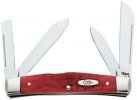
The third chestnut I got turned out not to be a chestnut at all. It's a congress, pattern 64052, model CA6992. The website I purchased it from describes it as chestnut bone (the url even has the page for this knife as /casemediumcongresschestnutbonecv.aspx). But it's not chestnut. The box it came in had matching a matching #, but simply says "Red". I'm not sure this knife even exists in chesnut, or at least is not currently available. Googling CA6992 returns results as being "Dark Red", and shows the same stock picture as the website I ordered mine from. Only one other website has it described as "Chestnut", but it also says "dark red" in the description.
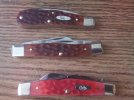
If the knife I received had been dark red, or had at least matched the color shown in the stock photos, I would have been OK with that. But unfortunately, as you can see in the picture below, it's not. It's more a pinkish-salmon, a color that frankly I don't find attractive at all.
Even if the color was what I wanted, I probably wouldn't be happy with the knife anyway. Based on what I was told and info I pieced together from the 'net, I was expecting the knife to use 2 backsprings like they did on the 64052 back in the old days. Instead this one uses 4 backsprings, like I guess every model with this pattern apparently does these days. 4 backsprings would have been OK if only it was just a hair thicker. Compared to my Steel Warrior congress (which looks like a clone of this Case pattern), the SW is just a bit thicker. Very marginally so; there's no way anybody could think the Case was pocketable but the SW wasn't - the difference isn't noticeable unless you're looking at them side-by-side. 1/16" or less. However, this tiny difference makes the springs, and thus the blades thinner. On the SW the blades aren't too thin, and you have to try pretty hard to get them to flex. On the Case though the blades are quite thin, and the 2 master blades have a ton of flex. The hollow grinds might have a part in this (the SW blades are flat-ground), but the thinness doesn't help either.
So unfortunately, the congress is going back for a refund too.
At least the Sway Back Jack is a nice knife. So nice that I'm left with a dilemma; what do I do with the refunded money. The next knife on my list to get was going to be a Queen Dan Burke small barlow, but the SBJ is so nice that I'm considering getting a second one, either another Chestnut CV or possibly one in stainless and stag.
The knife that's great is the Sway Back Jack. This shouldn't be a surprise to anyone here, as even the hardcore customs collectors here have been raving about the SBJ. I was a bit trepidatious about this knife, being barely over 3" in length. It's not that it's not "enough knife" to be useful, but rather that the handle length would give me not enough knife to grip; my Case 6344 stockman at 3 1/4" is barely long enough, and the SBJ is even shorter. But I bit the bullet and am happy to report that it's not too small. Probably due to the fatter handles and sway back curve. The bone on my particular example has black highlights (or lowlights, I guess) on the chestnut.
Everything about the SBJ oozes style and craftsmanship. It's obviously a sexy knife, with the swedged wharncliffe and curved handles. The fact that springs sit flush when the blades are at half-stop definitely adds to the appeal. But what I think really sets this knife apart is the way the springs also act as the butt of the knife, especially how the pen blade spring is one large piece that fills up the unused length of the handle instead of leaving a gap. As an aesthetic, open gaps on a knife irk me (why not just make the blades longer?), and the SBJ corrects that peeve with class.
If only they made a 3.5" version...
The second chestnut I got was the medium stockman 63032 pattern. I like the 3 5/8" size. It's a happy medium between the just-a-bit-too-small 3 1/4" - 3 3/8" stockmans that are so common, and the 4" size stockmans. The blade lengths though aren't really all that much longer than what you'll see in 3 3/8" stockmans from other brands, such as the Buck 303; less extra length than you'd expect for the overall size difference in the knives. That's not really an issue though. The issue with this particular knife is that the sheepsfoot and pen blades are too close to each other. So much that the pen blade is very difficult to open, and practically impossible to open without gouging the heck out of the sheepsfoot blade. I don't know if this is a design flaw common with this pattern, or my example just had the blades too close together (but it doesn't look like there's much room to not have them so close). Even if the blades didn't rub, the pen blade's opening arc runs the blade right into the nail nick of the sheepsfoot, which is what makes it practically impossible to open without deliberately grinding the blades against each other.
So the stockman, unfortunately, is going back for a refund. Damn shame, because otherwise the knife is nearly perfect. The clip blade had the slightest bit of wobble, but nothing to get in a twist over. No gaps between liners/springs, and the bone was a beautiful uniform color, with zero gap and perfectly smooth transition to the bolsters.
The third chestnut I got turned out not to be a chestnut at all. It's a congress, pattern 64052, model CA6992. The website I purchased it from describes it as chestnut bone (the url even has the page for this knife as /casemediumcongresschestnutbonecv.aspx). But it's not chestnut. The box it came in had matching a matching #, but simply says "Red". I'm not sure this knife even exists in chesnut, or at least is not currently available. Googling CA6992 returns results as being "Dark Red", and shows the same stock picture as the website I ordered mine from. Only one other website has it described as "Chestnut", but it also says "dark red" in the description.
If the knife I received had been dark red, or had at least matched the color shown in the stock photos, I would have been OK with that. But unfortunately, as you can see in the picture below, it's not. It's more a pinkish-salmon, a color that frankly I don't find attractive at all.
Even if the color was what I wanted, I probably wouldn't be happy with the knife anyway. Based on what I was told and info I pieced together from the 'net, I was expecting the knife to use 2 backsprings like they did on the 64052 back in the old days. Instead this one uses 4 backsprings, like I guess every model with this pattern apparently does these days. 4 backsprings would have been OK if only it was just a hair thicker. Compared to my Steel Warrior congress (which looks like a clone of this Case pattern), the SW is just a bit thicker. Very marginally so; there's no way anybody could think the Case was pocketable but the SW wasn't - the difference isn't noticeable unless you're looking at them side-by-side. 1/16" or less. However, this tiny difference makes the springs, and thus the blades thinner. On the SW the blades aren't too thin, and you have to try pretty hard to get them to flex. On the Case though the blades are quite thin, and the 2 master blades have a ton of flex. The hollow grinds might have a part in this (the SW blades are flat-ground), but the thinness doesn't help either.
So unfortunately, the congress is going back for a refund too.
At least the Sway Back Jack is a nice knife. So nice that I'm left with a dilemma; what do I do with the refunded money. The next knife on my list to get was going to be a Queen Dan Burke small barlow, but the SBJ is so nice that I'm considering getting a second one, either another Chestnut CV or possibly one in stainless and stag.


 (My solution: only buy two blade Case knives ..... Peanut, SBJ, Texas Jack, Trapper).


