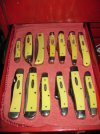
Case White Composition or Is It Yellow?

Joined
May 26, 2010
Messages
2,872
I know that Case called one of its' composition handles White Composition and was made of the same material as the Yellow and Black Composition. I also know that most, if not all of the White Composition I have seen has yellowed considerably and that they stopped using the White sometime in the 1970's. While not as yellow as the Yellow it gets to be a bit confusing at times. What I cannot find out from research is when they started using Yellow and were Yellow and White used at the same time at any point in their history. Additionally for you Yellow collectors, has the yellow in the Yellow scales been consistent in shades over the years?

Please confuse more than I am:confused:

I know this may be more appropriate for the BRL forum but decided to try here first.
 
My barber showed me a knife (Case Eisonhower) his Dad gave him when he was 12 years old (he's now 60 something)...he tells me he remembers it being white, it's now every bit as yellow as these I have....
 

Attachments

  • Picture 081.jpg
    Picture 081.jpg
    45.5 KB · Views: 19
At one time, the white was celluloid. I sent two XX era knives back to Case to be rehandled, and the symptoms were unmistakable. It was circa 1995 that I sent them, and the white handles that they put on them (sausage/melon testers) was Delrin I believe, which they were using on new ones, at the time of the repair.
My point is, more than one material was used. I sold them, so I cannot speak to the yellowing. The old Cell handles were yellowish, grayish, mottled and crumbling!!
 
Case's site (link below) lists the handle/pattern codes for several types of handle materials, like '6' for jigged bone (usually; sometimes jigged synthetic or wood laminate), '5' for stag, etc. One of the codes listed is the uppercase letter 'I' for (both) ivory and for imitation ivory. Their description mentions that the imitation ivory is a 'composite' material. Maybe some of the old 'white composition' knives might be actually be classified/named as 'imitation ivory' instead, and perhaps the pattern numbers might include the 'I'.

http://www.wrcase.com/case_college/handles/handlematerials.php

"I - Imitation Ivory
Not currently used at Case, Imitation Ivory is a composite material that looks like natural ivory. "

The mention that it's not currently used might(?) imply that it was found on some of the older knives.

Same page also lists the code '4' for 'smooth synthetic':
"4 - Smooth Synthetic
Poured plastic or Delrin® molded handles made in most any color except black and yellow. "

This '4' code might be more likely for the white comp handles. I'm seeing a 5-1/2" Melon Tester pattern listed in my guide(*) with 'White Composition' handles, and listed under the pattern# 4200 SS (2 blades). Also seeing a 4100 and 4100 SS Melon Testers. Vintages of the Melon Testers run from 1960 through 1974. And a 3-1/4" Budding Knife in white composition, pattern 4103B&G, from the 'Tested' era (pre-1940).

One thing for sure. If the pattern number for a particular knife begins with a '3', then it's definitely 'yellow' composite/synthetic. I do know Case started using the yellow comp a very long time ago (pre-1940, I think). My guide mentions a 'white liner' version of 'yellow', which existed on pre-XX era knives (pre-1940) and is described as having a 'deep glossy yellow color handle with a white line around it's outer edge.' Interesting...

(* The guide I'm referring to = The 'Official Price Guide to Collector Knives', Fourteenth Edition, by C. Houston Price; 2004)


David

 
Last edited:
Thanks guys. You have given me some new ideas.

Case keeps it too simple sometimes. They have used the #3 since the Tested era but the make-up of that composite has changed over the years. Delrin was formulated around 1952 but apparently DuPont was not able to produce it commercially until 1960. I have seen #4's that yellowed to the point without looking at the tang stamp you would swear they were #3's. Some of these materials used before 1960 while not Delrin were very Delrin like, and some like Charlie mentioned were definitely not. Hard to imagine what all was actually available considering that new fangled thing called Micarta actually dates to 1910. Probably does not exist but how cool would it be to find a Tested era with yellow or white Micarta scales!

I was hoping to find some reference material that gets specific about what materials were used and when but such data may be long lost or have been destroyed along the way.

Thanks again.
 
The collectors of the future are going to have a somewhat easier time of it. Some cutleries keep very complete records, esp. GEC.
 
The guide that I was referring to earlier also mentions that Case didn't start using the true 'Delrin' until 1967, which just happens to coincide with the introduction of the Sod Buster (2138) in black Delrin.


David
 
The guide that I was referring to earlier also mentions that Case didn't start using the true 'Delrin' until 1967, which just happens to coincide with the introduction of the Sod Buster (2138) in black Delrin.


David

David that guide you mention is one I don't have. I missed your footnote earlier. That is exactly some of the data I have been looking for. Exact dates for the beginning of certain material usage.

It is hard to imagine with the way Case has always embraced composites that they did not pick up on Micarta and some of the other more durable materials of the early 20th century. Cost motivated no doubt.
 
Back
Top