Challenging Me Right Now: Sheath for a Trailing Point

redsquid2

Free-Range Cheese Baby
Knifemaker / Craftsman / Service Provider
Joined
Aug 31, 2011
Messages
3,112
42818268584_fd0c51427a_b.jpg

42818265424_c39084c5a8_b.jpg


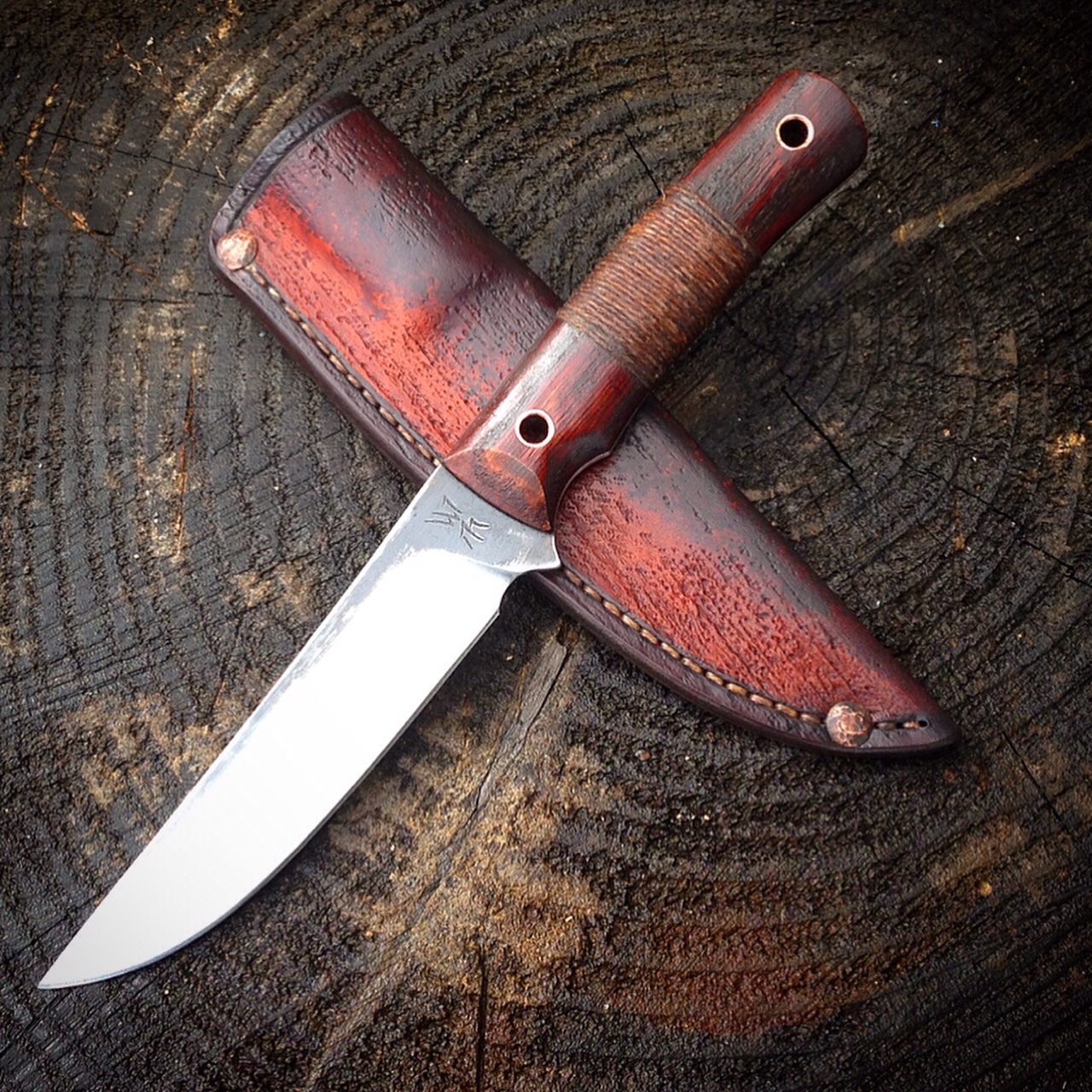
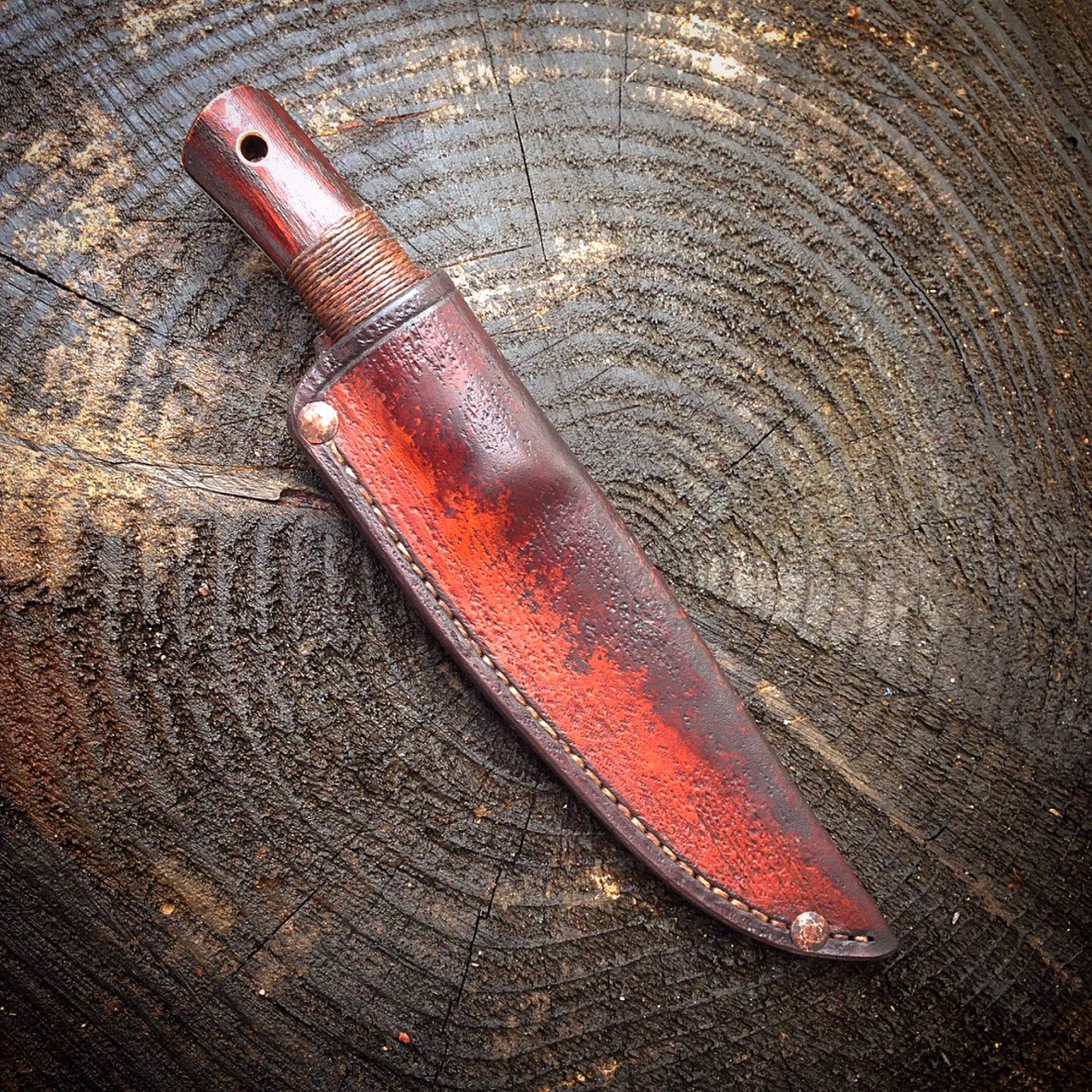
The one pictured here is my third attempt at making a sheath for this thing. I hate throwing away Hermann Oak leather. This latest iteration is also half lined with turkish calfskin.

On the sheath pictured above, I must visually guide the knife into the sheath, taking great care that it is headed in exactly the right direction. Otherwise the blade slices right through the welt, and cuts through the stitching too. I am looking for better ideas.
 
My thoughts are that perhaps, your welts are too thick. If your blade is 1/16" and your wellts are almost 1/4", there will be nothing to guide the blade in and center the edge on the welt. Hard to tell without seeing up close. I have made many trailing point sheaths. That is my first stab at your problem. It could be that the leather is too soft, as well but it sound like you have decent stuff.

Ask the guys in Sheaths n Such. I can't move this thread.
 
Make drawings on paper and cut out paper templates. See how the knife will travel and have room for the point to pass.
Have a look in the sheats section of this forum as well
 
Have a look at the sheath and picture the knife all the way in it.
There's a "dent" behind the point. That's your problem.
You followed the shape of the knife, but the widest part has to pass everything.
If the line from the point to the handle would have been straighter and more flowing you wouldn't have had this problem
 
OK. Lots of good ideas.

Sorry I didn’t think to post this in Sheaths n Such.
Maybe this would work:

43538273021_79d1b5602a_b.jpg
 
Last edited:
Perhaps a pouch sheath would be a better option?
 
Agreed

This trailing point of mine isn't quite as swept as yours but the folded pouch sheath is wet formed to guide the blade down the sheath on a fixed path.
2v2JW6RSyxAhgEC.jpg

2v2JW6RhNxAhgEC.jpg
It has lots of character too!
 
This trailing point of mine isn't quite as swept as yours but the folded pouch sheath is wet formed to guide the blade down the sheath on a fixed path.

And on my sheaths the welt helps guide the blade while protecting the stitching.
 
Heck that ain't a tough one. Yep taper your welt a little and you want approx. 3/8" clearance at the widest. Here's another little trick. Reinforce that welt where ya keep cutting the stitching with JB Weld (what Paul Long does ) or superglue (what I do ). Either will work and help a lot. Only a type away
 
Funny this topic comes up. I have a blade That is suffering from these same issues. Wife keeps bugging me to just get it finished and ship it out. But I have been scratching my head about the sheath.
Photo%20Jul%2021%2C%202%2031%2002%20AM.jpg
 
I suspect the welt isn't properly glued up.

Make sure you glue the welt to the outer layers solidly. I personally don't like barge/contact cement. I use leather Weld. Once dry, the layers become virtually one piece of leather. Then the stitching can't be cut without cutting through the welt first.
 
I suspect the welt isn't properly glued up.

Make sure you glue the welt to the outer layers solidly. I personally don't like barge/contact cement. I use leather Weld. Once dry, the layers become virtually one piece of leather. Then the stitching can't be cut without cutting through the welt first.


Bingo! This is exactly what I came to post. Your knife shouldn’t even be coming close to being in contact with the stitching. That’s the welts job. Make sure your welt is very well glued. Then the blade won’t slip into the groove between the welt and outer layers.

Also, you could move your stitching more towards the outside edge of the sheath. That way it would be further from edge/tip.
 
Funny this topic comes up. I have a blade That is suffering from these same issues. Wife keeps bugging me to just get it finished and ship it out. But I have been scratching my head about the sheath.

Hi JT, IMHO you can put a nice subtle curve in the sheath for a blade like that (great blade BTW). The pro's will probably chime in but I've made sheaths for some pretty extreme trailing points and they insert well with the curve. It doesn't match the blade shape exactly but kind of follows it, maybe a tad wider than normal if you see what I mean. You kind of insert it following the curvature, like a scimitar.

And I fourth the gluing of the welts both side, that's mandatory. I line up the pre punched holes with finish nails, apply the glue and press, easy peasy. I glue my welts to the back usually with finish nails aligning, then glue the fronts to the backs. Hope that helps someone.
 
When making a sheath (or saya) for a curved blade. I test the blade on a cardboard drawing to see if it can be inserted/removed properly. I draw around the blade and put pins along the line, then slide the blade in and out. I move the pins that bind until I get a smooth insertion/removal. I redraw the sheath using the new lines, and cut the welt the same.

On a saya I do it on the wood slab. I have become a fan of a three piece saya for blades with high curvature, as you can guarantee a proper fit before assembly.
 
Whole nuther thought would be to change your design. I was asked to build this sheath for this knife. The curved blade was not the difficultly, the width of the guard was. Tapered welt to the rescue. This is 8-10 oz Wickett and Craig and handled and has handled the trailing point well. As Stacy mentioned ya have to give it room.

oBb2RUb.jpg


l9hZUdI.jpg


WTSzOdI.jpg
 
Whole nuther thought would be to change your design. I was asked to build this sheath for this knife. The curved blade was not the difficultly, the width of the guard was. Tapered welt to the rescue. This is 8-10 oz Wickett and Craig and handled and has handled the trailing point well. As Stacy mentioned ya have to give it room.

oBb2RUb.jpg


l9hZUdI.jpg


WTSzOdI.jpg

That’s an interesting blade. At first I thought the guard was reversed to keep your thumb from slipping over the spine.
 
Don't know who made the knife. Friend of my customer is all I know.
 
Thanks, I've done a couple. That one has a belt loop on the backside by the fold so it has two attachment points. This allows the sheath to be carried crossdraw on the left side or butt forward on the right side.
 
Back
Top