

- Joined
- Aug 23, 2004
- Messages
- 382
In the late 1980s, Al Mar Knives introduced a multi tool called the 4x4 Tool Mate. It was a beautiful piece of work, elegant in design, which had a distinctly different look about it than the standard Leatherman or Gerber multi tools of the day. Ex-Green Beret Al Mar himself was still alive at this time, and was the major influence on everything his company produced. Al Mar knives and tools from this era are still highly coveted to this day.
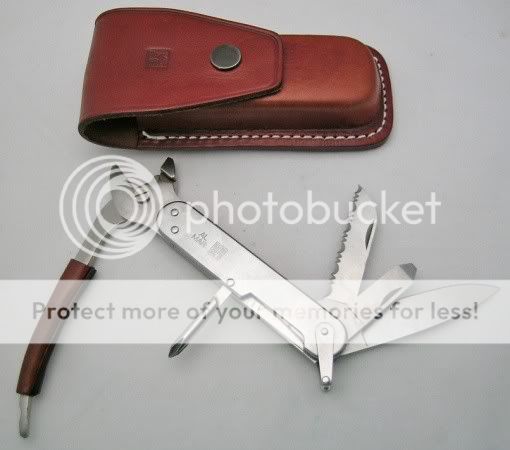
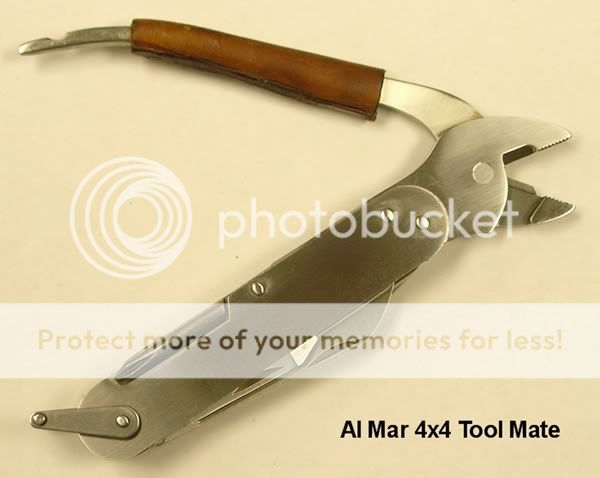
Like many Al Mar knives, the 4x4 Tool Mate (and its sister, the Quick Clip) was manufactured by Seki in Japan. Seki cutlery has a well-deserved reputation for superb quality, and these multi tools were no exception. Offering both a conventional 3 spear-point knife blade and a sheepsfoot serrated 2-3/4 blade, the 4x4 was well equipped to deal with any cutting related situation. The third blade was a combination standard screwdriver / file blade, while a Phillips screwdriver unfolded from the other side. The plier jaws themselves were short and stout, with plenty of leverage available from its long, leather-cushioned handle. A wide wire-cutter section was included on the plier jaws.
When introduced, the Al Mar 4x4 Tool Mate was advertised as being a design based upon the famous OSS Escape Tool of WWII. Famous it may indeed be, but I was (and still am) a bit uninformed about the precise details and history of the OSS Escape Tool. I invite those who are more knowledgeable to please weigh in, but here is what Ive been able to piece together so far:
Sometime around the beginning of the last century, the famous British cutlery company of Joseph Rodgers & Sons introduced a convenient-sized clasp knife that included a set of heavy duty wire cutters. Proudly wearing the Star and Maltese Cross mark of the firm, this multi function clasp knife was decades ahead of its time. Not surprising, given its place of birth. Sheffield, England was a city of knife makers, and Joseph Rodgers & Sons in particular was world renowned for its quality and innovation. Each knife produced was labeled Joseph Rodgers, Cutlers to His Majesty. (Or Her Majesty, as the era dictated.)
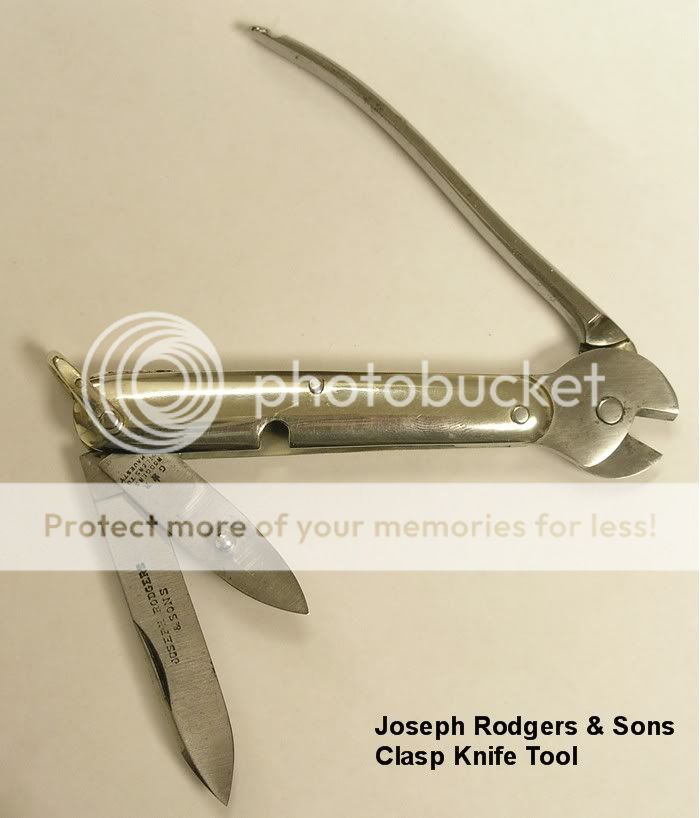
This Clasp Knife Tool was ruggedly constructed, built for serious duty in a rough world of conquest and exploration. A 3-inch spear point with a heavy cross section was its main blade, complimented by a rather short blade sporting a thumb stud. With only about one inch of grind, along both edges, this short blade can be rather puzzling to us 21st century folks. Ive been told that its purpose was as an opener for canned foods, specifically the standard tins of British bully beef." (Keep in mind that, ironically, canned foods were around long before the invention of the can opener!)
The wire cutter mechanism was a massive device of the bypass type construction. Expected to become dull or notched far from civilization, it was designed to allow for sharpening in the field. Simply open the jaws wide enough and touch up the cutting surfaces with a file or grinder, a process which cannot be done on anvil type cutters. The jaw handle was kept secured in the closed position by means of a sturdy cast bail.
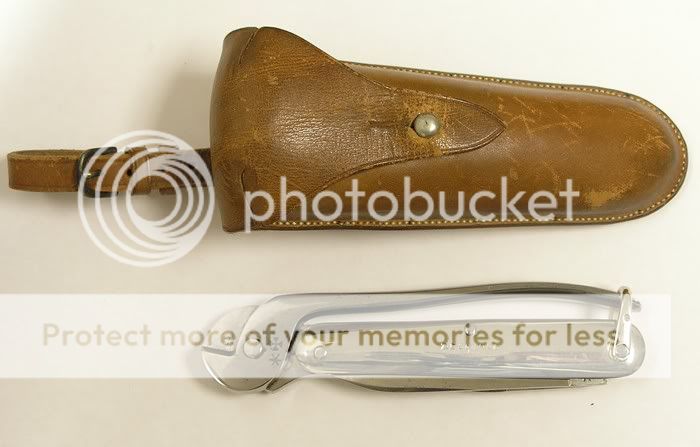
The side panels and bail are made of nickel bronze, while the wire cutter jaws, handle, liners, and knife blades are all constructed of hardened steel. With no such thing as stainless steel, and nickel electroplating in its infancy, all steel surfaces are bare and exposed to the elements. A Joseph Rodgers Clasp Knife Tool with shiny, untarnished surfaces these days is a rare jewel indeed.
Not surprisingly, the tool found some favor amongst the troops and engineers of World War I. Never a standard issue item, Ive been told that many soldiers simply purchased their own, then kept them handy at the front. Which no doubt contributed to the next evolution of this device, the OSS Escape Tool.
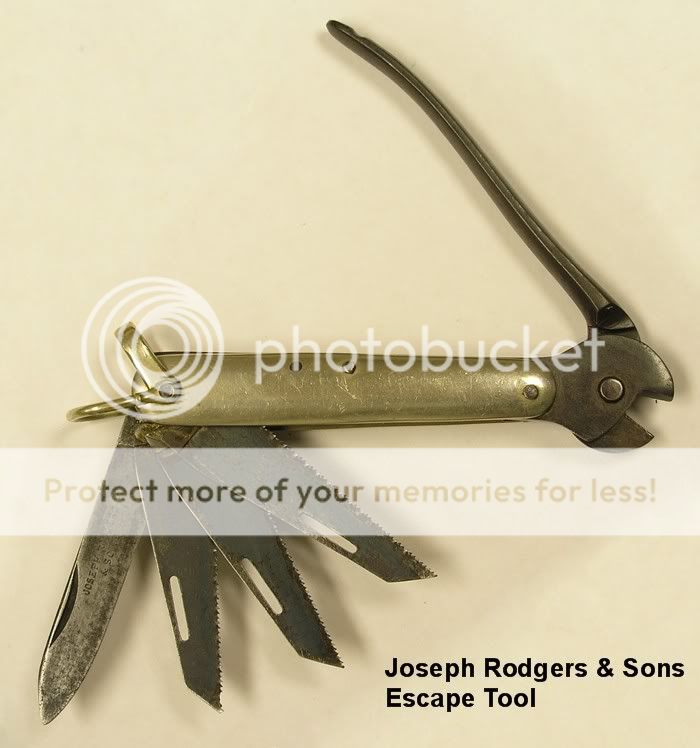
Issued during WWII to the OSS and SOE, the origin of the tool has been the subject of some debate. While I have heard mention of Wild Bill Donovan, most sources credit the development of this tool to Major Clayton Hutton, who devised it for the British MI-9. It retains the obvious wire-cutter chassis of the earlier Clasp Knife Tool, but with one minor and one major improvement. The minor change is in the surface finish, which went from shiny bare steel on the Clasp Knife, to a non-reflective black oxide finish on the Escape Tool.
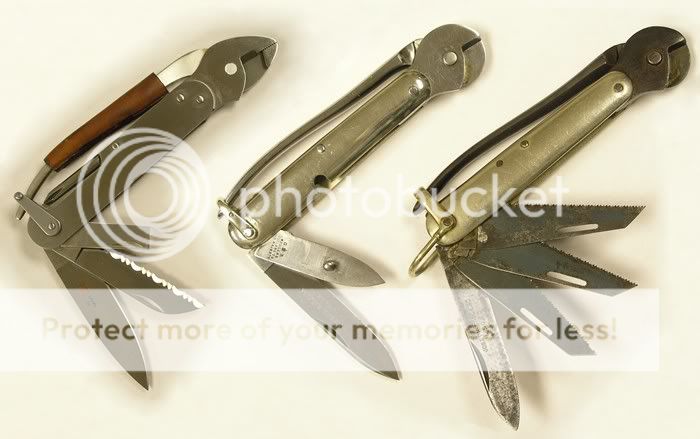
The major change is in the blade selection. Instead of the short can opener tool, a bouquet of three metal-cutting hacksaw blades has been substituted. All three saw blades are identical. But why three identical saw blades? My friends, we are spoiled in this age of diamond files and quick-disconnect blade exchangers. Sixty years ago, hack saw blades didnt hold up as long, and there was no ready replacement. When you were trying to cut your way through a chained gate, and the Germans were close behind you, there was no time to waste. When one blade got dull, simply fold it away and bring out the next one. A simple solution to a serious problem.
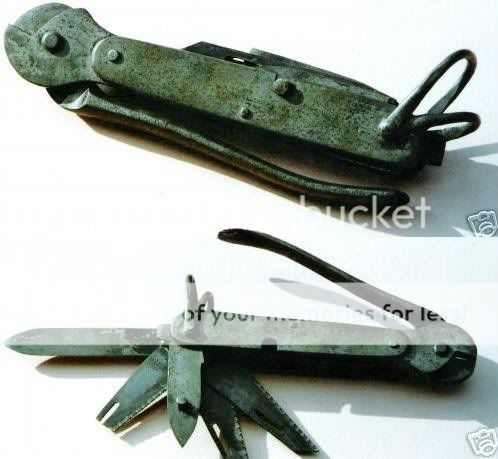
There are variations of the OSS Escape Tool. Note this model, while a bit rough and corroded, is equipped with the spear point master blade, the short can opener punch, AND the three hacksaw blades. Furthermore, in addition to Joseph Rodgers, these devices were also produced during the war by the George Ibberson firm, also of Sheffield, England.
Manufactured at No 6 Norfolk Street for almost half a century, these early multi tools certainly have a rich and colorful history. I only wish the ones in my collection could talk!
~Bob
Like many Al Mar knives, the 4x4 Tool Mate (and its sister, the Quick Clip) was manufactured by Seki in Japan. Seki cutlery has a well-deserved reputation for superb quality, and these multi tools were no exception. Offering both a conventional 3 spear-point knife blade and a sheepsfoot serrated 2-3/4 blade, the 4x4 was well equipped to deal with any cutting related situation. The third blade was a combination standard screwdriver / file blade, while a Phillips screwdriver unfolded from the other side. The plier jaws themselves were short and stout, with plenty of leverage available from its long, leather-cushioned handle. A wide wire-cutter section was included on the plier jaws.
When introduced, the Al Mar 4x4 Tool Mate was advertised as being a design based upon the famous OSS Escape Tool of WWII. Famous it may indeed be, but I was (and still am) a bit uninformed about the precise details and history of the OSS Escape Tool. I invite those who are more knowledgeable to please weigh in, but here is what Ive been able to piece together so far:
Sometime around the beginning of the last century, the famous British cutlery company of Joseph Rodgers & Sons introduced a convenient-sized clasp knife that included a set of heavy duty wire cutters. Proudly wearing the Star and Maltese Cross mark of the firm, this multi function clasp knife was decades ahead of its time. Not surprising, given its place of birth. Sheffield, England was a city of knife makers, and Joseph Rodgers & Sons in particular was world renowned for its quality and innovation. Each knife produced was labeled Joseph Rodgers, Cutlers to His Majesty. (Or Her Majesty, as the era dictated.)
This Clasp Knife Tool was ruggedly constructed, built for serious duty in a rough world of conquest and exploration. A 3-inch spear point with a heavy cross section was its main blade, complimented by a rather short blade sporting a thumb stud. With only about one inch of grind, along both edges, this short blade can be rather puzzling to us 21st century folks. Ive been told that its purpose was as an opener for canned foods, specifically the standard tins of British bully beef." (Keep in mind that, ironically, canned foods were around long before the invention of the can opener!)
The wire cutter mechanism was a massive device of the bypass type construction. Expected to become dull or notched far from civilization, it was designed to allow for sharpening in the field. Simply open the jaws wide enough and touch up the cutting surfaces with a file or grinder, a process which cannot be done on anvil type cutters. The jaw handle was kept secured in the closed position by means of a sturdy cast bail.
The side panels and bail are made of nickel bronze, while the wire cutter jaws, handle, liners, and knife blades are all constructed of hardened steel. With no such thing as stainless steel, and nickel electroplating in its infancy, all steel surfaces are bare and exposed to the elements. A Joseph Rodgers Clasp Knife Tool with shiny, untarnished surfaces these days is a rare jewel indeed.
Not surprisingly, the tool found some favor amongst the troops and engineers of World War I. Never a standard issue item, Ive been told that many soldiers simply purchased their own, then kept them handy at the front. Which no doubt contributed to the next evolution of this device, the OSS Escape Tool.
Issued during WWII to the OSS and SOE, the origin of the tool has been the subject of some debate. While I have heard mention of Wild Bill Donovan, most sources credit the development of this tool to Major Clayton Hutton, who devised it for the British MI-9. It retains the obvious wire-cutter chassis of the earlier Clasp Knife Tool, but with one minor and one major improvement. The minor change is in the surface finish, which went from shiny bare steel on the Clasp Knife, to a non-reflective black oxide finish on the Escape Tool.
The major change is in the blade selection. Instead of the short can opener tool, a bouquet of three metal-cutting hacksaw blades has been substituted. All three saw blades are identical. But why three identical saw blades? My friends, we are spoiled in this age of diamond files and quick-disconnect blade exchangers. Sixty years ago, hack saw blades didnt hold up as long, and there was no ready replacement. When you were trying to cut your way through a chained gate, and the Germans were close behind you, there was no time to waste. When one blade got dull, simply fold it away and bring out the next one. A simple solution to a serious problem.
There are variations of the OSS Escape Tool. Note this model, while a bit rough and corroded, is equipped with the spear point master blade, the short can opener punch, AND the three hacksaw blades. Furthermore, in addition to Joseph Rodgers, these devices were also produced during the war by the George Ibberson firm, also of Sheffield, England.
Manufactured at No 6 Norfolk Street for almost half a century, these early multi tools certainly have a rich and colorful history. I only wish the ones in my collection could talk!
~Bob


