Cherry Burl

DanF

Knifemaker / Craftsman / Service Provider
Joined
Apr 17, 2017
Messages
1,523
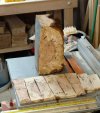
This is a small bit of the cherry I cut back during the winter, wanted to see how it was doing. Will repaint the big piece and let sit another 6-8 months. The chunk is 6x5x12. It has lost at least 40% of it's weight (that's a guess). Need to pick up a moisture meter.
IMG_20180721_100331.jpg
Is there a "best"direction to saw something like this?
 
Yep, there surely is a "best" direction to cut..... and it varies all depending on grain and what it looks like. I don't think I'd saw into scale thickness until it was ready for use. Scale thickness sometimes tends to warp a bit when drying. Do you plan to have those stabilized? OR home stabilized with something like Cactus Juice?

Good looking cherry
 
Incidentally, probably the best way to tell if your wood is dry is to use weight. Weigh it every month, and when it stops loosing weight, it’s as dry as it’s gonna get.
Unless you use heat.
 
I have used a food dehydrator for the final drying of my maple blocks before sending it out to K&G, but only after letting them sit for a while, if they dry too quick cracking is more likely.

Regarding best direction to cut, it depends on what you want. If you want to maximize your aesthetics, I'd cut it like this shooting for 1 1/4"+ slabs. (Not sure how big your block is.) I guess you could just cut 1 1/4" slabs parallel to what you've got and not angle them like I did and get the same look.
WFd73aC.jpg


To maximize your pieces, just continue to cut it like you are. To maximize the strength, the more parallel the grain is to the axis of the handle, the stronger. There's some debate as to whether it matters for scales because of the epoxy. My take on this is that danger is prior to epoxying, but one they are on the knife, you're good. But I do mostly kitchen knives.
 
Thanks all, I'll be sending it to k&g for stabilizing.
I guess based on what I read today I need to move the big blocks inside now to facilitate further drying. They are at around 18-19% MC, which is as dry as they will get outside. Bringing them inside should take them down to 10-12%, if the article I read was correct. I guess then I'll have to consider manipulating the MC indoors to drop it further than that.
Again, thanks!
 
Dan those numbers do not sound right. For the wood to dry all it can and still be 18-19% it will have to be kept in an enviroment that is 85-90% humidity, here in NC wood can get to 12% outside Arizona gets lower than that. There is a chart about halfway down this page that will give you an idea what the humidity needs to be to finish drying. http://www.lonniebird.com/wood-moisture-content-by-lonnie-bird/
 
Thanks for the link, I'll go through my search history tomorrow and find the article I read and compare the two articles and post what I find. May be operator error on my part.
 
Also, if the ambient humidity varies during the year, the wood will as well.

Another thing that helps for the final drying is a small space heater, like folks put under a desk.
 
For drying, that depends on a lot of factors. Where it was, was it waxed, was the tree cut when the sap was up or down?

As for how to cut it, i made a short series of videos on my instagram about cutting burl, and i wrote a few articles on the bladeforums about it was well.

Essentially, you want to cut parallel to make a tangential cut to the surface of the tree at the burl. I know that isnt very helful, but if you look through my post history i have articles, or if you want to call me and discuss it my number is 310-963-9852
 
Okay, I found the article and will try to link it. I got the numbers skewed in my head but after testing everything this morning I think I need to move the blocks to a dryer location. Currently they are stored under my shop off the ground to allow air circulation. I have other pieces of wood there( kiln dried boards), that are registering 15-16% MC. Those boards have been there almost 3 years. Inside my shop, I have stacks of maple and Walnut that register 5-7%, and have been there only a year or less.
If what I'm reading in the article is correct, at 18-19%, the "damaging" effects of rapid moisture loss should have already happened, as the article states that once it is at 18-19%, cracking and warping are not as prevalent (but I'm not going to risk it and I won't cut any more blocks into blanks/scales until I hit around 12%). Here's the link (I hope).
http://cwc.ca/design-with-wood/durability/durability-hazards/about-moisture-and-wood/
If I'm thinking right, the location of my blocks and lumber are a contributing factor to their MC. Also, looks like my blocks need more time to reach what the lumber There reads for MC. And this IS a very damp location and looks like I need to move everything under there. (Maybe plastic ground cover might help similar to a house crawlspace?).
@greenburgwoods, I'll check out your articles, thanks for the offer, much appreciated.
And thanks to all for the input, it is very appreciated!

 
Right, when the wood reaches 18% the chances of the wood developing new cracks are greatly diminished. (there may be cracks that are already there that wont show until the moisture level gets to 8-10% because the wood is still "swollen")
But I disagree with Ben - It does not matter where it was or if it was waxed or if the moon was full. The environment your wood is kept in is what determines the moisture content. Look at that chart I linked to and you will see what humidity you need to get to the moisture level you want.
You have wood that was kiln dried and was at that time around 8% and you have kept it in a wet environment and it is no longer kiln dried. If you move the wood back to your shop in time it will all be 5-7%
If it was me I would go ahead and move it all inside the shop.
 
Right, when the wood reaches 18% the chances of the wood developing new cracks are greatly diminished. (there may be cracks that are already there that wont show until the moisture level gets to 8-10% because the wood is still "swollen")
But I disagree with Ben - It does not matter where it was or if it was waxed or if the moon was full. The environment your wood is kept in is what determines the moisture content. Look at that chart I linked to and you will see what humidity you need to get to the moisture level you want.
You have wood that was kiln dried and was at that time around 8% and you have kept it in a wet environment and it is no longer kiln dried. If you move the wood back to your shop in time it will all be 5-7%
If it was me I would go ahead and move it all inside the shop.

My questions of where was about the ambient humidity. If he was in say, British columbia, wood drys more slowly than in say, Arizona or Texas.
 
My questions of where was about the ambient humidity. If he was in say, British columbia, wood drys more slowly than in say, Arizona or Texas.

I know this one. My bro in law lives in Edmonton. When I put my moisture meter on "dry wood" there he can get down around 8%. Where I live on the coast in BC best I can do is around 11-12%.

Also how they are prepped does seem to affect how quickly they dry. The general rule of thumb is 1 year/inch of thickness for slab lumber if you are air drying it. But I noticed with stuff that I have waxed the ends on it seems to be a bit longer. But there are so many factors like Ben mentions. I had some cherry that was cut when the sap was running....absolutely soaking wet. I cut it into 2" thick slabs. Even with the ends waxed it warped and cracked like crazy and I got nothing useable out of it. If I get some more I am going to leave it as a log for a year first before slabbing.
 
I know this one. My bro in law lives in Edmonton. When I put my moisture meter on "dry wood" there he can get down around 8%. Where I live on the coast in BC best I can do is around 11-12%.

Also how they are prepped does seem to affect how quickly they dry. The general rule of thumb is 1 year/inch of thickness for slab lumber if you are air drying it. But I noticed with stuff that I have waxed the ends on it seems to be a bit longer. But there are so many factors like Ben mentions. I had some cherry that was cut when the sap was running....absolutely soaking wet. I cut it into 2" thick slabs. Even with the ends waxed it warped and cracked like crazy and I got nothing useable out of it. If I get some more I am going to leave it as a log for a year first before slabbing.

I was actually wrong about the idea of the sap running, most modern lumber wrights agree that this doesnt effect moisture content. It can however effect color and easy of drying, but not time.

As for the wax, that is how cracking is avoided. Basically, moisture escapes from the end grain far more quickly than from face grain, and as the moisture level changes, the wood shrinks and this can cause stress leading to cracks, checks and splits. By waxing the ends, the total moisture rate is cut greatly, allowing a slow and more controlled drying. It also lets water evaporate evenly from the whole face of the board, rather than quickly leaving through end grain leading to the splits and cracks that are commonly found on the ends of boards.
 
IMG_20180731_105825.jpg
I moved the remaining large blocks into the shop last week, the smaller blanks were moved in to my instrument room where I keep a dehumidifier on constantly.
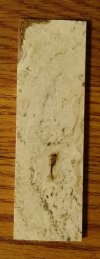
This is the smallest piece of that group, after trimming and milling flat on a flycutter, I have a scale a little over 5"x1-13/16x3/8" thick. Right now it is reading 6.5% MC.
 
surfacing a wood scale with a fly cutter? I'd never even considered that. With metal clamps against the side, does it hold the wood ok? OR - how do you clamp wood to mill table for fly cutting? Superglue to a metal plate?
 
Use a vise and parallels to raise the ftop of the scale above the top of the vise, vise jaws grip the scale. Quick, easy and true.
 
A flycutter works on burl like the cherry. On Koa they do a LOT of tear out. I made a jig to go on my surface grinder to hold scales. No tear out.
 
Helical head planer or jointer will do for anything that isn't punky. Occasionally minor tearout with extreem burls. Perfect finish on anything stabilized. Just use a slow, controlled feed and pay attention to grain direction.
 
Back
Top