

eisman
Platinum Member
- Joined
- Sep 9, 2009
- Messages
- 7,025
Experiences with auction sites opened my eyes to the number of people who rebuild (or remake) knives. While I'm not at that poit (no shop, minimal room) I have found that cleaning and working around with the knives I can find at "bargain" prices has taught me a thing or two.
Currently I have a small ultrasound tank that's taken my fooling around to a new level. It's amazing how much junk I can get out of a knife with this gadget. Currently the best regimen I've found is to soak the knife in mineral oil between bouts in the tank. This works for most (but not all) specimins. Wood handles do not react well to such treatment. Some artifical stuff does poorly too.
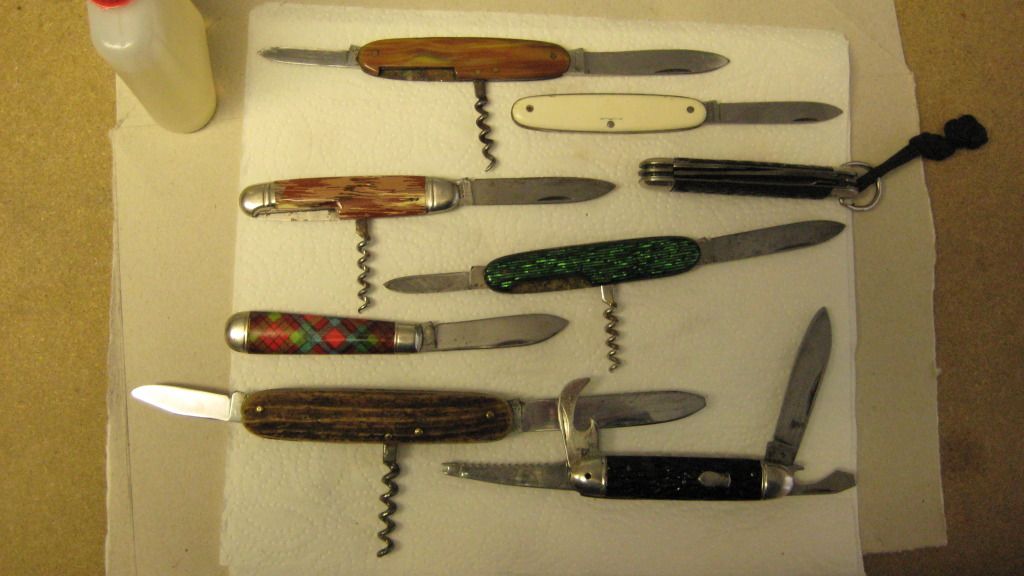
But most knifes get tremendous results from this treatment. The following are a few examples from a flea market crawl last month.
first is this Imperial. It's an inexpensive model with the pressed metal scales. Still, and nice size and pattern except for the rust.

A couple weeks later after a couple cycles throgh the cleaner and with the appliction of a little Flitz and Tri-Flow and it's a pretty nice little pocket knife. Needs an edge, but when I decide to watch TV that'll get fixed too.

Here's what the machine looks like after a couple knives. It's been settling for a while to clear the liquid, but you can get a good idea of the amount of material left behind.

This Case Trapper was stiff to open and had no spring play at all; no lock, no snap, nothing. My guess is it spent a fair amount of time in a tackle box, and around here that means saltwater. The original owner had used a wheel to remove some of the rust, but all he really did was mess up the grind lines.

I reworked the blades with files and stones so they're square and straight, and killed of the rust in the pitting. Vinegar does a nice job on stopping rust, but turns carbon blades very black. Still, it does not work as well as modern cleaners developed for steel at lifting rust. I tried severa different solutions on this knife over a couple weeks time. With a lot of soaking and a fair amount of exercising the blades (open/close) with heavy oiling it's now got nice snap and pulls at about a 5. I put the patina back on; I think it looks good against the yellow scales.

This next one was tricky; the celluliod scales have been pocket worn an amazing amount. When I picked this up the main blade was the only one that would move. The rust was bad. I'm not sure if this was because of the celluliod or not, but the blades have very little worn away by sharpening (discovered when finally open).

I had to use some less aggressive solutions to break this one free, but it finally let me see all three blades out in the open. The makers mark is Iroquois, Utica, NY. The main blade needed a little profile work due to a nick in the edge, and it needs sharpening, but it's usable again, and that makes me feel good.

Now that the rainy season is here I'll be doing a lot more like this and then digging through the books just to see what I can find on each. New knives (like the Case) are OK, but the old ones are more fun to play with.
Currently I have a small ultrasound tank that's taken my fooling around to a new level. It's amazing how much junk I can get out of a knife with this gadget. Currently the best regimen I've found is to soak the knife in mineral oil between bouts in the tank. This works for most (but not all) specimins. Wood handles do not react well to such treatment. Some artifical stuff does poorly too.
But most knifes get tremendous results from this treatment. The following are a few examples from a flea market crawl last month.
first is this Imperial. It's an inexpensive model with the pressed metal scales. Still, and nice size and pattern except for the rust.
A couple weeks later after a couple cycles throgh the cleaner and with the appliction of a little Flitz and Tri-Flow and it's a pretty nice little pocket knife. Needs an edge, but when I decide to watch TV that'll get fixed too.
Here's what the machine looks like after a couple knives. It's been settling for a while to clear the liquid, but you can get a good idea of the amount of material left behind.
This Case Trapper was stiff to open and had no spring play at all; no lock, no snap, nothing. My guess is it spent a fair amount of time in a tackle box, and around here that means saltwater. The original owner had used a wheel to remove some of the rust, but all he really did was mess up the grind lines.
I reworked the blades with files and stones so they're square and straight, and killed of the rust in the pitting. Vinegar does a nice job on stopping rust, but turns carbon blades very black. Still, it does not work as well as modern cleaners developed for steel at lifting rust. I tried severa different solutions on this knife over a couple weeks time. With a lot of soaking and a fair amount of exercising the blades (open/close) with heavy oiling it's now got nice snap and pulls at about a 5. I put the patina back on; I think it looks good against the yellow scales.
This next one was tricky; the celluliod scales have been pocket worn an amazing amount. When I picked this up the main blade was the only one that would move. The rust was bad. I'm not sure if this was because of the celluliod or not, but the blades have very little worn away by sharpening (discovered when finally open).
I had to use some less aggressive solutions to break this one free, but it finally let me see all three blades out in the open. The makers mark is Iroquois, Utica, NY. The main blade needed a little profile work due to a nick in the edge, and it needs sharpening, but it's usable again, and that makes me feel good.
Now that the rainy season is here I'll be doing a lot more like this and then digging through the books just to see what I can find on each. New knives (like the Case) are OK, but the old ones are more fun to play with.


 I really like that - I have such an ultrasonic but I wouldn´t be allowed to use it; my wife needs it to clean her glasses (oil wouldn´t be a favorite then...)


 )
)