Cliff Stamp: please your opinion

Joined
Apr 2, 2005
Messages
496
I've to regrind my Bradley Alias II. S30V at 58-60HRC and 25° per side bevel.
It should be meant for general utility usage and trekking usage (cutting ropes, cardboard ...). I was thinking about a 20° bevel (per side) and a DMT fine (red) finishing. I should not face chipping problems, right? Should I stay at DMT Coarse (Blue) or Extra Fine (Green) instead?

TIA
 
Slicing ropes, cardboard and other similar materials, x-coarse DMT works well as does the 90 grit x-coarse side of cheap hardware stones, essentially you just go with the lowest abrasive. This has to be very sharp, shave and push cut newsprint. Often you just need aggression initially. On cardboard you need a really high sharpness to start the cut because there is no tension holding the cardboard rigid at the edge of the sheet but once you get into the sheet the blade can zip along much easier, a lot of materials are like that.

This suggesta more versatile methods of sharpening is to leave the very first part of the blade, an inch or so, with a really coarse finish to enable starting cuts on difficult materials, and raise the rest of the edge up to a higher polish to allow the tip and belly of the blade able to do push cutting without the high resistance you will feel from a x-coarse edge, Joe Talmadge popularized (invented) this dual edge configuration. This also allows you to check out both finishes and see which one you tend to use most. If all you want to do is aggressive slicing then you can leave the entire edge very coarse.

The angle doesn't need to be near 20 degrees to cut such materials or even harder ones like woods and plastics. You generally only need to go over 15 if you want to chop into metals or do really aggressive cutting of bones (chopping or twisting). On cardboard and ropes and other such materials there is really no lower bound on cutlery grade steels. I run all mine flat to the stone or close to it, but this will readily damage the finish. I would suggest a 15/20 primary/micro to start, if that is damaged in the use you describe the steel is horribly defective. A 10/15 profile is even overkill for that use but that profile will dramatically change the appearance of the knife and is probably best worked down to because it will drastically change how the knife actually handles..

You will also find that as you decrease the edge angle you will start to see more aggression at high polishes, this is because the size of the tooth that is left by a specific grit increases as the edge angle is reduced (basically linear), and the overall cutting ability is greatly increased, thus you don't need to use as coarse a finish to get very high slicing aggression. As an extreme example, my primary use cutting knives usually have 3/6 degree edge profiles and are finished usually with the x-fine DMT, they blaze through cardboard, ropes and woods. However on the more heavily edged knives, like the Ratweiler which is at about 17 degrees per side, I leave about an inch near the choil with a really coarse finish, 90 grit AO lately, and the same through the tip, and polish the rest of it up to 0.5 micron chromium/aluminum oxide for push cutting, mainly chopping.

-Cliff
 
Thanks Cliff.
I'll start with a 20 primary *side going with DMT coarse (not x-coarse).
The I'll try the Red DMT at same angle.
My understanding is that I could never go at 15 due to blade geometry: please go here to get what I mean
http://www.bradleycutlery.com
The EDC use includes some plastic wire cutting and some electric wire cutting too: would you recommend further hints for that?

Cheers
 
bbcmat said:
Cliff - are these x/y degree reference points total or per-side?

Per side, primary/micro bevel.

daberti said:
My understanding is that I could never go at 15 due to blade geometry:

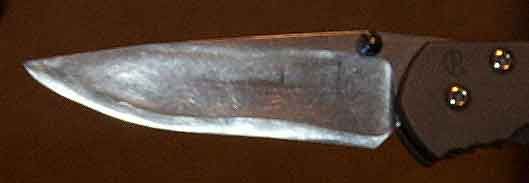
From the pictures, assuming a primary grind close to 0.125x0.75, the primary grind is about 5-7 degrees per side, this then is the minimum you can sharpen and would have you working the entire primary grind, not very efficient, though 15 per side would be easily possible, the stud could get in the way though so you have to angle the knife.

The EDC use includes some plastic wire cutting and some electric wire cutting too

Plastic and wire both work better with higher polishes, plastic doesn't require much in the way of edge cross section unless you are doing something drastic like trying to baton it through a sheet of thick material. If you can cut it by hand without excessive torque you can go really low, I cut it all the time with my small Sebenza, 5 gallon buckets and the like. Wire cutting can be very demanding depending on the wire, method is really critical.

Cutting metals you need to prevent edge torque, partial cuts are the problem. If you try to push cut through the wire on a piece of wood (or whatever) and the blade gets halfway through and then stops, it will twist in the wire. TV cable is bad for this because it has a soft outer core and a hard inner piece of copper so when you try to cut it, the core squats against the side and twists.

If you are cutting wire like that, do it against something hard and make the cut in one sudden push. I would in general not go under 15 per side for that type of work unless you had a hard tool steel and were careful to avoid side torques. At 20 degrees per side you should be able to be really sloppy and have no damage.

With the tasks this different (cardboard/ropes vs wire) you either have to choose sharpening to suit the most demanding one, accept damage if you pick the less demanding one or run a dual profile and use differnet parts of the blade for each task. Or of course carry more than one knife.

-Cliff

 
Ok. Current sharpening status: finished with DMT Coarse (blue).
Angle: 23.3 (just primary) or the thumbstud will get into way. From what I can see factory sharpening was at more than 25.
Test cut: synthetic climbing rope, 1/2" . From heel to beginning of the belly (the curve in fornt of the blade, if I'm not wrong) I nearly push cut the rope with very slight force applied.
State of the cutting edge: under direct artificial light it looks like there is a teensie weensie of burr. Very very very slight.
I could go in one of these ways:
1)Next degree mark (26.6) with 3 light strokes of DMT Blue or Red (which in case?)

2)Slightly moving the blade (vertically) against/into a flat piece of wood.

What?

Thanks
 
daberti said:
Angle: 23.3 (just primary) or the thumbstud will get into way.

This is a problem with studs, if you are not careful you can grind into them, you can work around it. This is a Sebenza which is usually sharpened flat to the stone, so the angle is about three degrees per side :

small_sebenza_reground.jpg


you have to hold the blade on a slant across the stone so the stud never makes contact.

1)Next degree mark (26.6) with 3 light strokes of DMT Blue or Red (which in case?)

Cutting it off on the stone is usually the best choice, try a few passes, if this doesn't work, then you have three options, the simplest one is to just use a few more passes, this works sometimes but often you have to try a higher angle and/or recut the edge at the primary angle and try again. Which angle depends on what you want, the DMT blue will give better cutting on cardboard and rope and the fine will handle plastics and wire better.

Slightly moving the blade (vertically) against/into a flat piece of wood.

It is often recommended to break of the burr by cutting cardboard or wood, I really don't understand the reasoning with that, the steel just fractures and both cracks off fresh steel and squashes against it in sections. It will remove the burr but it does not leave optimal sharpness. You can of course go back to the stone and try to resharpen, but this tends to reform a burr anyway. The only reason to do this generally is on really low end steels which form really wide burrs, I have seen them ~1/16" wide, often it is most efficient to form the angle, grind straight into a stone to remove the burr and then reset the edge. This can also happen on really heavily used knives where the edge has been weakened by a lot of high impact work.

-Cliff
 
Thanks Cliff.
I'll go Blue with a couple passes each side, one each time.
Just wondering if 26.6 will decrease noticeably cutting performances.
Time will tell
 
Generally if you keep the passes low it will have an insignificant effect. You are basically applying a very tiny bevel about 10-20 microns wide so it effects a tiny fraction of the edge.

-Cliff
 
Cliff Stamp said:
Generally if you keep the passes low it will have an insignificant effect. You are basically applying a very tiny bevel about 10-20 microns wide so it effects a tiny fraction of the edge.

-Cliff

Done. Cuts rope and cardboard like butter.

Edited at 21:20 Italian time: a careful analysis had shown that going Blue 26.6 raised a burr in just one stroke per side. Thus I had to go with one additional stroke per side with Red (always at 26.6).

Thanks again Cliff
 
Back
Top