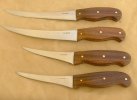
Cocobolo kitchenknife

Hengelo_77

Basic Member
Joined
Mar 2, 2006
Messages
6,314
I have a kitchen knife with a cocobolo handle almost finished here.
It has a bone 'guard' and a cocobolo handle. The wood is beautifull but also has pores.
Will it be unhygienic to use a pored wood handle in a kitchen?

Sanding the handle left fine dust in the pores. Shoud I flush it out with water or do you guys have other tips?
 
Good questions; cocobolo is good-looking, durable and popular, so this thread will be helpful.

Will it be unhygienic to use a pored wood handle in a kitchen?

Just keep it clean.

I haven't worked with any cocobolo, so I can't say if this technique will work for certain: with rosewood and walnut, I like to sand it while it has a coat of Danish oil on it. The sanding dust/oil slurry helps fill up the pores. When the oil sets up, the pores are sealed. It takes a few "coats" but you can get a nice smooth finish that way. Again, I don't know how well those types of oil finishes will cure on cocobolo, but I'm sure someone with experience with it will comment.
 
Good questions; cocobolo is good-looking, durable and popular, so this thread will be helpful.


Just keep it clean.

I haven't worked with any cocobolo, so I can't say if this technique will work for certain: with rosewood and walnut, I like to sand it while it has a coat of Danish oil on it. The sanding dust/oil slurry helps fill up the pores. When the oil sets up, the pores are sealed. It takes a few "coats" but you can get a nice smooth finish that way. Again, I don't know how well those types of oil finishes will cure on cocobolo, but I'm sure someone with experience with it will comment.

Thnx. I believe cocobolo is a rose wood but I may be wrong there.
I went from gritt 120 up to 2500. At what stage should the oil be applied?
Will boiled linseed also do?
 
At what stage should the oil be applied? when you're close to final dimensions and are looking to put the final finish on
Will boiled linseed also do?I would think so, but I don't know for certain

I hope this helps. When in doubt, try it on a scrap piece.
 
Cocobolo is a great handle material, the natural oils help prevent water from pentrating and keep it from drying out.. Wood handles in the kitchen have been around long before any type of plastic or stabilized material and should not pose a problem, I typically sand to 400, after that I really don't see much benefit for the work, mostly alot of clogged sandpaper. I like any oil that will harden and boiled linseed is a good one. Use a light coat let it set for a few minutes and rub it all off. Thick coats tend to turn to a mess that is hard to wipe off. Let it dry for 30 minutes or so and put on more coats


View attachment 249583
 

Attachments

  • Fillet july -09 020.jpg
    Fillet july -09 020.jpg
    38 KB · Views: 40
Last edited:
I've worked with a lot of Cocobolo. Yep it is a true rosewood (Dalbergia retusa). I'm not sure about the hygienic side of your question, leave that to others. But as said above by Mr Terrio keep it clean and it won't be a problem. I've tried and RESEARCHed finishing coco extensively. Most finishes simply won't dry on it because of the oil already in the coco. I've tried Danish oil, Tung oil, Tru oil etc. Just don't work. If ya want to fill those pores use several coats of super glue sanding between coats. Superglue will dry on coco. There are several threads here on BF about superglue finishes. If ya want to go that route ya sure can and it works very well but the superglue also makes a great sealer for filling those pores. Then final sanding and a little buffing and your coco will glow. Most of the time I don't seal those pores anymore, I use to but not much anymore.
 
I didn't use any oil or sealant just hand finished it to 2500 and it glows! Those colour seem to flame!
I don't mind the pores I was just wondering about bacteria growing there.
I'll try the superglue next cocobolo project.
 
I typically sand to 400, after that I really don't see much benefit for the work, mostly alot of clogged sandpaper.

View attachment 249583


Wow, only 400?

I think if you take a piece sanded to 400 then take a similar piece and wet sand it from 600 to 1000-2000 you'd be pleasantly surprised at how much the wood comes alive. Sure it's a fair amount of extra work, but it's like the wood transforms when you hit 600, then starts glowing at 800. At 1000 it really looks nice then a finisher of 2000 gives it that final touch.
 
I'm about to do a cocobolo handle and was planning to hand-buff it with warm beeswax. Does this seem like a good idea? I'll boost the planned finish grit based on this thread.

-Daizee
 
On the food channel I watched a show where they tested cutting boards. I think it was Alton Brown but I may be mistaken. Anyway they cut up food on plastic and wood cutting boards, washed the boards with different methods, and did a little testing wth petri dishes to determine bacteria survival rates. The wooden cutting boards had the least bacterial growth on the plate samples after being allowed to air dry. The assumption they made was that the pores actually helped to trap the bacteria where they eventually died. I would think that this would also apply to knives with wood handles.
 
I did several coco handles up to 12,000 grit. They really glowed but almost too slippery. Backed them back down to about 2,000 on alot and that really brings out the appearance without being so smooth as to be not practical. Sure like to see the knife Hengelo.
 
One thing I'm a bit concerned with is that cocobolo is rated highly toxic, from what I've been told. I don't know exactly how the toxicity functions beyond it being really bad to inhale the dust and such. But I'm a bit concerned about using those on kitchen knives (not that it stopped me; I've got a cleaver WIP that I've handled in cocobolo). Might be something to keep in mind. I was planning on applying a few coats of lacquer to mine. Hopefully that will seal it enough for sanitation purposes. I will be interested to see what you decide to do.
 
From what I have been told it is only the dust that is toxic. The solid handle itself is not toxic.
I bought a good respirator with filters thet can be changed after they wear out. I don't want to take chances with my lungs.
I've asked around about the bacteria and pores. A micro bioligist told me: yes bacteria will grow there but no harmfull bacterea. They are everywere.
The knife now just needs an edge and I asked my father to make the photo's I have a bit brighter. They don't do the knife justice now.
I'll post them as soon as I have good pics :)
 
Last edited:
It's not so much that it's toxic, it's that the dust is a sensitizer. Meaning, that the more you are exposed to it, the worse your reactions will become...if you have them at all. Some people merely look at cocobolo dust and they breakout and start itching. Ive made 3 knives so far with cocobolo and the worst thing that happened to me was that my nose felt like I had breathed in a bit of black pepper. My arms were covered in dust, and I never itched once.

Now, if you said you were making your handles out of Yew...I'd be concerned. :)
 
Back
Top