- Joined
- Mar 7, 2006
- Messages
- 2,171
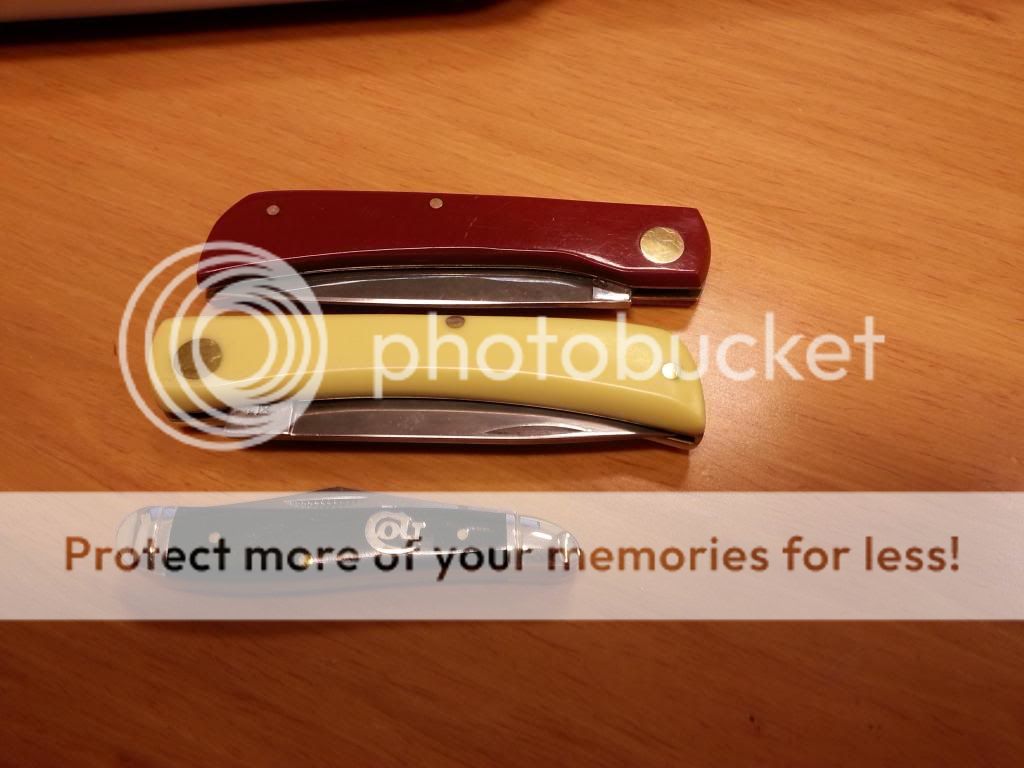
I finally had to try out one of the Colt carbon steel knives with the titanium blade coating. So I picked up a trapper. It came in yesterday. The edges were okay for a factory knife. The spey blade a little sharper. Each were usable, but like many factory edges could use a sharpening. So I gave them my now standard sharpening routing for a working knife. I use the KME sharpener with the 300, 600, and 1500 Gold series diamond stones, then finish off with a kangaroo strop loaded with 4 micron CBN emulsion. I find this a good balance between a really nice, sharp edge, and not spending hours on a knife trying to split atoms. However, the sharpening is not what this is about. It's about the knife, the blades, and how they cut. (Note: Much of the text below is cut from a similar post I did on another forum. It's my text so it's not plagiarism. I just didn't want to type it all over again. Slight editing was fine for me.)
I know a few have asked and some have wondered about the new Colt carbon steel line. So I thought I'd post some info on the one I got.
A little bit ago I went out back with the dog and saw the hackberry stick laying there I'd been roughing around with and had already done some cuts on with the knife when it first came in. I thought, "Yeah, grab that Colt and see how it does now." So I did.

First I cut the leftmost notch. Several curling cuts then cuts down at the ends to separate the sliced parts. Then some smoothing cuts. Next I started on the right most section cutting the ramp. After the full cuts I started using the blade making smoothing cuts on the little ridges that remain as each slice comes off. I then flipped the blade to a 90 degree or so angle and started scraping. Finally I cut the center notch and cut a small twig on the back side of the branch at it's base. In case anyone isn't familiar with a hackberry bush, they're pretty tough. This schteek was cut last week when I was checking out another knife so it's not quite green, but not dry and seasoned eihter.
After the cutting I checked the edge and there was no rolling or chipping. I cut some phone book paper and slick paper from a catalog and it sliced neatly through it no problem and not catching. So far the blade is acting like good carbon tool steel that's been properly heat treated.
Lastly I reached for a section of belt blank strap I had loaded with green compound and did 4 or 5 stropping strokes per side alternating as I went. Yup, shaved some hair.
This isn't an exhaustive test to be sure, but if the blade was crap steel or the HT was off the edge wouldn't have held like it did. Notching and shaving a tough wood will tell you really fast if your edge sucks or is weak. Since the knives I've been carrying are stainless (Case, SAK) and I haven't put many to hard use in some time, I'd almost forgotten just how nice a carbon steel blade could be. Sure, I like 1095 for all the traditional reasons and have carried and used it plenty in the past. But even so, I'd not really given a good sharpening to a carbon steel blade and really used it in awhile. It's easy to forget the finer things along the way.
Dang it. I may have to carry this thing a bit. Unless it shows pimples later, I'd carry this thing and use it hard in the woods, shop, farm/ranch, if I had any of those to mess around in, or around the yard (and I ain't got much of that). It's nice enough to carry, but not not so much to worry about and not use. As you can see from the photo the coating on the blade held up well. Not sure what it would do over the long haul, but if it was weak it would have started showing wear on all the passes through the wood. The little spot at the spine near the pivot was there when I got it. That would probably wear in a pocket over time as well. The spot on the choil is from me nicking it with the stones a few times to many.
Maybe folks like Case or Queen will take notice and incorporate carbon steel blades with a similar coating into a workman series of blades. G10 and Micarta scales and coated carbon steel blades in some good working patterns at a decent price and maybe introduce some new folks to the cutting ability of carbon steel without them fretting over discoloration or corrosion as much. Yes, you still need to wipe the blade down and not leave the exposed edge bevels wet for long, but that takes little to do and a lot of neglect to even see discoloration.
I guess I need to find some hard jobs for this to see how well it holds up and if it develops blade wobble. We shall see.
I know a few have asked and some have wondered about the new Colt carbon steel line. So I thought I'd post some info on the one I got.
A little bit ago I went out back with the dog and saw the hackberry stick laying there I'd been roughing around with and had already done some cuts on with the knife when it first came in. I thought, "Yeah, grab that Colt and see how it does now." So I did.

First I cut the leftmost notch. Several curling cuts then cuts down at the ends to separate the sliced parts. Then some smoothing cuts. Next I started on the right most section cutting the ramp. After the full cuts I started using the blade making smoothing cuts on the little ridges that remain as each slice comes off. I then flipped the blade to a 90 degree or so angle and started scraping. Finally I cut the center notch and cut a small twig on the back side of the branch at it's base. In case anyone isn't familiar with a hackberry bush, they're pretty tough. This schteek was cut last week when I was checking out another knife so it's not quite green, but not dry and seasoned eihter.
After the cutting I checked the edge and there was no rolling or chipping. I cut some phone book paper and slick paper from a catalog and it sliced neatly through it no problem and not catching. So far the blade is acting like good carbon tool steel that's been properly heat treated.
Lastly I reached for a section of belt blank strap I had loaded with green compound and did 4 or 5 stropping strokes per side alternating as I went. Yup, shaved some hair.
This isn't an exhaustive test to be sure, but if the blade was crap steel or the HT was off the edge wouldn't have held like it did. Notching and shaving a tough wood will tell you really fast if your edge sucks or is weak. Since the knives I've been carrying are stainless (Case, SAK) and I haven't put many to hard use in some time, I'd almost forgotten just how nice a carbon steel blade could be. Sure, I like 1095 for all the traditional reasons and have carried and used it plenty in the past. But even so, I'd not really given a good sharpening to a carbon steel blade and really used it in awhile. It's easy to forget the finer things along the way.
Dang it. I may have to carry this thing a bit. Unless it shows pimples later, I'd carry this thing and use it hard in the woods, shop, farm/ranch, if I had any of those to mess around in, or around the yard (and I ain't got much of that). It's nice enough to carry, but not not so much to worry about and not use. As you can see from the photo the coating on the blade held up well. Not sure what it would do over the long haul, but if it was weak it would have started showing wear on all the passes through the wood. The little spot at the spine near the pivot was there when I got it. That would probably wear in a pocket over time as well. The spot on the choil is from me nicking it with the stones a few times to many.
Maybe folks like Case or Queen will take notice and incorporate carbon steel blades with a similar coating into a workman series of blades. G10 and Micarta scales and coated carbon steel blades in some good working patterns at a decent price and maybe introduce some new folks to the cutting ability of carbon steel without them fretting over discoloration or corrosion as much. Yes, you still need to wipe the blade down and not leave the exposed edge bevels wet for long, but that takes little to do and a lot of neglect to even see discoloration.
I guess I need to find some hard jobs for this to see how well it holds up and if it develops blade wobble. We shall see.