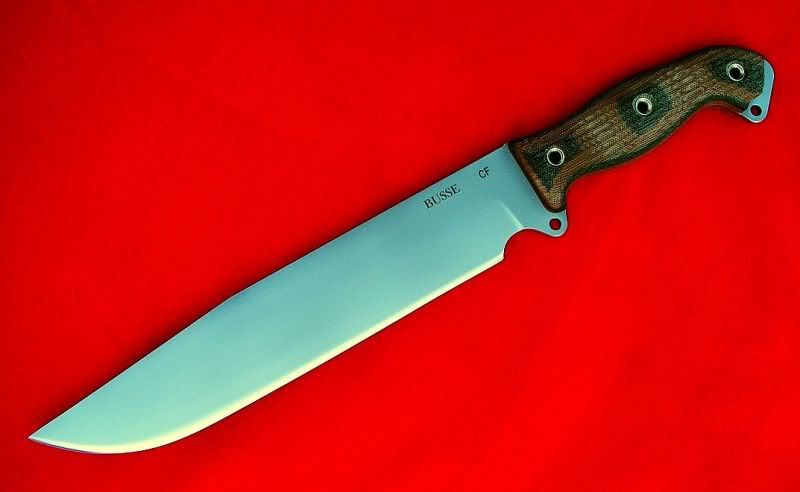
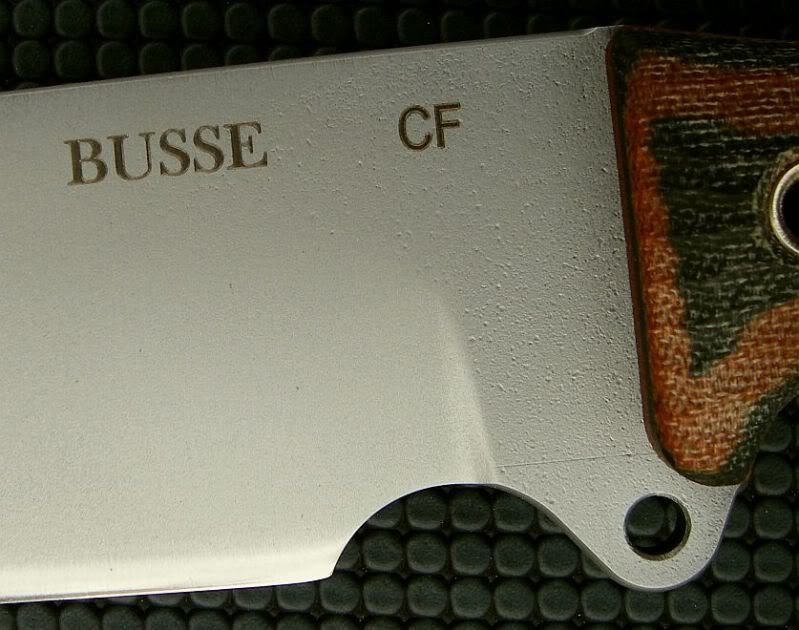
Competition finish

Joined
Jan 18, 2010
Messages
403
Not exactly sure what the competition finish is. Is it bead blasted at all? Is it what a CG coated blade would be before the coating? Is it more prone to rust?
Just trying to get a more clear idea of what it actually is, and how it compares to a satin finish. From the pics I've seen, it looks kinda like satin, but duller.

thanks
 
Not exactly sure what the competition finish is. Is it bead blasted at all? Is it what a CG coated blade would be before the coating? Is it more prone to rust?
Just trying to get a more clear idea of what it actually is, and how it compares to a satin finish. From the pics I've seen, it looks kinda like satin, but duller.

thanks

Unless you are talking about the new BWM that was avaliable through Knob Creek or the most recent ganzza then the CF isn't bead blasted. Its as raw as INFI gets, and if you strip your coated blade, depending on how you do it you will end up with the same finish. And yes it is more prone to rust, but if you take care of the blade its gonna be just fine. INFI doesn't rust easy.
 
Unless you are talking about the new BWM that was avaliable through Knob Creek or the most recent ganzza then the CF isn't bead blasted. Its as raw as INFI gets, and if you strip your coated blade, depending on how you do it you will end up with the same finish. And yes it is more prone to rust, but if you take care of the blade its gonna be just fine. INFI doesn't rust easy.

+1

CAVEAT: The original competition finish DOES rust quite easily, in contrast to Busse's double cut (bead blast) or the satin finish.

However, Jerry described the new competition finish on the BWM released at KC as being "double cut", which is Busse's bead blast finish:

The "Competition Finish" is a bit different than the previous Competition Grade in so far as we are double cutting these prior to sharpening! This will cut down greatly on the decarb/oxidation issue.

These bad boys have INFI dimples and polished edges!!! :thumbup:

They are wicked sharp!!! :thumbup:

They feature a heavy striped black and tan canvas micarta and will make the air bleed!!!! :eek: :thumbup:

Jerry :D


KCBWBMCF2.jpg


KCBWBMCFCLOSEUP.jpg
 
Thanks for the info!
How difficult do you think it would be to convex the edge on these?
 
If you're talking about the new CF BWM's, they're already convexed to a "zero" edge, which is very easy to maintain. There are several tutorial threads here on convexing INFI edges, also--a quick search should turn them up.
 
What exactly is convexed to a "zero edge"? I know what convex edges are, love them, and can usually easily maintain them with mousepad/sandpaper or just strop, but not quite sure what a "zero edge" is.
 
What exactly is convexed to a "zero edge"? I know what convex edges are, love them, and can usually easily maintain them with mousepad/sandpaper or just strop, but not quite sure what a "zero edge" is.

Good question. I was about to ask the very same thing.
 
What exactly is convexed to a "zero edge"? I know what convex edges are, love them, and can usually easily maintain them with mousepad/sandpaper or just strop, but not quite sure what a "zero edge" is.

I am sure Will can answer this easily but sometimes pics help.

Here is a convex edge:


and here is a convex "zero edge" (bottom 3):


A zero edge has a nice smooth transition from the cutting edge to the blade, hence the term "zero edge" meaning there is no noticeable edge or transition on the shoulder above the cutting edge.

They are my favorite edge hands down.:cool::thumbup:
 
Ohhhhh, you mean a full convex grind as opposed to just a convex edge. Gotcha.
I guess it's just a semantics difference. I LOVE full convex grinds, although some prefer the compromise of a flat blade with a convex edge.
 
Ohhhhh, you mean a full convex grind as opposed to just an edge convex grind. Gotcha.
I guess it's was just a semantics difference. I LOVE full convex grinds!!!

Not necessarily. You can have a full convex grind and not have a zero edge.

The SAR4 SE is an example of this:
2145514.jpg


As you can see in the pic the knife has a full convex grind on the blade and a convex edge but there is not an even transition from cutting edge to blade. You can also have a zero edge on a knife that does not have a full convex grind as seen on the original Custom Shop AD which has a nice zero edge on a saber ground blade:


The zero edge is the nice smooth transition from cutting edge to side of blade.:thumbup:
 
A zero edge has a nice smooth transition from the cutting edge to the blade, hence the term "zero edge" meaning there is no noticeable edge or transition on the shoulder above the cutting edge.

They are my favorite edge hands down.:cool::thumbup:

Yep--zero means there's no secondary edge bevel, i.e. the primary blade grind transitions to the edge with no secondary edge "shoulder". That little shoulder between the primary blade grind and the secondary edge bevel on conventional blades creates a "drag" point where friction is concentrated. Zero edges penetrate past that critical depth without encountering the friction threshhold of that shoulder, making for smoother/easier penetration by the blade into the material being cut or chopped.

The down side that's sometimes mentioned is that these edges often come fairly thick from the factory and can benefit considerably from thinning on a belt grinder, but a thick zero edge is also a very strong configuration, which of course is Busse's stock-in-trade.
 
And I am indeed thankful that I'm getting my belt grinder soon...just to reprofile some other blades that I have. Thanks for knowledge, folks!
 
I always thought a zero edge was like the NMFBMLE. Where you can see no transition. As to say if the blade is bead blasted you could not put a zero edge without making the entire blade to satin.

Maybe I have been way off. If its just a smoother transition then all of my knives are "zero edge". I think I may be confused now also.
 
I always thought a zero edge was like the NMFBMLE. Where you can see no transition. As to say if the blade is bead blasted you could not put a zero edge without making the entire blade to satin.

Maybe I have been way off. If its just a smoother transition then all of my knives are "zero edge". I think I may be confused now also.

Yes and no, I think. You can have a zero grind, absent any secondary shoulder, and still polish the edge so that there is a distinct visual difference between the polished edge and the blade flat behind the edge, but the visible line you see is only a difference in finish, not angle.
 
I think I'm getting it Will.

Let's say full flat ground zero edge. To keep the angle the same you would be sharpening from edge to spine right? If not you would definately be putting atleast a microbevel right?

I think I may be thinking into it too much.

Thanks Will
 
I think I'm getting it Will.

Let's say full flat ground zero edge. To keep the angle the same you would be sharpening from edge to spine right? If not you would definately be putting atleast a microbevel right?

I think I may be thinking into it too much.

Thanks Will

Full flat primary to zero convex edge is a concept that can be approximated by a method Jerry Hossom taught me, where you start above/behind the edge with a slack belt and fairly coarse grit, make a couple of passes, then drop down with a little finer grit belt and blend that first thinned area with the next, and so on. Finally, you blend the broad area you've thinned into the edge with a fine-grit belt. By doing this, you can just about eliminate any shoulder, meaning any perceivable transition, between the primary grind and the edge. The effect of this edge is devastating in terms of high-speed penetration. A machete with this kind of edge will pass through light brush almost without perceivable resistance. The "apparent" edge bevel is almost a half-inch wide, by the way.

But obviously, you are technically correct. For a true primary flat grind to a zero edge, you would not have a convex edge. It would be flat from spine to edge, like the technique employed by Ed Schott on his knives about ten years ago. I think of the concept of a "zero edge" in practice to be synonymous with the absence of any secondary shoulder, and there are different ways of getting there, some of which may not fit the strictest technical interpretation.

So are you over-thinking it? I don't know. Does it really matter? Probably only insofar as it accurately describes the result.
 
Last edited:
The bottom line is being able to sharpen with a mousepad/sandpaper or slack belt.

Certainly, that is true. And, of course, it's also true of any convex edge, zero or not. All convex edges have the advantage of a smoother transition from primary grind to edge bevel, but many convex edges still have a discernable shoulder--meaning an obvious threshhold at which the primary grind angle changes to a steeper secondary bevel angle. For example, many scandi grinds have a slightly convex edge bevel with a fairly pronounced shoulder where the edge bevel meets the blade flat.
 
Last edited:
Back
Top