

- Joined
- Jul 20, 2002
- Messages
- 4,187
A bronze calculating machine salvaged from a shipwreck a century ago is finally yielding its secrets, revealing a Greek computer of remarkable sophistication for a device constructed long before the birth of Christ.
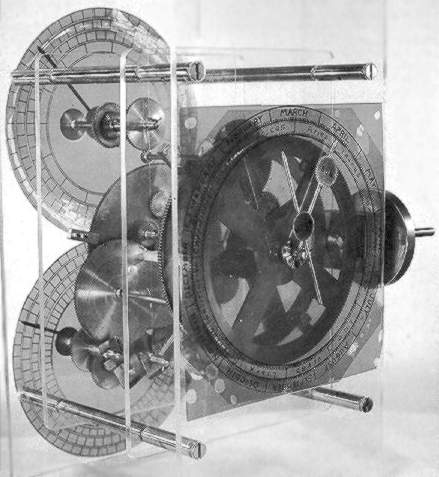
A reconstruction of the device
Scholars have been baffled by the 80-plus fragments of the mechanism, which was found in 1901 by sponge divers in a Roman shipwreck near the island of Antikythera, midway between the Peloponnese and Crete.
It was the earliest known machine involving an arrangement of gear-wheels, built centuries before such technology became commonplace, but it was badly corroded and its use was a mystery.
Following a study of its workings published today in the journal Nature, the "Antikythera Mechanism" will transform the way we think about the technological capabilities of the ancient world.
An international team unveils a reconstruction of the way it worked and has doubled the number of deciphered inscriptions on the casing.
It reveals a spectacular and ancient astronomical calculator that may even have been designed by Hipparchos (190BC-120BC), the great astronomer.
Prof Mike Edmunds and Tony Freeth of Cardiff University and colleagues in Greece and America say it was used to chart the movement of the Moon and Sun, along with eclipses and perhaps even the passage of Mercury and Venus.
The hand-driven mechanism was not a true computer, since its "program" could not be changed. Nonetheless, it would have been a wonder of its age, the supercomputer of its day, which could do multiplication, division, addition and subtraction. Although the wreck has been dated to 65BC, the device itself was probably built around the end of the second century BC.
One of the provocative issues raised by this machine, said Prof Edmunds, is what other mechanical devices the ancient Greeks built.
Another profound question is how this extraordinary technology was lost when the Roman Empire came to dominate the Mediterranean.
"In terms of historic and scarcity value, I have to regard this mechanism as being more valuable than the Mona Lisa," said Prof Edmunds.
The Antikythera Mechanism Research Project was given access to the instrument at the National Archaeological Museum in Athens last year.
The international research team used imaging techniques that shed new light on inscriptions that had been impossible to decipher. The lettering indicates a construction date of between 150BC and 100BC, slightly earlier than had been assumed, describes how it was made and used, and information on motions of the heavens.

An X-ray scanner revealed a complicated arrangement of 30 precision, hand-cut bronze gears. The team has inferred that there were at least seven more gears.
"It is only when you get medieval astronomical clocks that you go beyond this in complexity," said Prof Edmunds.
Speculation about how this marvel was used continues and the team is now building a virtual version in a computer.
Prof Edmunds said: "It makes you wonder what they would have achieved if the Romans hadn't taken over and put a stop to things. Would they have had a man on the Moon by AD300?
"It sounds ridiculous, but if they were able to construct something as technically brilliant as this, it's not complete fantasy."
http://www.telegraph.co.uk/news/main.jhtml?xml=/news/2006/11/30/nbronze30.xml
(Telegraph article has link to 3D animation)
maximus otter
A reconstruction of the device
Scholars have been baffled by the 80-plus fragments of the mechanism, which was found in 1901 by sponge divers in a Roman shipwreck near the island of Antikythera, midway between the Peloponnese and Crete.
It was the earliest known machine involving an arrangement of gear-wheels, built centuries before such technology became commonplace, but it was badly corroded and its use was a mystery.
Following a study of its workings published today in the journal Nature, the "Antikythera Mechanism" will transform the way we think about the technological capabilities of the ancient world.
An international team unveils a reconstruction of the way it worked and has doubled the number of deciphered inscriptions on the casing.
It reveals a spectacular and ancient astronomical calculator that may even have been designed by Hipparchos (190BC-120BC), the great astronomer.
Prof Mike Edmunds and Tony Freeth of Cardiff University and colleagues in Greece and America say it was used to chart the movement of the Moon and Sun, along with eclipses and perhaps even the passage of Mercury and Venus.
The hand-driven mechanism was not a true computer, since its "program" could not be changed. Nonetheless, it would have been a wonder of its age, the supercomputer of its day, which could do multiplication, division, addition and subtraction. Although the wreck has been dated to 65BC, the device itself was probably built around the end of the second century BC.
One of the provocative issues raised by this machine, said Prof Edmunds, is what other mechanical devices the ancient Greeks built.
Another profound question is how this extraordinary technology was lost when the Roman Empire came to dominate the Mediterranean.
"In terms of historic and scarcity value, I have to regard this mechanism as being more valuable than the Mona Lisa," said Prof Edmunds.
The Antikythera Mechanism Research Project was given access to the instrument at the National Archaeological Museum in Athens last year.
The international research team used imaging techniques that shed new light on inscriptions that had been impossible to decipher. The lettering indicates a construction date of between 150BC and 100BC, slightly earlier than had been assumed, describes how it was made and used, and information on motions of the heavens.
An X-ray scanner revealed a complicated arrangement of 30 precision, hand-cut bronze gears. The team has inferred that there were at least seven more gears.
"It is only when you get medieval astronomical clocks that you go beyond this in complexity," said Prof Edmunds.
Speculation about how this marvel was used continues and the team is now building a virtual version in a computer.
Prof Edmunds said: "It makes you wonder what they would have achieved if the Romans hadn't taken over and put a stop to things. Would they have had a man on the Moon by AD300?
"It sounds ridiculous, but if they were able to construct something as technically brilliant as this, it's not complete fantasy."
http://www.telegraph.co.uk/news/main.jhtml?xml=/news/2006/11/30/nbronze30.xml
(Telegraph article has link to 3D animation)
maximus otter


