Converting a combo edge to a plain edge-Any tips or advice?

Joined
Mar 16, 2012
Messages
277
I have a spyderco native in 440v that is a combo edge. I would like to convert it over to a plain edge and want to do the work myself. If anyone has done this kind of conversion ( not necessarily on this exact model ) is there any tips on what you learned or any techniques you would be willing to pass along?

Thanks,
John
 
I have a spyderco native in 440v that is a combo edge. I would like to convert it over to a plain edge and want to do the work myself. If anyone has done this kind of conversion ( not necessarily on this exact model ) is there any tips on what you learned or any techniques you would be willing to pass along?

Thanks,
John


I have just sharpened serrations out over time by sharpening a lot and concentrating on the "non-flat" side of the serrations (AUS-8).

I once took a yard sale coarse stone and sharpened serrations out of a 440C blade while watching TV one Saturday. I was bored. Took a while. Lay on newspapers for the dust and finished ruining the stone in the process.

Ain't so bad to sharpen them out over time.
 
My advice would be to sell the knife and buy one in plain edge. By the time you get the scallops smoothed out, you will either have a recurve blade or you will have lost a lot of blade width. With the hollow grind on the Native, that will leave you with an extremely thick edge. The only way to get the cutting performance back then would be to regrind the blade, either to flat saber or full flat, unless you have the tools and skill to restore the hollow saber grind. I doubt you'd have asked this question if you did. Lastly, you said it was 440V, which has twice the vanadium content of S30V, making it more abrasion resistant.
 
I've tried that before and as yablanowitz said you'll have a a thick edge once the serrations are completely gone. Not worth it IMO.
 
My advice would be to sell the knife and buy one in plain edge. By the time you get the scallops smoothed out, you will either have a recurve blade or you will have lost a lot of blade width. With the hollow grind on the Native, that will leave you with an extremely thick edge. The only way to get the cutting performance back then would be to regrind the blade, either to flat saber or full flat, unless you have the tools and skill to restore the hollow saber grind. I doubt you'd have asked this question if you did. Lastly, you said it was 440V, which has twice the vanadium content of S30V, making it more abrasion resistant.

440V is S60V, has 5% Vanadium.
 
I've done it to several knives before, but not with any steel as hard as 440V. Takes a while, and converts your knife into a recurve. I don't regret the fact I did though.
 
geez; you really want to go to all that effort to remove serrations? once you do it you've hacked it into something nobody wants because it sure isn't a Native anymore...sell or trade it off and use the proceeds to get something you really want to use...
 
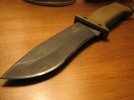
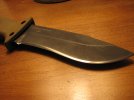
This is a Gerber LMFII that I did a long time ago, just showing it so you can see how much has to be removed from a formerly-straight blade. With a belt sander and ceramic belts, if you want a recurve, it can be done cleanly in about ten minutes if you know what you're doing. With a file/stone, it would be tedium to the Nth degree...

IMG_1331.jpgIMG_1332.jpg
 
IMG_5548.jpg


It does leave a thick edge which is more work to reprofile and thin out. Doesn't necessarily leave a recurve though. The EKA on top was half serrated and the edge is still too thick.

I don't guess I would do it on a knife I would be able to sell for most of what I have in it, although I do like to tinker with my stuff.

"if you didn't make it yourself, it isn't really yours" Tim the Tool Man Taylor
 
get a Harbor Freight 35$ belt sander ,, order some 200 grit sanding belts and in a few minutes your done !!
 
Back
Top