Convex a Kabar Kukri Machete?

Joined
May 19, 2009
Messages
1,161
Well I recently ordered this knife for larger tasks that my bk-2 campanion couldn't accomplish. When compared to the CS kukri machete that seems to be so popular, it has a much thicker spine, came w/ great fit and finish (was hair-popping sharp out of the box) and seems to have a much better heat treat/steel (1055 @ ?? vs 1085 @ 52-54hrc) . Overall, I definitely feel the extra $25 was worth it...

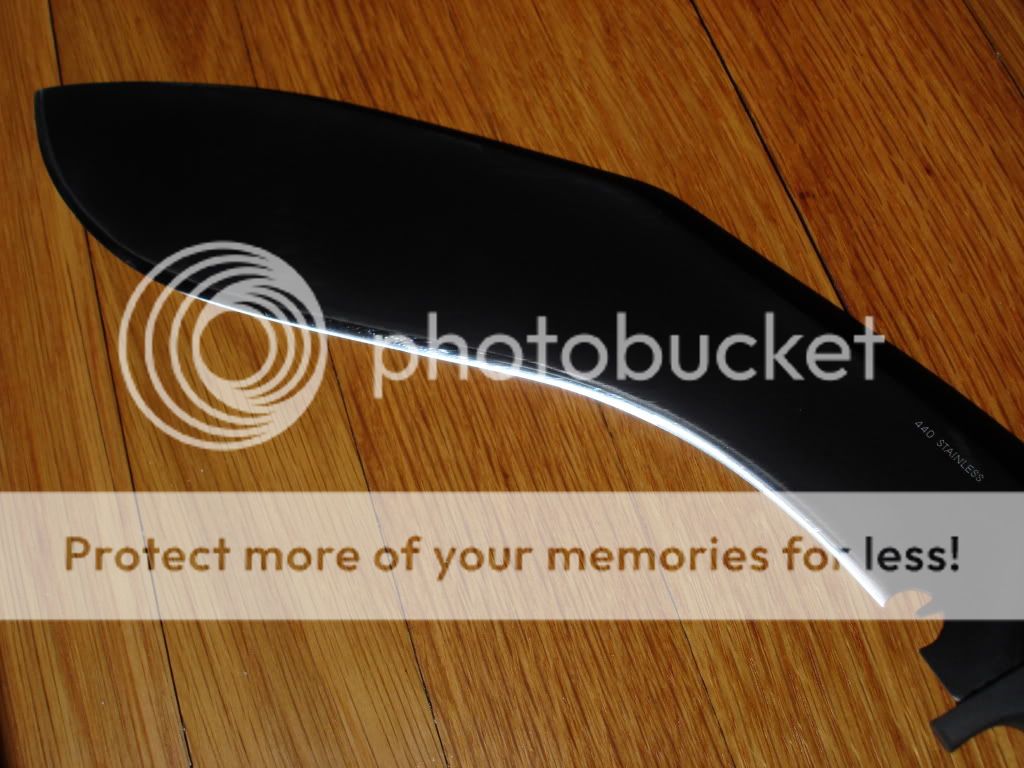
After testing it out, my only real complaint is Kabar's choice to use a hollow grind with a v-shaped secondary bevel... when hacking away at larger logs, it has a tendency to bite in and get stuck. I'm curious as to whether anyone has put a convex grind on one... since a large portion of the blade is hollow ground, is seems like quite a daunting task. I don't have much in the way of tools at my disposal, so I was thinking of using a dremel with a sanding band to get the initial shape in before using the sandpaper/mousepad method.

Thoughts, comments, suggestions would be very much appreciated :)

Picture to show how much of the blade is hollow ground:
KabarKukriNewnet.jpg
 
I'm doing it on a knife right now .Don't do it all at once ! Start out convexing just a little bit ,then each time you sharpen it do a little bit more.
 
A convex edge on that knife is definetely doable. Since you already have a decent factory v-grind your job is even easier. Basically, what you are going to do is knock of the shoulder of the "v" and round it into a convex. The method I mention is not going to keep your blade pretty, but if you plan on using it, that shouldn't matter anyway as that coating is coming off one way or the other. Using the mousepad, start at 220 grit and lay the blade flat on the paper and pull backwards putting the pressure on the front towards the edge but keeping the blade flat to the paper. The amound of pressure needed on the front edge should be enough that the edge is making contact but not enough to roll over the edge too much. Check it every few swipes to see where the 220 grit scratches are hitting. After a while, the shoulder of the "v" will round off and you will start seeing the edge take on a curve/convex. Because of the hollow grind, you will also see the shoulder of the hollow start to round off but that is ok since that will actually help the blade not stick in wood. Kind of a unintentional but helpfull side effect of this method. Once the edge area is nice and convexed, move up through the grits removing the previous grits scratches until you get to your highest grit available. If done correctly, this will give you a hair shaving sharp convex which I have found to work great on this knife. Here is a pic of what mine looks like after a few sharpening sessions and a few years of use:

DSC01249.jpg
 

The issue is that although the secondary bevel is a "V", the primary is a hollow grind which is what ends up catching... I knocked off the shoulders of the primary hollow grind and that helped a bit, but it would still be nice to convex the entire edge... from the look of that picture, the primary bevel is still hollow ground, with the primary edge being convex
 
I have been considering doing this to mine as well, but have not been bothered spending the time. Do think using a file to knock off the hollow-grind line would make its easier?
 
You will most likely need a belt sander or LOTS of time with sandpaper

Stay away from the dremel.
 
I too would advise against dremel for this function. As far as trying to get to a pure convex edge, you would have to remove an amazing amount of metal to overcome that hollow grind, only you can determine if you think the benefits outweigh the work involved.
 
I have been considering doing this to mine as well, but have not been bothered spending the time. Do think using a file to knock off the hollow-grind line would make its easier?

Yes, start off with a bastard file to knock off the shoulder of the edge.

I convexed the edge on my 12" bladed kukri using no power tools. It takes more time and elbow grease, but it certainly can be done. Another tip is to wrap sandpaper around a large cylindrical object to better get to the recurve portion of the blade. I used an empty pringles can, and it worked perfectly since the cardboard has just a touch of give to it.

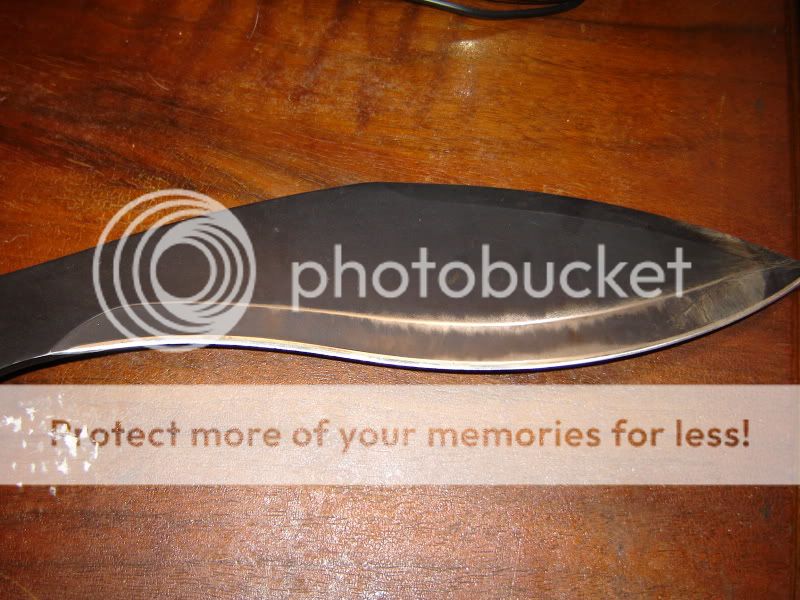
I did the rest with sandpaper on leather backing, then loaded strop....
various2008-2009110.jpg

various2008-2009109.jpg
 
Back
Top