I like the little to no maintenance of the salt series but I'm worried about edge retention with the PE. Ive heard that it has no edge retention, edge retention similar to AUS8, and edge retention is a hit or miss. That"s basically the only the thing that's holding me back so convince me to get (or not to get) the Pacific Salt.

-
The BladeForums.com 2024 Traditional Knife is available! Price is $250 ea (shipped within CONUS).
Order here: https://www.bladeforums.com/help/2024-traditional/
You are using an out of date browser. It may not display this or other websites correctly.
You should upgrade or use an alternative browser.
You should upgrade or use an alternative browser.
Convince me to pick a Pacific Salt
- Thread starter Waldamir
- Start date

- Joined
- May 25, 2013
- Messages
- 3,700
Hey, I have the dragonfly salt. Edge retention is indeed quite poor, but I LOVE the knife. Seriously, it's incredible. I have it on the ocean every day, clean fish, give it a half assed rinse and put it away until I give it more of the same abuse the next day! Bulletproof! It gets hair popping sharp, but I have to sharpen it daily to keep it that way. Fortunately, its the easiest knife to sharpen I've ever owned. I can take this thing from dull to razor sharp in under a minute freehand...and I'm not a great sharpener.
If you really need something corrosion resistant like me, don't even think twice! Get it. If you just want an edc and the rust proof aspect is more of a novelty feature, you might be happier with another type of steel.
If you really need something corrosion resistant like me, don't even think twice! Get it. If you just want an edc and the rust proof aspect is more of a novelty feature, you might be happier with another type of steel.


What other common steel would you compare the edge retention to? If its anything like AUS8 or 8cr ill have no problem with it for edc. The rust resistance appeals to me because where I work I am wet most of the day and that actually caused rust to form on my para2. I'm ok with edge retention similar to AUS or 8cr because regardless of the steel I usually sharpen any knife after use/work.

- Joined
- Sep 2, 2007
- Messages
- 1,169
H1 has less edge retention then aus8 in my experience. I wouldn't even consider it unless I was around salt water. When grinding H1, it stands out from any other steel I have worked with. It's hard to explain, but it's seems powdery and less dense then other types. It grinds fast and doesn't seem to be very wear resistance. Salt series makes a good jog knife as well because you don't need edge retention when running.IMO
Last edited:

- Joined
- Dec 10, 2006
- Messages
- 5,979
H-1 is not a wear resistant steel.
Lets look at characteristics of steel:
Edge performance
Edge performance consists of three elements: sharpness, edge stability and wear resistance.
Sharpness
The ability of the steel to support a keen edge with razor sharpness. It also means that the knife will be easy to resharpen. This is important for all knives.
Edge stability
The ability for the knife edge to withstand edge rolling and edge micro-chipping. Rolled edges and micro-chipped edges are the most common reasons for resharpening. This is important for all knives.
Wear resistance
The ability for the edge to resist abrasive wear. This is usually secondary to edge stability issues, such as micro-chipping or edge rolling.
Toughness
Toughness is the resistance of the knife to cracking. Cracks always start at a weak point in the steel, such as an inclusion or a large primary carbide. So toughness is enhanced by a homogeneous structure that is free from impurities and large carbides. A fine-carbide steel grade will always have higher toughness than a coarse-carbide grade with a given hardness. Toughness is vital for professional and military knives.
Corrosion resistance
Corrosion resistance should be selected to suit the application. Since high corrosion resistance involves sacrifices in edge performance, the best approach is to have corrosion resistance that is 'good enough' for the selected type of knife. An everyday carry knife and a fishing knife will make very different demands on corrosion resistance.
Strength
: The ability to take a load without permanently deforming. For many types of jobs, strength is extremely important. Any time something hard is being cut, or there's lateral stress put on the edge, strength becomes a critical factor. In steels, strength is directly correlated with hardness -- the harder the steel, the stronger it is. Note that with the Rockwell test used to measure hardness in a steel, it is the hardness of the steel matrix being measured, not the carbides. This, it's possible for a softer, weaker steel (measuring low on the Rockwell scale) to have more wear resistance than a harder steel. S60V, even at 56 Rc, still has more and harder carbides than ATS-34 at 60 Rc, and thus the S60V is more wear resistant, while the ATS-34 would be stronger.
Source: Sandvik knife steel knowledge and Zknives: Knife Steel FAQ
Now, H-1 ticks all the above characteristics except wear resistance.
I have personally moved away from high wear resistant steels. IMO if you want a steel that can offer you, the user, an option to cater the edge to your needs then H-1 is the best bang for your buck in a production knife to date with all the features that make a Spyderco "Reliable High Performance". There are some other steels out there that offer it, but none of them fall in the "super steel" category or high wear resistant category.
Lets look at characteristics of steel:
Edge performance
Edge performance consists of three elements: sharpness, edge stability and wear resistance.
Sharpness
The ability of the steel to support a keen edge with razor sharpness. It also means that the knife will be easy to resharpen. This is important for all knives.
Edge stability
The ability for the knife edge to withstand edge rolling and edge micro-chipping. Rolled edges and micro-chipped edges are the most common reasons for resharpening. This is important for all knives.
Wear resistance
The ability for the edge to resist abrasive wear. This is usually secondary to edge stability issues, such as micro-chipping or edge rolling.
Toughness
Toughness is the resistance of the knife to cracking. Cracks always start at a weak point in the steel, such as an inclusion or a large primary carbide. So toughness is enhanced by a homogeneous structure that is free from impurities and large carbides. A fine-carbide steel grade will always have higher toughness than a coarse-carbide grade with a given hardness. Toughness is vital for professional and military knives.
Corrosion resistance
Corrosion resistance should be selected to suit the application. Since high corrosion resistance involves sacrifices in edge performance, the best approach is to have corrosion resistance that is 'good enough' for the selected type of knife. An everyday carry knife and a fishing knife will make very different demands on corrosion resistance.
Strength
: The ability to take a load without permanently deforming. For many types of jobs, strength is extremely important. Any time something hard is being cut, or there's lateral stress put on the edge, strength becomes a critical factor. In steels, strength is directly correlated with hardness -- the harder the steel, the stronger it is. Note that with the Rockwell test used to measure hardness in a steel, it is the hardness of the steel matrix being measured, not the carbides. This, it's possible for a softer, weaker steel (measuring low on the Rockwell scale) to have more wear resistance than a harder steel. S60V, even at 56 Rc, still has more and harder carbides than ATS-34 at 60 Rc, and thus the S60V is more wear resistant, while the ATS-34 would be stronger.
Source: Sandvik knife steel knowledge and Zknives: Knife Steel FAQ
Now, H-1 ticks all the above characteristics except wear resistance.
I have personally moved away from high wear resistant steels. IMO if you want a steel that can offer you, the user, an option to cater the edge to your needs then H-1 is the best bang for your buck in a production knife to date with all the features that make a Spyderco "Reliable High Performance". There are some other steels out there that offer it, but none of them fall in the "super steel" category or high wear resistant category.
Very cool link. Thanks for posting.
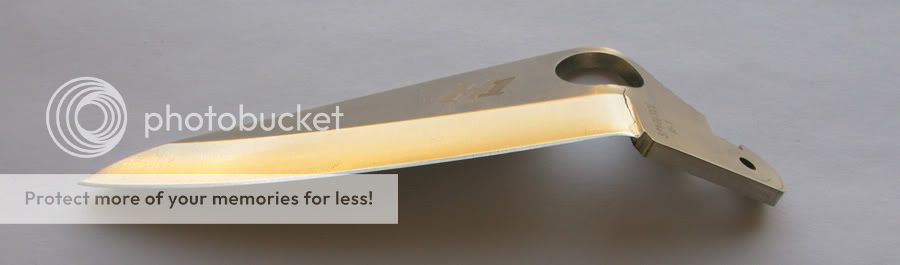
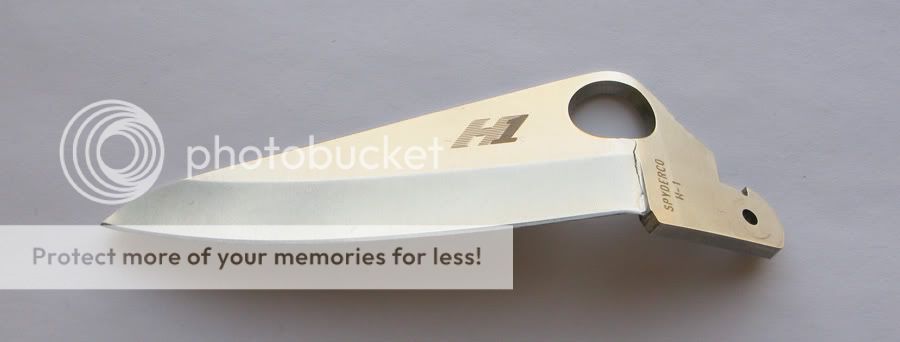
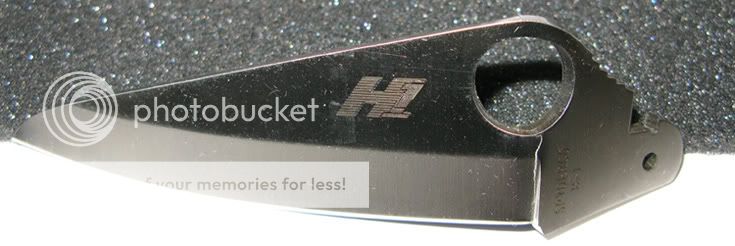
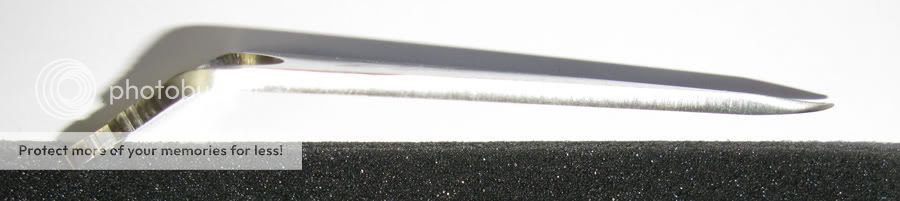
These are photos of an H1 blade tested by Spyderco showing that the blade bends instead of breaking.

- Joined
- May 25, 2013
- Messages
- 3,700
You'll like it. Have you noticed that everybody who owns one admits that edge retention isn't very good, yet they all completely love the knife anyway?
The good news is, the steel sharpens so easy, it makes u feel like a pro even if you kind of suck. .
.
The good news is, the steel sharpens so easy, it makes u feel like a pro even if you kind of suck.
.In my experience with both PE and SE H1, the SE holds an edge far longer than PE. And the SE holds an edge at least as well as SE in other steels like VG-10, and probably even better. Certainly better than AUS-8 in SE. And it's very easy to resharpen. Sometimes on the serrations you may get a wire edge if you contact something hard, but it can easily be corrected on a Sharpmaker.
The comments on poor edge-holding all seem to be regarding PE H1. IME, it certainly doesn't apply to SE. But either way, H1 is an excellent user steel.
Jim
The comments on poor edge-holding all seem to be regarding PE H1. IME, it certainly doesn't apply to SE. But either way, H1 is an excellent user steel.
Jim


Ive decided I'm going to pick one up.
You've made the right decision
I've carried a plain edge Pacific Salt since 2006. Edge retention has never been an issue and when it does need a touch up, sharpening is a breeze.
Just one quick question. Are all salt knives from spyderco on the market now screw construction?
To my knowledge, yes. Although it never hurts to check with your dealer when ordering.