I've now been using a couple of friction folders in my great experiment. I'm not really sure what exactly the experiment is about, other than I seem drawn to the most simple tool in my 'older' years. I've always lie the old time traditional stuff, which is why I don't even own a gun that would not look at home in a Tom Selleck western or Humphrey Bogart noir film. My knives usually went the same way. So I've been happily slicing and dicing with my little Pattadese and for a week now with 'The Turk.' I've come to calling it that for lack of a better name. Jon, (Kllneh) had the great give away, and I came into possession of the Turk.
I figured since it was a product of some Turkish working man, I'd pose it with a hand carved Meershaum pipe from Turkey that delivers a nice smooth smoke. The knife in not as smooth as the pipe, but that's all part of the character. It's a bit rough in workmanship, but then the sum total of a knife is in how it cuts. It does that! The blade is thin. Thin as in a smaller Opinel or kitchen paring knife. I touched it up on a silica stone and a leather strop, and now my thumb print shivers in terror if I go to feel the edge. I don't know what kind of carbon steel is used, it just came with a little slip of paper saying that it was hand forged by someone named Hasan. Hasan made a nice thin bladed little slicer. Hasan knows what makes a knife work. It goes right through carrot sticks, salami, and cordage like it's not there. The black goat horn handle fits the hand very nice. At least my hand. The upturn at the end makes a nice rest when I choke up on the blade for fine cutting. The surface of the goat horn is just rough enough that it makes for a good grip when hands are wet. It is not as pointy as the Sardinian knife, but it's more a matter of semantics as far as performance goes. A sharp knife is a sharp knife.
Both have been pocket carried, and both do an excellent job of every day pocket knife cutting job. Twine, mail, UPS boxes, slicing a quick snack off something in the fridge, whatever. But they are so different in nature you think there would be a big difference in performance. The Sardinian knife is like a lot of things from the Italian region. It has style, polish, and grace. Very fine finish. It's like a competent Italian guy in a nice tailored outfit from Milan's fashion stores, nice polished Gucci loafers, but he's a competent guy all the same. Just dressed well. The Turkish knife is just rough enough that it suggests the guy from the docks who may have shaved in the last week, down at the heels clothing work worn, but he's the guy you don't want to run into in some dark backstreet in Istanbul. Unless he's on your side. Two different knives, two very different approaches to a cutting tool. Both very competent at what they are supposed to do. Both have their own draw and attraction. Both will continue to see lots of time in my pocket.
Carl.
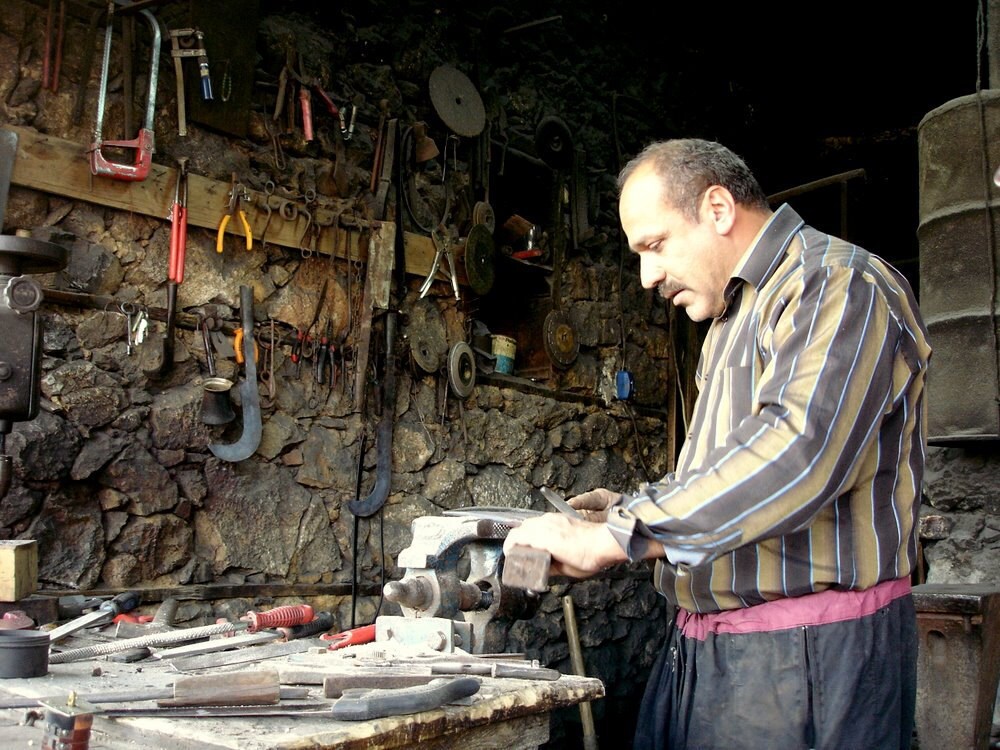
The slicer from the back streets of Istanbul.

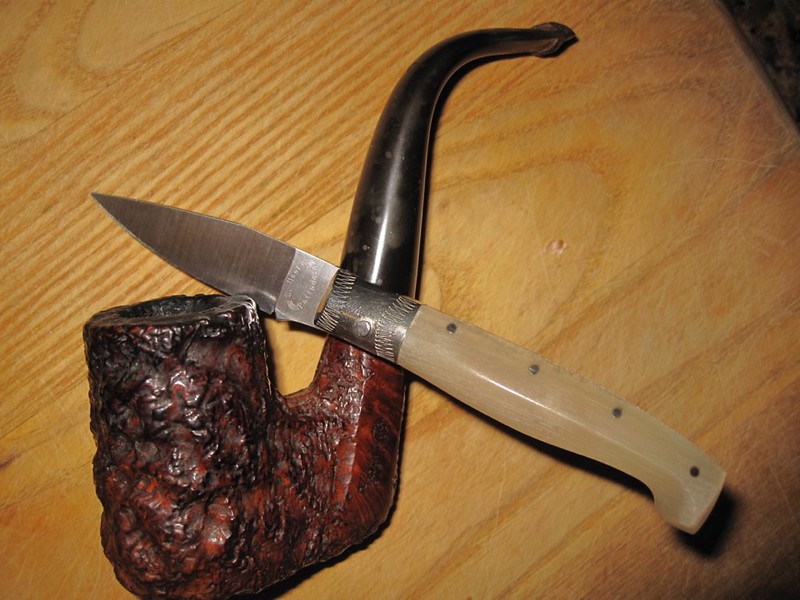
The Pattadese with a nice hand hand carved Caminetta pipe from Italy.
I figured since it was a product of some Turkish working man, I'd pose it with a hand carved Meershaum pipe from Turkey that delivers a nice smooth smoke. The knife in not as smooth as the pipe, but that's all part of the character. It's a bit rough in workmanship, but then the sum total of a knife is in how it cuts. It does that! The blade is thin. Thin as in a smaller Opinel or kitchen paring knife. I touched it up on a silica stone and a leather strop, and now my thumb print shivers in terror if I go to feel the edge. I don't know what kind of carbon steel is used, it just came with a little slip of paper saying that it was hand forged by someone named Hasan. Hasan made a nice thin bladed little slicer. Hasan knows what makes a knife work. It goes right through carrot sticks, salami, and cordage like it's not there. The black goat horn handle fits the hand very nice. At least my hand. The upturn at the end makes a nice rest when I choke up on the blade for fine cutting. The surface of the goat horn is just rough enough that it makes for a good grip when hands are wet. It is not as pointy as the Sardinian knife, but it's more a matter of semantics as far as performance goes. A sharp knife is a sharp knife.
Both have been pocket carried, and both do an excellent job of every day pocket knife cutting job. Twine, mail, UPS boxes, slicing a quick snack off something in the fridge, whatever. But they are so different in nature you think there would be a big difference in performance. The Sardinian knife is like a lot of things from the Italian region. It has style, polish, and grace. Very fine finish. It's like a competent Italian guy in a nice tailored outfit from Milan's fashion stores, nice polished Gucci loafers, but he's a competent guy all the same. Just dressed well. The Turkish knife is just rough enough that it suggests the guy from the docks who may have shaved in the last week, down at the heels clothing work worn, but he's the guy you don't want to run into in some dark backstreet in Istanbul. Unless he's on your side. Two different knives, two very different approaches to a cutting tool. Both very competent at what they are supposed to do. Both have their own draw and attraction. Both will continue to see lots of time in my pocket.
Carl.
The slicer from the back streets of Istanbul.
The Pattadese with a nice hand hand carved Caminetta pipe from Italy.