
D2 Metallurgical question...

Joined
Dec 25, 2004
Messages
1,363
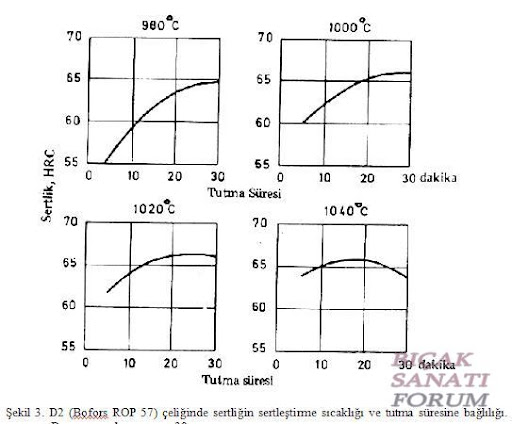
A friend of mine has sent me a chart which describes the HRC hardness values depending on the soak times and austenization temperatures for D2 tool steel. Here is the chart in question:
d2.jpg


I wonder why the 1040 degree in Celsius samples' hardness decline after 20 minutes? Is there a new carbide formation takes place stealing some carbon from martensite ?
 
I think the 1040 C temperature would be considered over heating. Too much carbide is being dissolved, putting too much carbon in the austenite. This leads to a high amount of retained austenite, and a lowering of hardness. This is a problem common to all steels with carbides present in the austenite at the hardening temperature (dual phase austenization of hypereutectoid steels). Kevin Cashen has a thread dealing with this topic floating around somewhere. Oversized grains are not the only problems that come with over heating.

I can't read the captions, and don't have the text to go with the pictures, but this looks like it came from a text book or similar source. D2 has a pretty narrow range for proper austenizing. Text books and other technical references will often include an illustration of incorrect methods, just to show what not to do. This makes it important to really read the text associated with any charts, to be sure of the reason for including any particular heat treatment.
 
Emre,
me2 has explained it pretty well.

For those whose Turkish is poor, how the charts are read is the time in minutes is on the bottom and the HRC is vertical.

Notice that at 980C (1800F)the solution of the carbides and distribution of the carbon starts after 5 minutes, and levels off at 30 minutes, but never attains full hardness.
At 1000C (188830F) it peaks higher and levels off.
At1020C (1870F) it peaks, and then starts to drop of as the secondary phase starts occurring.
At 1040C (1900F)the secondary phase is causing a noticeable drop in hardness.

What you take from this is that when hardness is the desired result, the optimal austenitization range for D2 is between 1000C and 1020C . In Fahrenheit texts they usually recommend 1825-1875F.
 
Nah... 1900 F isn't necessarily over heating. It will lead to more RA in a room temperature quench and will probably lower Mf to well under -100f. So depending on the quench will affect the RA and hardness. Personally, I do use 1850 though...

Also, in D2, you don't really get into a lot of grain growth under 2000F - it stays pretty flat unless badly over cooked.

One has to be careful putting too much faith in these charts, for two reasons. One: they frequently don't say what the quench rate is, which can affect RA (and subsequently hardness) nor do they say where they stopped the quench (70F?). So you can't always accept the values given as representing values you will achieve with your particular HT process.

To me, the thing about D2 and its use as a die steel vs a knife steel and the heat treat regimen frequently assumed for it in the literature doesn't always apply perfectly to applications in knives where RA is detrimental and the steel is processed differently.

RA in a die improves dimensional stability and impact resistance (in a tool), two things the steel was designed for that we don't need. When processed as a knife steel, those charts are a good starting place but are not the last word.
 
Thanks friends, these info really shed some light on the subject for me. Now I understand the post-HT hardness values are with RA on those charts, I know 1040 Celsius is not overheating, the accepted range is between 980 Celsius and 1040 degrees in Bohler's pdf. Some steel specs on other companies recommend up to 1050. But the high austenization values are used for high-temper and TiN coating applications. After reading through what Nathan said the logic seems quite clear for me now. Thanks a lot :thumbup:
Emre
 
Those charts tell me that 1875F for 25 minutes is ideal, which is always what I have done for D2. It works!
 
Just going by memory from my Smith's "Engineering Alloys," it said excessive austenizing temperature will cause a drop in hardness as queched. That's why I figured the 1040 range was too high. If you can deal with the retained austenite, and want more hardness than carbide volume, then it will work. Toughness may suffer, but if D2 is the steel, that's likely a secondary concern to holding a long working edge. The sources I've read always cautioned about a small window to austenize D2 without underhardening, whether by too low or too high a temperature.
 
Emre,
What you take from this is that when hardness is the desired result, the optimal austenitization range for D2 is between 1000C and 1020C . In Fahrenheit texts they usually recommend 1825-1875F.

Yes there is a small window. It is 20C or 50F.
 
I use to soak the D2 at 1010C. I'm always satisfact and I can obtain very pleasant results in this range. Occasionally I heat to above 1025°C and tempering to 495°C to have great edge quality (due to the secondary hump kick) vs a small reduction of stain resistance.
But better to stay in 1010°C IMO>
Cheers
 
Back
Top