D2 Tool steel good in a small blade for bushcraft?

Joined
Jan 7, 2015
Messages
7
So im new to bladeforums and i just am a little curious if D2 steel is good for bushcraft work suck as wood carving batoning and skinning. ive heard D2 is very hard and difficult to sharpen, and may chip in very frigid temperatures. i plan on getting a boker plus rold scout knife, it has a 3 1/4 inch d2 steel blade. so is D2 good for bushcraft? managable to field sharpen? and is it better to be on a smaller blade or longer.?
 
Last edited:
I like D-2 outdoors. it depends on the heat treat I guess but the ones I have I like. Just be sure you have a diamond sharpener, it's a bit harder than average to sharpen but if you strop it before it's too dull it helps a lot. I've used them in very cold temps with no chipping. Never a rust problem either. I notice no difference if the knife is long or shorter. In fact, I have my eye on that D-2 USMC someday.

Convex is good for bush ... or maybe a sabre grind. I have good ones in Scandi and full flat too.
 
D2 wouldn't be my first choice - it's neither the toughest, finest-edged, most stain-resistant or easiest to sharpen steel out there - but with good heat-treat it works very well in small knives. It's a good balanced compromise of all the attributes we like, put it that way.

also would a convex edge strengthen the edge and help prevent chipping?

That really depends more on overall geometry, than whether the knife is full-flat, convex or saber. The strength differences in those 3 grind styles are vastly overblown when it comes to smaller knives. Given the same spine and edge thicknesses, it's pretty hard to tell the difference (unless maybe you get to prying apart car doors or something). They do cut quite differently, though.
 
Like Mr. Terrio said, it's more dependent on the overall geometry than the type of steel used.

That said, D2 would be among my last choices for a fixed blade, below 440c and similar. I've found D2 to be 'chippy' like S30V, and if I carry a fixed blade it's because I need added strength.
 
I had a Blind Horse in D2 and I wasn't a fan of it for woodworking. The steel just didn't have the refined edge that I like. It was a bit "toothy" even when sharpened to a high polish and I could tell when making fuzz sticks and such. It acted similar to a knife with a coarse grit sharpening job. Not enough to really hinder performance, it just didn't feel right to me.

As for grind. It doesn't matter in terms of strength IMO. It matters in how it cuts like James said. An almost flat convexed edge is my favorite. It tends to glide down the piece of wood where the other grinds tend to dig in. A scandi with a slight convexing from a strop is about perfect for me for woodwork.
 
I had a Blind Horse in D2 and I wasn't a fan of it for woodworking. The steel just didn't have the refined edge that I like. It was a bit "toothy" even when sharpened to a high polish and I could tell when making fuzz sticks and such.

Yeah, D2's always gonna be a bit toothy - big chunks of chromium carbides are just like that. Sometimes that's a good thing - slicing hide or carpet or rope all day.

For really fine work you want steel with either very little carbides at all (AEB-L, 52100, etc) or very small, evenly distributed carbides (CPM/powder steels).

All of this is why I rarely mess around with D2 and use CPM-3V instead: It's much tougher, resists corrosion the same or better, holds an edge longer, and it takes a much finer edge to begin with. You can always make a fine edge coarser if you want ;)
 
I put a micro-bevel on my D2 Griptillian with the sharpmaker. It wasn't noticeably harder to sharpen than my S30V knives (actually it was easier but idk if that was due to blade shape or edge geometry). I don't use it for more than edc type activities so I can't attest to hard use durability, but touching up the blade with a ceramic rod isn't hard at all for me.
 
Do any of you guys own an Adamas 275 or 375? they're D2 steels and are some of the toughest knives around. Also D2 steel's original intent was to shear softer metals by using 2 stamp dies that grind against each other. I've got the 275 Adamas and its phenominal at slicing and edge retention. I also have a cheaper D2 slipjoint the country cousin by queen and that has been my edc for 6 months and holds its edge and that does everything from utility to food prep. I'm sorry I didn't discover D2 earlier the only issue is the patina that is developing on the country cousin but like I said it does a great deal of food prep, especially with apples almost daily so I'm not surprised about the patina.

You can check out this video and he has a spreadsheet around of all the knives he's tested, the adamas is the only one to "make it out"
[video=youtube;LWz_JLXgIL0]https://www.youtube.com/watch?v=LWz_JLXgIL0[/video]
 
Also D2 steel's original intent was to shear softer metals by using 2 stamp dies that grind against each other.

Yeah, but so what? Dies and knives are apples and oranges. Dies and even shears and planer blades (which don't "grind against each other", BTW, unless something is seriously wrong; in which case it's going to be a very expensive day for the guy who owns the machine) are generally not sharpened to extremely thin, acute angles. They mostly require wear-resistance... which is why D2 has so much carbon and chrome: to form carbides. That has very little to do with toughness.

In controlled Charpy testing by industry professionals, D2 has the same toughness as CPM-154 stainless... sometimes a bit less, depending on hardness. So by that logic, either CPM-154 is also "one of the toughest around" (it's not, not by far) orrr.... D2's not nearly as tough as a lot of other steels. (such as the simpler "plain carbon" steels, 3V, and many others)

Are D2 and CPM-154 knives tough enough for fairly rough use by reasonable individuals? Absolutely! Are they among the toughest around? Not by a long shot.
 
Yeah, but so what? Dies and knives are apples and oranges. Dies and even shears and planer blades (which don't "grind against each other", BTW, unless something is seriously wrong; in which case it's going to be a very expensive day for the guy who owns the machine) are generally not sharpened to extremely thin, acute angles. They mostly require wear-resistance... which is why D2 has so much carbon and chrome: to form carbides. That has very little to do with toughness.

In controlled Charpy testing by industry professionals, D2 has the same toughness as CPM-154 stainless... sometimes a bit less, depending on hardness. So by that logic, either CPM-154 is also "one of the toughest around" (it's not, not by far) orrr.... D2's not nearly as tough as a lot of other steels. (such as the simpler "plain carbon" steels, 3V, and many others)

Are D2 and CPM-154 knives tough enough for fairly rough use by reasonable individuals? Absolutely! Are they among the toughest around? Not by a long shot.
Well you taught me something and maybe grind was too strong of a word.

I looked up charpy as I hadn't heard of it, very interesting stuff I also understand what 7cr13mov and 8cr13mov are and why they're called that now so thanks.

I guess I need to do some better analysis of my own knives as I've seen d2 hold the edge the longest for me so far so maybe I wasn't using my grip (154) fairly but I just got my first two s30v blades last month so we'll see how that holds up
 
On the D2 it depends.

As was said it likes a diamond stone. Or I've had luck with 400 grit wet dry on a hard piece of leather.

I would think convexing would be worse because normally I polish a convex edge and I dont' think D2 works well with a polished edge. Or at least it hasn't for me.

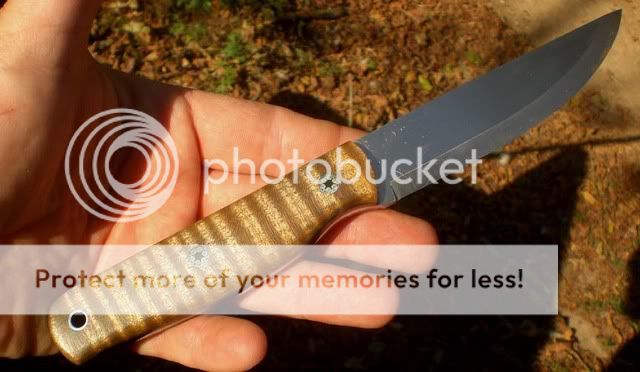
I have a Brian Andrews small knife in D2. I also have a Charlie May. I like both.

I think the key is intended use.


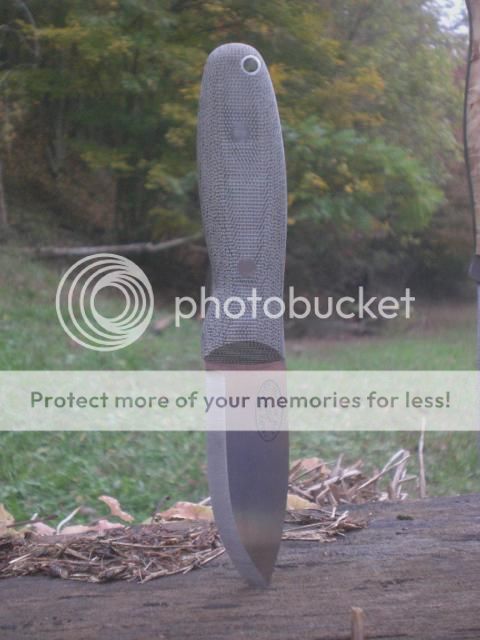
I have cleaned out deer with this little knife and hit bones and stuff w/o any chipping

minitony1.jpg


I love this one
skifa1.jpg


I like to take the D2 when I'm going to be cutting up a lot of food that might rust an 01, or if it's going to be raining a lot and I don't want to fool with continually oiling the blade. Or if I'm going to have to make a lot of stream crossings. Also I find that once D2 is sharpened it is sharp. Where sometimes with 01, on a very fine edge, if it is exposed to a lot of moisture micro fine rust dulls the edge if you don't strop it.

So really for ease of use and sharpening 01, but I love having the D2 for wet conditions or times when I want to carry a blade for several days and not do anything to it.:thumbup:
 
Last edited:
If its good enough for the Australian Army...
DFB090-W.jpg

DFB090 Army $162.00
12cm D2 tool steel, 4.5mm thick blade, Australian timber handle

DFB090-A.jpg

DFB090A Army - antler handle $195.00
12cm D2 tool steel, 4.5mm thick blade, Antler handle

DFB110.jpg

DFB110 Drop Point Hunter $154.00
8cm 12C27 S/S 3.0 mm thick blade, brass bolster, Australian timber handle
http://www.deweyknives.com.au/hunters.html
 
Well you taught me something and maybe grind was too strong of a word.

Thank you for not taking what I said, personally. Hopefully, we're all trying to learn together. :)

I looked up charpy as I hadn't heard of it, very interesting stuff...

Glad to hear it. Industry tests are not the be-all/end all, but they can provide a sort of baseline.

If its good enough for the Australian Army...

Sorry mate, that info is utterly useless without details regarding Rc hardness, cryo or not, edge thickness, final geometry, final edge angles, etc. Just saying that some gov't agency accepted one bid or another is not exactly a huge vote of confidence... in fact, I daresay it's the opposite.

The most powerful military in the entire history of our beleaguered, war-torn planet has spent millions of dollars on half-vast knives made of half-vast alloys at half-vast hardnesses designed by half-vast committees for several decades, and continues to do so.... :p As a result, the most popular/widely-produced and imitated "combat" knife on the planet is barely adequate for anything at all, and excels at exactly nothing.
 
Last edited:
The Dewey is handmade of 3/16-inch D2, hardened and tempered to 54-56 Rc.
http://www.tactical-life.com/tactical-knives/dewey-aussie-army-knife/

GUSTAV EMIL ERN knives are made using steel of German specification 1.4116 for blades of 2mm thickness and under (filleting, paring, turning, etc) and specification 1.4110 for blades greater than 2mm (boning, cooks, butchers, etc)
DEWEY knives are produced using the following steels; D2, ATS34, K1073 and German steel 1.4110 and 1.4116.
German Spec US Spec Carbon Chromium Silicon Manganese Molybdenum Vanadium
1.4116 - 0.42-0.50 13.8-15.0 - - 0.45-0.60 0.10-0.15
1.4110 - 0.48-0.60 13.0-15.0 1.0 1.0 0.50-0.80 -
- 440B 0.85-0.95 17 <1 <1 0.9-1.3 0.07-0.12
- D2 1.5 12 0 0.4 0.8 0.9
- ATS34 1.03 13.75 .41 .25 3.56 0
1-4034 420 0.42-0.50 12.5-14.5 <1 <1 0 0
1-4125 440C 0.95-1.2 17 <1 <1 0.4-0.8 0
GUSTAV EMIL ERN knives are treated using a vacuum process and ice hardening to ensure a consistent top quality finished product. DEWEY knives have always been treated by the same company. Each batch is processed individually taking into account the type of steel and end use of the knife.
http://www.deweyknives.com.au/steel.html
 
Last edited:
The Dewey is handmade of 3/16-inch D2, hardened and tempered to 54-56 Rc.

That's ridiculously low; nowhere near the optimum hardness to make the most of D2's better qualities. There is absolutely nothing to be gained from tempering high-alloy steel that low. In fact, it's a complete waste of money, a blatant misuse of good tool steel and a downright dirty shame. Whoever signed off on that should be fired forthwith. Boo, hiss! :thumbdn: :grumpy:
 
Last edited:
But some good reviews

The point is sturdy enough that it should hold up for light prying and puncturing. According to Dewey, the Army Knife was also designed for digging. The thick tang should be usable for pounding, if needed, as well. I tried doing a few tasks with the Dewey and found it handled prying, chopping, digging and puncturing well.
Rob Dewey emphasizes that the Army Knife was not designed as a fighter, but any military knife might conceivably be used in close combat. The Dewey has a sharp point and a sharp edge, which would allow it to be used for slashing or thrusting. The heavy blade should also allow the sharp point to thrust through many layers of clothing if necessary.
http://www.tactical-life.com/tactical-knives/dewey-aussie-army-knife/

I thought it was very versatile as a camp knife. For me it did everything I wanted, it was used for food prep, fire making prep, and shelter construction, ie shaping a couple of large branches for tarp support, and all the usual stuff cutting ropes etc.
http://www.australianbladeforums.com/vb4/general-blade-discussion/16788-dewey-knives.html
 
Thank you all for the information concerning this post i REALLY appreciate it. ive been convinced 154cm is a better bushcraft steel. If you all would like you caan reply to a thread i posted about deeper professional insight on 154cm.
 
Back
Top