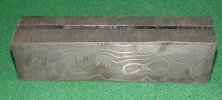
Damascus etching question

Always HT your damascus! If you don't want the hardness, draw it to about 500-550F. Much more than that and you'll lose contrast.

-d
 
Pre-HT, the 1084 is pearlite, which etches a gray color. The 15N20 etches gray because of the nickel.
Post HT the 1084 is martensite with very low alloy content, which etches dark. The 15N20 still etches gray,due to the nickel, so the post-HT contrast will be much bolder.
 
Always HT your damascus! If you don't want the hardness, draw it to about 500-550F. Much more than that and you'll lose contrast.

-d

I'm worried about the hosel warping when/if I do the HT. The wall is VERY thin. Is there any reason I can't clay-coat the hosel? It's the quench that warps, not the heating, right? Wow, at 1/2" thick, how long should I let it soak at 1450°?
 
I'm worried about the hosel warping when/if I do the HT. The wall is VERY thin. Is there any reason I can't clay-coat the hosel? It's the quench that warps, not the heating, right? Wow, at 1/2" thick, how long should I let it soak at 1450°?

How thin is "very thin"? .010", .030", .050"? Also, what are you using for a quenchant? If your normalizing/stress relief was done properly (and I happen to know it was ;) ) warping shouldn't be a huge issue if you're .030" or so thick. I will say that I'm not certain what the dynamics of the round and hollow cross section you're talking about there are. If you're really concerned about it, you could fit a plug into it (leave something to yank it out by) and quench it with a plug installed in the hosel (I'm making an assumption that I understand correctly what that is...).

As for soak time, preheat the oven, place the piece in and give it 3-4 minutes after the temp has stabilized after it's inserted and you should be fine. Are you using an anti-scale?

Drop me an email with a good number to reach you this evening and we can chat about it a bit if you want.

-d
 
Yes, I will have to research anti-scale. Very thin is .009" at the thinnest spot. I think it's parks 50 quenchant. I will try to keep it a little thicker on the next one that I make. I'm gonna clay-coat the hosel on this one due to the thinness. I think you have the hosel correct. It's the round part that a shaft goes into. A plug is a good idea.

That bullseye is just perfect where it is on the metal! Awesome job on it! If I can get it quenched this week it shouldn't take much work afterward to finish it. Just some light sanding, etching, and glue it up! I would post pics, but my camera is still at home:{
 
Yes, I will have to research anti-scale. Very thin is .009" at the thinnest spot. I think it's parks 50 quenchant. I will try to keep it a little thicker on the next one that I make. I'm gonna clay-coat the hosel on this one due to the thinness. I think you have the hosel correct. It's the round part that a shaft goes into. A plug is a good idea.

That bullseye is just perfect where it is on the metal! Awesome job on it! If I can get it quenched this week it shouldn't take much work afterward to finish it. Just some light sanding, etching, and glue it up! I would post pics, but my camera is still at home:{

I'd never recommend it for a knife, but maybe you want to just quench the body of this one......009" is AWFULLY thin. On the next one, leave some more meat there to machine/grind away after HT.

-d
 
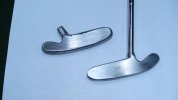
I may have missed something. What is a hosel? When I googled it, it said is was a part of a golf club. Are you making a damascus golf club?? (I hope you are, but the .009 has me stumped)
 
I may have missed something. What is a hosel? When I googled it, it said is was a part of a golf club. Are you making a damascus golf club?? (I hope you are, but the .009 has me stumped)

Yup, he is indeed.

-d
 
Yes, it's a golf club. Been working on the design, implementation, material, etc., since a few weeks before Ashokan. Deker has produced a beautiful piece of damascus for it, with a big bullseye right on the sweet spot of the putter face. I figured I'd do a WIP as soon as I'm done with it. It's been a great learning experience with lots of filing, as well as having to repair my bandsaw from trying to cut such a thick piece of damascus. BTW: The hosel thickness isn't an issue on a putter. On the sand wedge that I'll make next, it will be a different story. I need to learn how to forge a bit more before I begin it.
 

Attachments

  • 4.jpg
    4.jpg
    25 KB · Views: 29
  • 1.jpg
    1.jpg
    56 KB · Views: 26
Can't wait to see them all etched up and finished!

The more I think of it though, the more I will tell you to use anti-scale on that piece. With the hosel being as thin as it is, you're not leaving yourself much room for cleanup if you don't. Sand to 600 grit or so and use anti-scale. I like the Brownell's anti-scale powder, but if you're short on time (and I know you are), 100% boric acid roach powder from the dollar store can work as anti-scale in a pinch. Just heat to 500F or so and sprinkle it over the piece until you have a thin, glassy coating over the piece. Most of it should pop off in the quench, what doesn't will come off with hot water and a scouring pad.

-d
 
Boric acid can be mixed with isopropyl alcohol and brushed on. Ignite, and let it burn off. Great anti-scale compound. You can dunk the part, too. Stir the mixture before applying.
Close the alcohol container, and make sure you don't have any on you before igniting it!
 
Been reading threads on anti-scale all day. Boric acid and alcohol it is. I'll take your advice and finish grinding before HT. Thanks for all the howtos on applying the anti-scale. I might have to beg someone to let me use their oven this weekend. Only 10 days left and a lot of HT to accomplish.
 
I've tried the boric acid and alcohol with mixed results. I'd say to try a test piece first to see how it goes for you. A 500F preheat will guarantee that the boric acid will melt on and flow since it melts at about 400F.

-d
 
Back
Top