Damascus patterns question

Joined
Nov 14, 2006
Messages
414
Hello everyone,
I've been wondering a couple of things about damascus patterns, and I'd like to know what others think about it.

Do collectors and buyers in general value more the "hard to make" patterns? Such as multi-twist, feathers, mosaics, than the "simpler" patterns?
Or is just a matter of final looks?
I love all damascus patterns, from the most simple random, but I think complex pattern show extra skills from the bladesmith.
This leads to another question: do complex pattern should be more expensive that simple patterns?

Any thoughts?
 
As far as cost goes, I think it is completely fair to charge more for a more complicated pattern because at the planning stage you know that the more complicated pattern will most likely take more time, more time hammering, more fuel used because it takes longer, etc. etc. so I think it is only fair since much of the cost of a knife comes from the time and expertise of the maker then it is justifiable to pay for the maker's time.

In my opinion collectors will seek out whatever styles attract them and there is no universal scale for this. Some really bold patterns might turn off some collectors whereas it might attract others. In the case of patterns it really is a matter of personal taste.

Just my two cents.
 
Besides personal taste, I think there is a simple truth: a complicate pattern in a bad knife will never be paid as a normal pattern in a good knife...
 
to my eye, when steel is pattern welded to fulfill a previously conceived design, it looks best. Most especially when the pattern follows the curvature of the blade as opposed to ending abruptly where the profile of the blade curves.

When damascus is used just because it's damascus, with the thought that it will draw buyers- without forethought of how it will interact with other aspects of the design- it can be a real turnoff.

I'd say it's a no brainer that as the pattern becomes more complicated, or if services such as EDM are outsourced, the price should reflect it.
 
I'm a huge fan of pattern welded steels. It can add to the aesthetics of a knife if both the design and the steel itself are executed well. It makes a knife more unique as no two patterns will ever be the same. And it's more durable than some other steels/finishes.

The more complex patterns not only require more time from a maker but often require more steel or waste of steel to achieve the desired pattern. So I feel it's reasonable that they would cost more.

I agree with Lorien in that I also like when the pattern follow the curvature of the blade. I especially appreciate when the spine of a feather pattern follows the blade centerline from guard to tip, except when the maker is deliberately creating a 'wandering' feather.

I like the complex 'Ws", ladders, feathers, wolftooth, mosaics, twists etc, however also like the heck out of a nice well executed random pattern.

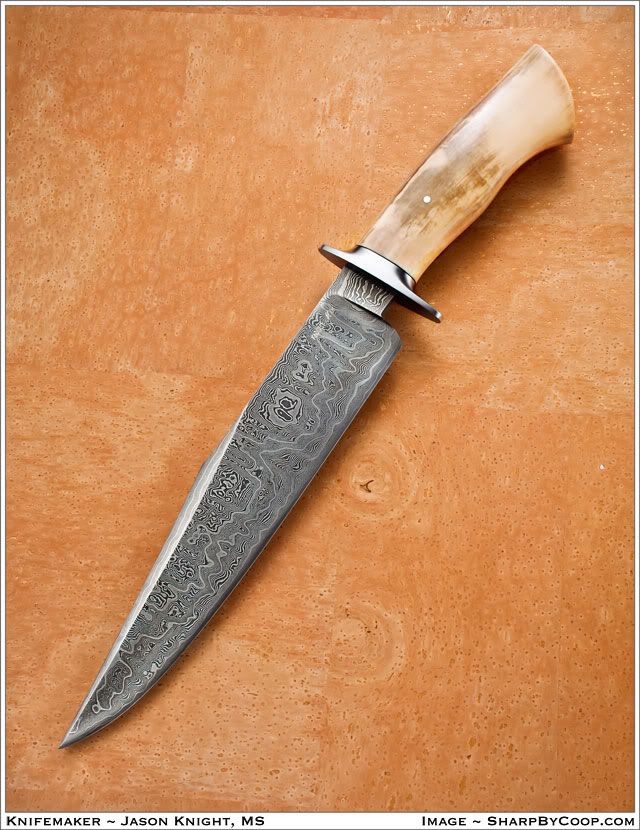
Knight_110611-web-1.jpg
 
Personally, how hard it is to make does not directly enter the equation for me - but may do so indirectly.

The factors that matter most to me when it comes to a Damascus pattern are the beauty, precision, and uniqueness of the pattern, and how the pattern integrates with the other elements of the knife. As you know, how well the the pattern follows the curvature of the blade can be very important to me - just as Lorien and Kevin noted. I also like it when the pattern is brought out all the way to the edge of the blade.

Some of my favorite patterns, when they are well executed, are laddered patterns and Turkish twists. I do not know if these patterns are harder to make or not, and I guess that I do not really care.

I suppose that excellent execution at anything is harder than poor execution - at least for most folks. But I am paying for the execution (result) itself - not the amount of skill or effort required. In general a knife will not command more money or attention from me just because it is hard to make.
 
I also like it when the pattern is brought out all the way to the edge of the blade.

I personally prefer that the final edge be applied apres etch.
Have a feeling that this is one of those areas that hasn't been discussed much in this forum, and I'm curious where other folk are at wrt this.
 
this is a intriguing thread im going to keep my eye on it. i have several Damascus pieces planed one that has been kicking around in my head for over a year now. its great to get the collectors view point on the higher end stuff
 
Have to agree with all thats been said here. If its got no flow, then its got no go. Nothing worse than seeing a damascus pattern that does not follow the lines of the blade. I like all patterns, ( if they are made well )some suit various blade types better than others. For example the dagger I put up here recently was made from Ws firestorm pattern. I have had the bar for some time with a slight etch,( so I could see the pattern )hanging around the shop. It screamed dagger. And now it is. I guess what I'm saying here is that it may not have suited a Bowie style blade.
Cheers Keith
 
Just for the visual joy of it, Manuel, here is a page from my book
Modern Custom Knifemaking (2006) displaying a few of the Mosaic
Damascus patterns made by Robert Eggerling (USA).

Pay special attention to the small Boot Knife he designed and made from
one piece of his Ladder pattern Damascus, made of 1095, 15N20 and O2 (129 layers).

The design of the handle, two wings, each folded in on itself from opposite directions,
makes this knife unique.

It also shows the simple beauty of a well made Ladder pattern Damascus shaped
by someone with an amazing eye for original design, who does not usually make knives....

All the best,
David Darom (ddd)

Damascus-page.jpg
 
Manuel-

This is something that I have discussed with a few friends many times.

IMHO, doing complex patterns has to be a labor of love. Just like doing a blade with a polished hamon.

When making a complex pattern (at least in my experience) you can easily spend triple the amount of time that it takes to do a more basic pattern--- but can you charge 3 times the amount for the finished knife? Nope. No way.

I think if a guy is going to do the fancier stuff, it has to be to make an impression and give his customer some extra "wow factor" but not to make more money.

Just my opinion... :)
 
Complex patterns are time consuming and extremly wasteful of materials. In a finished knife the pattern should flow with the rest of the knife.
I have wasted up to 90% of the material on some of my complex mosaics. Should I charge more for the finished product? Yes and I do.
Do I get paid 3 times what I think it is worth? No.
I think there has been less interest in high price and inovative patterns. But you will continue to see them because it is hard to slow down creative minds.
Just a few quick thoughts, Gary
 
Nick the "Wow" factor should always enter the price factor and be charged for on any knife. Gary
 
Thank you David for the picture, those mosaics are a clear example of complex damascus. Gorgeous work...

Nick, "doing complex patterns has to be a labor of love", I agree completely...some times you just want to do something beautiful, you don't think about a potential client.

Thank you all for the comments.
 
For my own point of view, the first thing I though when I see the knives is how it looks, No matter is complex or simple. If is beautiful, I will buy it. No consider the useful too much. For the price, it represent the materials cost and bladesmith work fee, if it take too much time, should be more expensive.
Hang
 
I have used a lot of different Damascus from many smiths. I purposely try to buy what I think will work for me as I see it. Not very often do I buy with the intention of using it in a particular knife. I find that getting the Damascus home and on a shelf where I often will see it, encourages me in time to come up with a pattern - styling suitable to it. The most variation in Damascus patterns comes from smiths making a mosaic type. These, however can be difficult to find a place where they work their best. Prices seem fairly competitive and I am pleased to say the quality is generally very good. Frank
 
Back
Top