DC power supplies

fitzo

Gold Member
Joined
Aug 14, 2001
Messages
6,648
What would it take to power a magnetic surface grinder chuck that operates on 110V DC? No info other than 110VDC. I don't have a clue what to look for or what it should cost. I googled for it but only come up with fancy stuff that costs $$$$.

Any help would be appreciated.
 
That's a pretty easy one Mike. I don't know the amperage rating for it but it will be close to what a comparable sized AC motor would pull. The simplest way to power it would be to Rectify an AC line. You then have 110-120 (more likely 118) DC. That should be well within parameters for the chuck.

Now simple doesn't always mean best. While that should work, I'd get a line conditioner to rectify and stabilize the voltage. Your still not talking much money.

Oh...to rectify it, just add two diodes, one in each line. The AC line will now become DC with one being positive and one minus. The diodes need to be turned opposite to each other so one lets the + flow to the Negative and the Negative lets the current go past.

Couple of bucks each for heavy diodes.
 
That's what I needed to know for now, Don! Thank you!:)

Edited to add: I don't have a clue about electrical stuff, so I'll need someone to walk me through building it. I'm looking at something, though, and needed to know whether I'm looking at a boat anchor or not. Thanks, again!
 
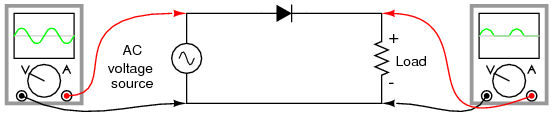
This might help Mike:

03258.png


This is a good link for more information:
http://www.allaboutcircuits.com/vol_3/chpt_3/4.html
 
Fitzo, take a look at this one.
http://www.jameco.com/webapp/wcs/stores/servlet/ProductDisplay?langId=-1&storeId=10001&catalogId=10001&productId=259741

It may be a little over kill but that will not hurt anything. A full wave bridge rectifier will allow more current then a half wave. It will need a good heat sink, the hole in the middle correspndes to a stove bolt diameter (#8) then it attaches to an aluminum heat sink to pull the heat away from the rectifier. You can get a small tube of dielectric silica heat sink paste at Radio Shack. You smear it around the surface contacting the heat sink so there are no micro gaps. You can make your own heat sink out of a chunk of aluminum. A 6"Lx4"Wx2"h piece would be adequate. You just mill out 1/4" troughs along the length of it to get the maximum amount of surface area. Drill a hole in the middle slightly smaller then your stove bolt and cut some threads and attach the rectifier (with heat sink paste).

The contacts just use regular spade connectors and the dot indicates the DC positive and the other contact kitty corner is the DC negative. The other two are the AC connectors.

I have built DC power supplies for years now and it is fairly simple. I can PM you if you want a slightly more complex capacitor set up to make a smoother sine wave output. For a mag chuck it probably is not needed unless you want to get rid of or reduce the 60hz hum.
 
Thanks, guys! I'll probably have some questions when I get to making this, so I appreciate the offer to help! :)
 
Do you know the amount of current draw there will be on the mag chuck? Make sure you get a rectifier that is rated at or above the draw of the chuck.
When it comes to a heat sink any large chunk of metal will work, like a metal table, bench etc. As long as you can tap a #8 hole into it and there is enough mass to keep the rec. cool then your set.

I have built DC power supplies from a few milliamps clear up to 50 amps and sometimes for very sensitive equipment that needs good filtering. If I lived close to you I would just come over and get you set up. It would cost you a beer though.
 
Go with that full wave rectifier. That way all you've got to design is a heat sink. At my work we use chunks of aluminum drilled with holes for a heat sink. Those full wave aren't too expensive either. Plus half wave rectifiers aren't as efficient and don't put out as clean a DC charge.

Why make one from scratch if you don't have to. Be super careful with hi amp DC power. AC power will throw a person if it gets you while DC will freeze you onto it and toast your A__!

I'm an electrical engineer.
 
I forgot to mention that in my forays around the metal scrap yards I quite often see alot of alum heat sink in many different sizes. The one I usually go to only charges $1.50 a Lbs for scrap aluminum, even it has been milled into a heat sink for a former use.
 
I envy your access to scrapyards, Brent! They won't let us into them around here; insurance liability is the excuse.

I'm starting to get cold feet about messing with this; I had a hunch this would happen. :o I've had my muscles locked up from a current before and I'm still afraid of it 40 years later. I've also seen a co-worker knocked unconscious by a 440V line and be lucky to live through it. A guy I grew up with took an arc through the forehead working in a substation; I would hope he never knew what hit him. Electricity just plain scares me: I look askance at my anodizer... :rolleyes:

I am going to make a call this afternoon and find out what a "generic" controller would cost from Electro-matic. There's also the possibility I may get to look at another chuck and see what the circuitry looks like. If I know for sure what I need, I know you guys can help me through the rest.

Thanks for the help, guys. I bookmarked the links.
 
welllll, the appropriate controller for that chuck, per Electro-matic, would cost me $850. Yikes! I think theirs is variable power, but, man, is that expensive! Scratch that option. :o
 
If you know the amperage pull I will build one for you with a heat sink and enclosure, and it will be far, far less then $850.
 
Seriously Fitzo that full wave rectifier was like 5 dollars. Its not hard to put together and as long as you insulate the lines you should never have to mess with it again. That's not such a big deal. I just wouldn't design a half wave and put lots of parts together if I didn't have to. Hope I didn't scare you away from the chuck. Sometimes I push electrical safety a little hard.:o
 
aproy1101 said:
.....Sometimes I push electrical safety a little hard.:o

No, that's definitely NOT the case, Andy! Your nod to safety is very much appreciated, believe me. I try to watch out for chemical safety just like you're doing with the electrical stuff. I would hope any here would apply their expertise to help someone avoid hazard.

Why would the controller cost so danged much if all one needs is a simple DC circuit?

Brent, that's a kind offer. I will get back with you after I see where this goes.

Thanks, again, guys!
 
A variable output controller will have alot of circuitry and is much more complex then just just converting AC to DC. The other reason is there is an incredible mark up on electronic devices when you look at the cost of componets plust the time to assemble it.
 
fitzo said:
What would it take to power a magnetic surface grinder chuck that operates on 110V DC? No info other than 110VDC. I don't have a clue what to look for or what it should cost. I googled for it but only come up with fancy stuff that costs $$$$.

Any help would be appreciated.
mIke
normaly they don't use ele curent for a
magnetic chuck for a surface grinder for safty sakes , and I say normaly..
if you lose power before the grinder stops or you get a blimp in the power the piece may end up in a wall or in someone and or distroying the stone and they don't weir well either:eek: .
they use opossed magnets for off and on..
 
Mike, if Brent gets tied up, let me know. I'll build it. The sinks aren't bad to mill out and like I said above, The diodes are not expensive.
 
Dan, thanks, I was reading that earlier today, "when it fails, it fails to 'off'". I've had projectiles come off that machine and it isn't fun. It gave me pause to rethink my desire for the little beast, because I had plans for using it on the surface grinder. I have a permanent magnet chuck, but the one I was looking at bent at one end. ;) I've always wanted to try one of those bendable chucks for tapering tangs.

I think I'm just about convinced this isn't for me.

Thanks, guys, I appreciate all the input.

Addded: Thanks, Don. You guys are way kind.
 
fitzo said:
but the one I was looking at bent at one end. ;) I've always wanted to try one of those bendable chucks for tapering tangs.
.
that sounds interesting Mike.

Mike you could keep two places on a permanent magnet chuck cut just for
tapering tangs as long as you use the same angles each time.
one angle for the non ground side then on the other position double the angle for the other side I havn't tryed it but can see it working almost:o ,

two problems though
if you do a lot of grinding on one side you will get warping and then your angles won't work for you any more, surface grinding is good but gives you more problems to work out:D
never mind,,,, I wondered why I havn't done that myself:D hehehe:)
 
Mike,
If you've seen a good home-brewed set-up for anodizing titanium, they should give you enough power to run your chuck.
Most of the controllers I see for chucks are kind of light weight 300 to 500 Watts units, so unless you've got a really huge chuck, you don't need too much power.
 
Back
Top