
Design Advice - matched knives

Joined
Jan 3, 2011
Messages
205
I'm working on a design of matched knives while I'm filing my first knife.

I wanted some input on the design. I intend for these to be "Kitchen Knives" at Stans suggestion that this steel makes for good filet/slicers.

I'm thinking of a plungeless/convex type grind. Most common used would be preparing meat (trimming fat, cubing etc). For fun I want to try to get two knives out of the bar, so I'm trying to think of either symmetrical designs or maybe even a different design for each from the same dimensions. They'll have the same handle material - some kind of wood with brass pins but I havent decided for sure on that one.
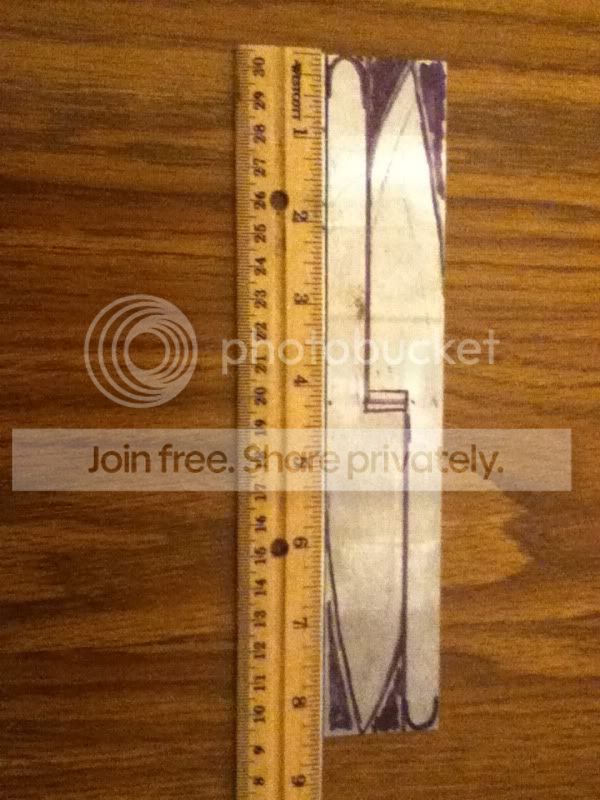

3c8cb71c.jpg


Thoughts?
 
I see people draw that placement of two knives on a bar of steel often. They look at me kind of funny when I ask,"How are you going to cut the piece between the two ricasso areas?" Then they say, "Yeaaahhhh?"

Generally, you need to make the knives back to back, or cut them with the tips by-passing each other at a diagonal.
The desire to get two knives from one piece of steel is good, but not always practical.

If you have a jeweler's saw and some #2 blades, you can cut that last section as drawn.
 
I did that once, and used a dremmel cutoff wheel VERY CAREFULLY to cut between the ricassos. Took a whole pack of those little wheels to accomplish it because they break easily. A small gaffe where you score the tang of either knife would make an awful weakpoint IMO. I never did it again.
 
I see people draw that placement of two knives on a bar of steel often. They look at me kind of funny when I ask,"How are you going to cut the piece between the two ricasso areas?" Then they say, "Yeaaahhhh?"

Generally, you need to make the knives back to back, or cut them with the tips by-passing each other at a diagonal.
The desire to get two knives from one piece of steel is good, but not always practical.

If you have a jeweler's saw and some #2 blades, you can cut that last section as drawn.

you could take out the bulk of that with the drill

That was the general idea...I thought of cutting it and then added those extra lines so I could use my drill press and then square it up against the platen/with a file. I plan on cutting the rest with a hacksaw.

As to the steel it's 1/16x8.5"x1.5" 15n20.
 
In my admittedly limited experience, at 1/16" thick, it's no so tedious to dremel or hacksaw apart. However, a little space between the knives would give you a bit of leeway if the hacksaw or dremel wandered.

On the other hand, 15N20 is inexpensive. 1.5x48" bars sell for less than $10, so this is like $2 worth of steel you are working to save. It's probably not worth it if it takes $5 worth of tooling and an extra hour of your time.

I would consider starting by making the outline exactly like you want, THEN seeing if you can get two of them out of the piece of steel.
 
In my admittedly limited experience, at 1/16" thick, it's no so tedious to dremel or hacksaw apart. However, a little space between the knives would give you a bit of leeway if the hacksaw or dremel wandered.

On the other hand, 15N20 is inexpensive. 1.5x48" bars sell for less than $10, so this is like $2 worth of steel you are working to save. It's probably not worth it if it takes $5 worth of tooling and an extra hour of your time.

I would consider starting by making the outline exactly like you want, THEN seeing if you can get two of them out of the piece of steel.

Stan sent me this steel in a starter kit so I want to make the most out of it. That was my primary driver. If I'll make a better knife getting one piece out of it then I'll do that. That would make the blade ~1.5 inches at it's widest instead of 1".

I'll draw up some further designs today
 
WEDM for the win!!! and its cheaper way to go as well. a little bit slow tho, take few hours for the mechine to finish the cut.

btw, i am curious, why don't see you makers use WEDM a lot??
 
I should mention that I'm pretty close to a beginner myself and have been struggling to make kitchen knives I'm happy with.

The recent thread on Kitchen knife with no plunge lines saved me a BUNCH of heartache on kitchen knives. And, (if you have a grinder) it can be done without using a hard platen, so it uses fewer sanding belts.

Are you planning to heat treat yourself, or send out?
 
WEDM for the win!!! and its cheaper way to go as well. a little bit slow tho, take few hours for the mechine to finish the cut.

btw, i am curious, why don't see you makers use WEDM a lot??

For me, I am a home shop enthusiast, not making large numbers of knives, and working out of a garage shop. If my little pocket tools ever go to a production run, I would probably send out for waterjet versus EDM because I worry waste heat with EDM might affect the blade. (That said, I know many great knives have been made with EDM, so it's probably not a big concern).
 
My advice is to worry less about "making the most" of a piece of steel, and focus instead on making the best knife you can from that steel. Doing things like this to minimize waste can end up creating waste by making it impossible to make even one good knife from the steel. Just a thought.
 
For me, I am a home shop enthusiast, not making large numbers of knives, and working out of a garage shop. If my little pocket tools ever go to a production run, I would probably send out for waterjet versus EDM because I worry waste heat with EDM might affect the blade. (That said, I know many great knives have been made with EDM, so it's probably not a big concern).

EDM "waste heat" is very minimal, >.001" if done right.
 
WEDM's waste heat is no more than 0.03mm. not a big problem for a knife since you have to grind it anyway.
 
How are you going to attach the handle material? The drawing sort of looks like it will be a hidden tang design rather than a full tang. Is that correct? Do You have some idea of how you want the completed knife to look?

- Paul Meske
 
My advice is to worry less about "making the most" of a piece of steel, and focus instead on making the best knife you can from that steel.

I agree! Good steel is inexpensive, compared to the time and effort that goes into making a great knife. The only time it really pays to concern yourself about using every square inch of steel is when you're buying in much larger pieces/sheets and "nesting" several blades into that shape.

Think of it this way, when working by stock-removal, you're going to drill and grind away about half the steel anyway. Perhaps more if you go for full-distal tapers and nice keen grinds. Is that "waste"? Now if you really want to make the most of every bit of the steel, the guys who forge can show you how to do that. :thumbup:
 
I agree! Good steel is inexpensive, compared to the time and effort that goes into making a great knife. The only time it really pays to concern yourself about using every square inch of steel is when you're buying in much larger pieces/sheets and "nesting" several blades into that shape.

Think of it this way, when working by stock-removal, you're going to drill and grind away about half the steel anyway. Perhaps more if you go for full-distal tapers and nice keen grinds. Is that "waste"? Now if you really want to make the most of every bit of the steel, the guys who forge can show you how to do that. :thumbup:

+1

Also +1 on Tryppr. IMO, the profile needs work. I think you would be better off making one knife out of that steel. Lonepine suggested that you may be making a hidden tang. Based on the length of your tang, I fear it is supposed to be full tang. Not enough handle. I made one with a small handle like that and although some people I know like it, I don't.

Erik
 
Back
Top