There's been a lot of misunderstanding about the screws on the 42.
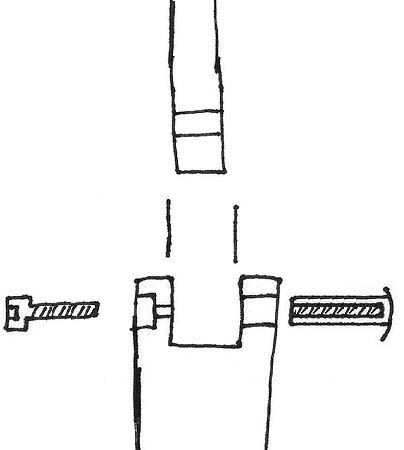
The figure below shows a simplified exploded diagram of a cross-seciton of one of the 42's joints. The handle is on the bottom. The screw is on the left. The pin is on the right, the blade is at the top, and the two vertical lines between the blade and the handle are two washers.
The pin is hollow and threaded on the inside to accept the screw. I know that for some of you who have had the cheap imports, a hollow pin may sound alarm bells. Fear not saddle pals. Benchmade knows Bali-Songs and has successfully been making them for the most demanding users for decades. This pin is made of titanium which is very strong. Furthermore, while it's hollow inside, the walls are still plenty thick.
If you leave the walls thick enough, a hollow pipe can be almost as strong as a solid rod. On many parts, the contribution that material makes to the strength of the overall part is inversely proportional to that materials proximity to the edge of the part. This explains, for example, how an I beam, which may have only 10% of the material that a solid bar would, can be almost as strong as a solid bar.
Furthermore, once you put the screw into the pin, the pin essentially becomes solid again. So, I don't think you have to worry about pins breaking prematurely.
The pin is press-fit into the handle. If you remove the screw, the pin does not just fall out. I don't know the actual specs, but I have seen the press that Benchmade uses to press the pin into the handle and it would not surprise me at all if over 100 lbs of pressure are used.
Why do they do this? Well, first, they don't want the knife to fall apart if the screw should fall out. Second, they don't want the pin turning in the handle. That would create wear between the handle and the pin and would eventually ruin the handle. The interface between the blade and the pin is loose enough to get a lubricant into it and keep that wear to a minimum. And, third, they don't want the pin wobbling around. That would make the knife messy to manipulate.
What Clay discovered in a Bar in Atlanta, aside from the fact that can't substitute a hammer for frys, is that this press-fit means that disassembling this knife requires more than a torx driver.
This knife is not intended to be frequently disassembled. Driving the pin out and back in is a rather tramatic process for the parts in question. I don't know exact numbers, but my guess is that the handles will not endure this more than a handfull of times in a knife's life.
If you don't have a proper press (and most people who make and work on folding knives will since press-fit pins are commonly used in folding knives), you can take your 42 apart yourself if you want to. OF COURSE, DOING SO WILL VOID YOUR BENCHMADE WARRANTY. With a hammer and a little tool called a pin punch (less than $5 at Home Depot), you can drive that pin out of the handle. You can drive it back in with a rubber mallet later.
So, if the pin is friction-fit into the handle, then what's the screw there for at all? First, it provides some adjustment of the tightness of the joint. Don't expect this to completely compensate for splaying of the handle over time. This is a small screw and you'd be asking it to pull on two rather thick bars of Titanium. Second, the screw stabilizes the pin on the (in this picture) left side. On the right, the pin is held by being press-fit into the handle. But, on the right, it would be free to move if not for the screw. If that pin were left floating free on the left, the force of manipulating the knife would put a lot of stress on the right side of the handle and eventually break it. So, if you loose a screw out of your 42, put the knife aside until the screw can be replaced. Third, the screws make the knife much more manufacturable. The old design used press-fit pins too, but they were pressed into both sides of the handle. The process for doing this is quite demanding. And, forth, the screw allows the knife to be disassembled easily with proper tools when necessary. The old design was very difficult to disassemble because you were trying to drive out two press-fits without deforming the pin in the middle since it would still be going through the blade. This new design allows you to remove the screw and drive out the pin easily.
Finally, I think the screws are kind of attractive. Torx screw heads have a sort of sparkly look to them. I'm looking forward to getting mine fileworked to further enhance that appearance.
So, there you have it, the "inside" story on the 42's joints.
------------------
Chuck
Balisongs -- because it don't mean a thing if it ain't got that swing!
http://www.balisongcollector.com
Post #1100!
[This message has been edited by Gollnick (edited 06-10-2000).]