
different angles for different uses?

Joined
Aug 12, 2009
Messages
410
hey guys, in a few days I'm going to receive a dmt aligner sharpening kit in the mail. Ive got a few questions about what angles to set certain knives at.

1. What angle for kitchen knives meant for just slicing?
2. What angle for larger chefs knife the does chopping and slicing in the kitchen?
3. What angle for an outdoors knife, 5 inches made by puma, used for chopping? batoning, and anything the I encounter?
 
With the aligner setting 5 and 6 are all you will ever want to use. 5 for strength and 6 for most everything.
 
Never had an Aligner. Is setting 5 (strength) equiv. to 40 degrees inclusive and 6 (everything) equiv. to 30 degrees?
 
when you guys say 30 degrees or 40 degrees.. are you really saying 15 degrees per side or 20 degrees per side? or do you mean 30 or 40 per side?
 
I think anything between 30 and 40 inclusive is fine for most people, on most knives. Go closer to 40 for greater edge retention and strength, especially when chopping. Closer to 30 for improved slicing ability. It'll be sharp either way.
 
Kenix, I agree . I'll put a 19* edge on a field/ camp kife for heavy use and a 15* on a folder . DM
 
crap...you just saved me alot of frustration...im a dunce...

This stuff can be confusing. I've regularly got a little pointed hat on my head. Sharpening is part science and part art. The basics like edge angle and grinds you can pick up pretty quickly, but actually getting that hair whittling edge on a blade is where the art comes in, and in comparison to some of the artists here I'm still painting with my fingers.
 
Honestly, whether we're talking kitchen slicers or full blown choppers, I've never experienced better edge retention at 40 degrees than I have at 30-10 degrees inclusive.

My layman guess is the thicker the edge is, the harder the edge is going to have to work at penetrating whatever is being cut. In theory the 40 degree edge may sound more durable than a 30 degree edge for chopping, but think of how stressed the edge will get trying to force that chunk of steel through the wood.
 
Honestly, whether we're talking kitchen slicers or full blown choppers, I've never experienced better edge retention at 40 degrees than I have at 30-10 degrees inclusive.

My layman guess is the thicker the edge is, the harder the edge is going to have to work at penetrating whatever is being cut. In theory the 40 degree edge may sound more durable than a 30 degree edge for chopping, but think of how stressed the edge will get trying to force that chunk of steel through the wood.

That is a very interesing theory. I've never heard that before. You know, it makes sense when I really think hard about it (especially for ~30 degree inclusive edges), but it is just so counter-intuitive and contrary to commom wisdom that it's hard to fully buy into (especially for 10 degree inclusive edges... that's 5 degrees per side!:eek:). But I don't need to, only you do. I'll try it out for myself as best I can with my available knives, sharpeners and skills and see what happens. Thanks for this new perspective.:thumbup: Can't wait for other opinions to roll in on this one.
 
Another forumite posted a link to a article on sharpening that addresses the question of thin vs. thick edges. The author agrees with Vivi. Here's an excerpt:

The theory is that thick edges (larger angles) last longer than thin edges, and the majority of the knife buying public wants the edge to last as long as possible. But it doesn’t work out that way in practice. Thinner edges actually outlast thicker edges almost all the time.

The thinner edge starts out performing better than the thicker edge. So even if it does degrade it has a lot of ground to lose before it falls to the performance level of the thick edge.

Thinner edges cut more easily, putting less stress on the edge. If a thin edge takes three slices to get through a big slab of raw meat, a thicker edge might take six or seven. Or three with a lot more force. The thicker edge is doing twice as much work, degrading twice as quickly.

Thinner edges are easier to control. Lateral stresses are a significant source of edge degradation. The more smoothly, accurately and easily you are able to cut, the less lateral stress you put on the edge.

Thin is good.

http://forums.egullet.com/index.php?/topic/26036-knife-maintenance-and-sharpening/

Hope this helps.
 
"The thinner edge starts out performing better than the thicker edge. So even if it does degrade it has a lot of ground to lose before it falls to the performance level of the thick edge."

Sure, I agree with that. But what about when edge degradation is worse than simple dulling? When it is chipping, rolling, deformities, etc? If that's the case then the edge has no ground to lose before it falls to the performance level of the thick edge... it just jumps straight to almost unusable and in need of metal removal.
 
Keep in mind that the author of the article was talking about kitchen knives, but I think the principle holds for any normal slicing/cutting chore. Of course if one is trying to baton through wood or working with any particularly hard medium then a thicker edge might be called for.

Since I use a Sharpmaker as my primary sharpening tool my knives are either 15* or 20* per side. If I need something thicker than 20* it's probably time to reach for an axe.
 
"The thinner edge starts out performing better than the thicker edge. So even if it does degrade it has a lot of ground to lose before it falls to the performance level of the thick edge."

Sure, I agree with that. But what about when edge degradation is worse than simple dulling? When it is chipping, rolling, deformities, etc? If that's the case then the edge has no ground to lose before it falls to the performance level of the thick edge... it just jumps straight to almost unusable and in need of metal removal.

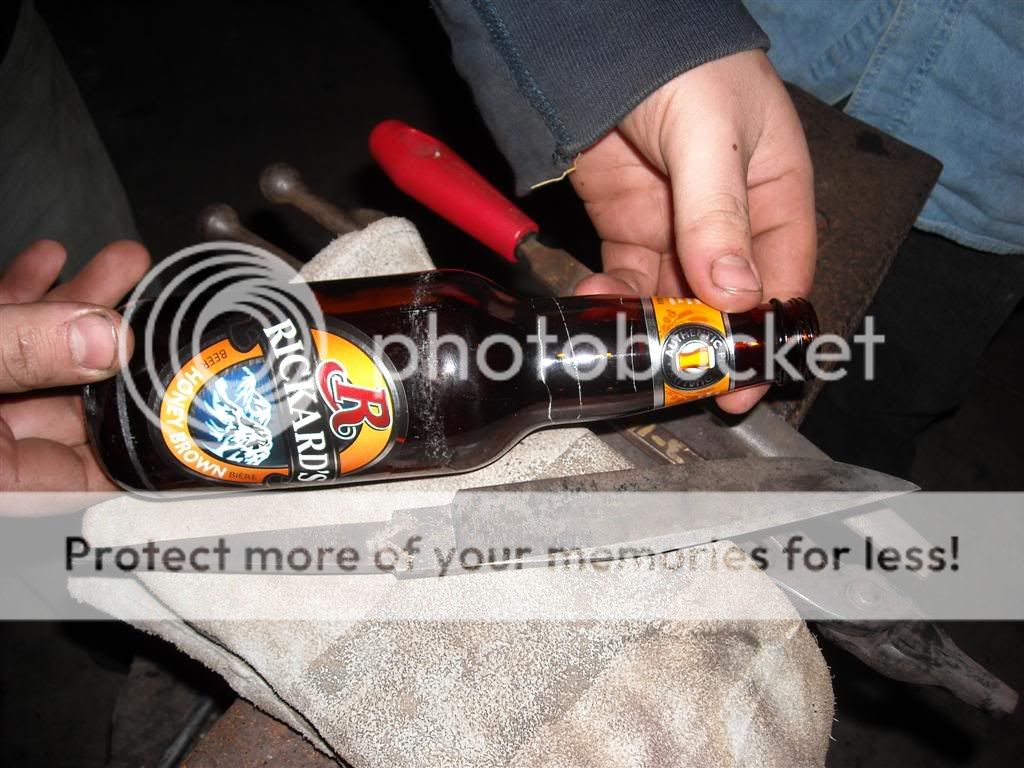
Chipping, rolling and flattening are the result of heat treating and tempering not so much edge geometry. Kevin Cashen has some interesting ideas on heat treating blades and foregoing tempering. Below is a picture of a blade from Ashokan 09. The edge must be 67RC or better to perform this.

image001-1.jpg


Johnny
 
Chipping, rolling and flattening are the result of heat treating and tempering not so much edge geometry. Kevin Cashen has some interesting ideas on heat treating blades and foregoing tempering. Below is a picture of a blade from Ashokan 09. The edge must be 67RC or better to perform this.


Johnny

Impressive:thumbup:
 
I must have missed something... all I see in that pic is a guy holding a beer bottle (mmmm... Rickard's) next to a file, a glove, some pliers, and a knife without a handle. Unfortunately someone's gonna have to spell it out for me.:o
 
Take a look at the bottle neck below the label.


Johnny

Okay, it looks cracked. Maybe my monitor sucks, but I still have no idea what's going on there:confused:. Can someone please tell me what I'm supposed to see and why it is relevant or significant?:)
 
Last edited:
Back
Top