Do I want a Cocobola handle?

Joined
Sep 21, 2008
Messages
144
I found a Buck 102 with a Cocobola handle. It looks nice. Is Cocobola something I want or a gimmick? It cost about $20 -$25 more than the regular handle. I wanted something with more grip but this knife doesn't appear to have that, so I wanted to get a "prettier" handle if I can't have one for utility. Thanks.
 
I always thought that it was one of the prettiest handle materials around. I would say, if you like how it looks and don't mind that it is not that grippy, go for it. That said, I don't have any cocobolo knives myself.
 
A cocobola handle adds to the esthetics, not the utility.

That being said, I think cocobola is really nice looking.
 
How likely am I to really need to worry about the grip as far as slipping goes. It is a small game knife. If it doesn't for small, does it matter for bigger game like deer? Thanks.
 
A cocobola handle adds to the esthetics, not the utility.

That being said, I think cocobola is really nice looking.

+1 :thumbup:

I have 'several' Queen slippies in Cocobolo.
They have a lovely dark warm color.
I really like Cocobolo as a wood on a knife.
 
Have a Spear point Hunter in it and it is exquisite. Define your need for grip. Many synthetics loose much of their superduper grip with blood. It won't improve the performance of the Buck but the pleasure of owning and using.
 
Meh.

The cocobolo on my knife has oxidized and is now all dark brown. No orange, no red, no yellow. Just dark brown, and almost black brown.

It has nice figure, but you have to get up close to see it.
 
Cocobolo is a first-blood relative of the rosewoods (family). Being a rosewood, it is dense, hard, and naturally oily to some degree, though you won;t feel that oil or know it's there. It normally doesn't change colors drastically as would, say, padauk, for example, though any wood will change color if exposed to the elements and, even if not overexposed, given enough time.

The higher cost of the cocobolo is for the buyer to decide. Like everyone said, it won;t improve the performance of the knife, just the aesthetics.

Here is a pic of a fixed blade in cocobolo:
EnZo-rswd-02.jpg
 
Cocobolo is a beautiful wood that has durability characteristics that make it ideal for knife handles. I highly recommend it.

Just to clarify what Stretch said, cocobolo is a true rosewood. It is a member of the rosewood genus (Dalbergia) not just the family.

The natural oil of the wood helps preserve and seal the wood (and it gunks up sanding belts). Cocobolo changes color strongly in the first few days after cutting, after that it only darkens a bit.

The quality and appearance of cocobolo varies widely in terms of grain and color. This is dependent on the tree and the way the wood is sawn. It may help to be able to pick out the specific knife, as the quality could vary a lot.

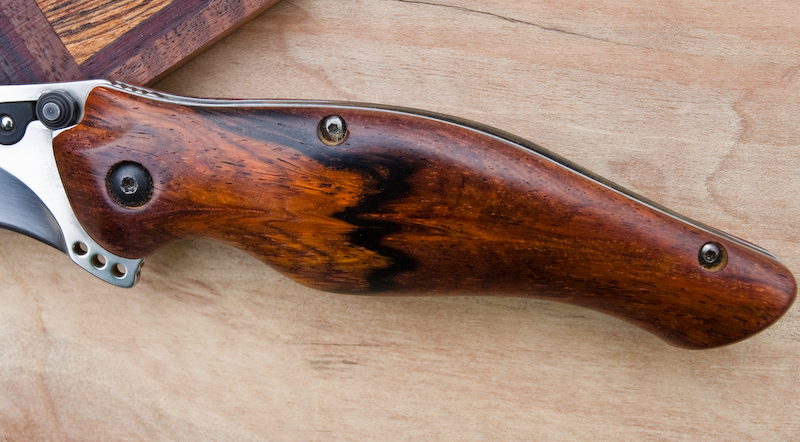
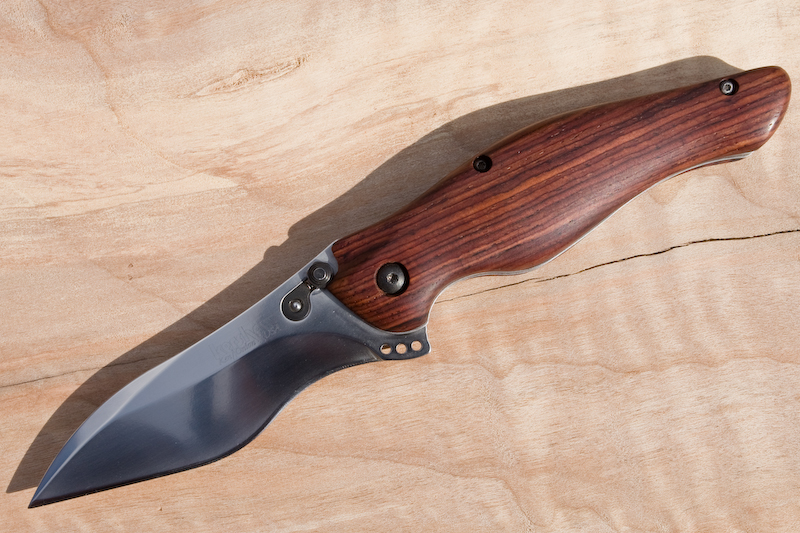
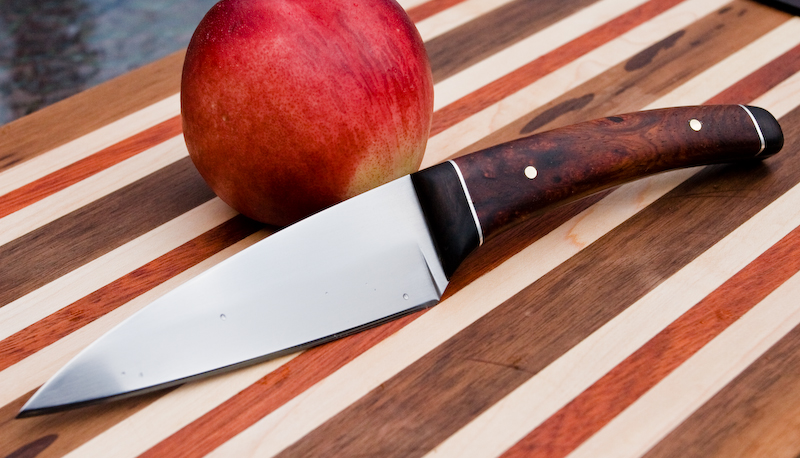
Here are some knives and handles I made from cocobolo, you can see some of the variety:

2911893371_3743729b98_o.jpg


quartersawn
2886110488_d69b1ed8a2_o.jpg


burl
2825998780_a737794fee_o.jpg


2680406833_bc34dc37f0_o.jpg


Phillip
 
Has anyone had any issues with natural woods in a low humidity area? Reno is VERY dry overall and may people have shrinkage problems with some wood PRODUCTS :D here.

I have wanted to try some wood scaled knives but am concerned about the edges shrinking and exposing the liners a bit.

I'm a guitar player and on a few of my guitars the fretboard shrank enough to expose the fret edges along the sides of the neck. Mostly on the ebony fingerboard guitars. Fortunately a product called Dampit in the case has eliminated the problem but I have to rehydrate them weekly.

Anyone?
 
I'd be more worried about a moist environment. But most of the time the problem comes from moving the lumber from a moist area to a dry one or vice versa.

Lumberyards in dry areas command a premium over those in moist places (unfortunately most exotic logs come on boats so lumberyards tend to be near ports). I live in a fairly dry climate and like to store my (air-dried) lumber for a while after purchasing it from coastal yards.

My cocobolo/blackwood kitchen knife has not shown any movement despite being rinsed in soapy water every day.

The only time I've had a problem with scales was due to very high humidity. I was on a very wet hike with my re-handled Kershaw RAM (I think I was using pernambucco at the time). By the end of the hike, everything was soaked including the knife that had pretty much been steaming in my pocket. The pivot screw goes through the scale, and as a result of the wood expanding, the pivot was a bit tighter than usual. This returned to normal after an hour back home.

I suppose all I can recommend is that you purchase your knife from a maker in a dry area. There will be no relative change that way.

Phillip
 
The knife will shrink slightly in Reno unless the knife is made in a similarly arid area as Firebert said. In the wintertime, some of my Bark Rivers will shrink slightly, exposing a tiny ridge of spine and in the summer will expand and the pins will seem to "sink" slightly. All in all though it's just nature at work. Chances of shrinkage or swelling (unless the knife you're considering has HUGE scales) to the point of annoyance are almost non-existent.

As far as the guitar goes, I play too. I keep a hyrgrometer in the case to monitor humidity levels but, unfortunately, this does nothing to alleviate the situation. Tuning is, of course, the greatest annoyance, and even that's minor.

Firebert you are indeed right about Cocobolo being of the same genus (dalbergia)as rosewood. That is what I meant when I said family, but was not "smooth" enough to say that in my post ((( :D ))) Nice knives, by the way. I especially like the wharncliff by the apple!
 
Back
Top