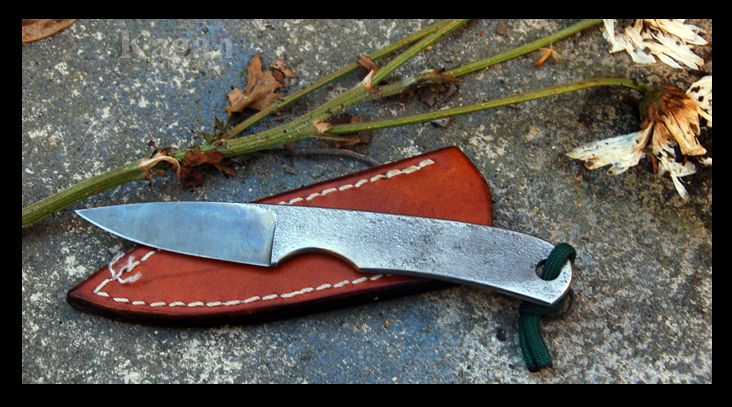
Does a knife blade require less maintenance if....

Joined
Mar 14, 2013
Messages
163
Does a knife blade require less maintenance or become maintenance free when it developes a patina?

 
Tarnish is a surface phenomenon, that is self-limiting unlike rust. Only the top few layers of the metal react, and the layer of tarnish seals and protects the underlying layers from reacting.
Tarnish actually preserves the underlying metal in outdoor use and is called patina. The formation of patina is necessary in applications such as copper roofing, and outdoor copper, bronze, and brass statues and fittings. Patina is the name given to tarnish on copper based metals.

Patina (pron.: /ˈpætɨnə/ or /pəˈtiːnə/) is a tarnish that forms on the surface of copper, bronze and similar metals (produced by oxidation or other chemical processes); stone;[1] a sheen on wooden furniture produced by age, wear, and polishing; or any such acquired change of a surface through age and exposure. Patinas can provide a protective layer to materials that would otherwise be damaged by corrosion or weathering. They may also be aesthetically appealing.
On metal, patina is a coating of various chemical compounds such as oxides, carbonates, sulfides, or sulfates formed on the surface during exposure to atmospheric elements (oxygen, rain, acid rain, carbon dioxide, sulfur-bearing compounds). Patina also refers to accumulated changes in surface texture and colour that result from normal use of an object such as a coin or a piece of furniture over time.

Wikipedia ^^

wheeler3_zps31b0c1d9.jpg
 
i dont think so but then again pretty much the only maintenance i do on knife blades is to sharpen them and wipe them off after i cut something. ymmv.
 
With carbon steel, less maintenance in my experience. Yet none are maintenance free.

I think that's my view as well.^^

Patina slows down reactions with rust-makers like moisture and food acids, but it still won't prevent rusting altogether. A lot depends on how the knife will be used. Acids in particular can also remove or change patina and attack the 'clean' steel underneath it. So, some care still needs to be taken to keep the blade reasonably clean after use. Salt and other chlorides (bleach) are also things to keep ahead of; it'll accelerate rust a lot, whether there's a patina or not.

I'm convinced patina helps minimize some rusting from handling (fingerprints) and from occasional light exposure to moisture. But still make sure to wipe the blade down, if it's wet.

I wipe my carbon steel blades down with some Windex on a paper towel each evening, before putting them away. That does a good job of removing the stuff left by the fingers (moisture, salts) and it's all I've needed to do to keep my blades in good shape (I don't even oil mine). Keeping the blade clean will take care of 99% of the worries. :)


David
 
"Patina" is not "tarnish".

"Patina" is oxidation of iron in the presence of moisture, which is to say, "rust". It isn't red rust, which is the result of a slightly different proportion of oxygen and water with the iron. But it is rust.

But it looks nice.
 
Quote by ISKski:

The formation of patina is necessary in applications such as copper roofing, and outdoor copper, bronze, and brass statues and fittings.

That's jut a rumor started by those who are too lazy to polish those applications.
 
You need a thick dark patina too really know what they are all about. Once you have one the knife is worry free. Can't say that for a shiney polished 1095 blade.

I also don't like polishing blades because just as the polish can be used to strop and sharpen it can dull it too when you polish the blade.

I let a real patina set in and strop the edge with a waxed compound. That protects the edge.
 
Patina does not make the blades maintenance free. You still need to keep them clean and rubbed down occasionally with a lubricant or protectant. Mineral oil USP or food-grade silicone spray (Weston, Kel food-grade) if you plan on using them for food prep. If not used often for food, then one of the non-food silicone sprays (Kel, Castle, CRC), WD-40 Silicone spray, Corrosion X, Eezox, Tuf-glide or anything that prevents rust and corrosion. You can even use light oils, I just dislike the oily residue myself. I used to use 3-in-1 but find that I prefer a silicone-based product instead.

Or you can just use it and clean it up with steel wool and one of the corrosion removers mentioned above if it develops rust. Just try to catch it early before it starts pitting the steel.
 
I also feel that a nice dark patina is more scratch resistant than bare carbon steel. I could be wrong.

With a deeper patina, you can still get rust in the right conditions.
 
all I know is that my carbon knife stopped leaving a bitter, metallic taste (you know what I mean I'm sure) after it got a decent patina. From what I can gather, that is due to less oxidised material rubbing off on the food, so the patina must have done something. Think I saw somewhere that people in the logging (?) industry used to force a patina on their new knives before they took them out into the wet conditions of whatever river they were in.
 
all I know is that my carbon knife stopped leaving a bitter, metallic taste (you know what I mean I'm sure) after it got a decent patina.

Yep. You'll often read that "carbon steel makes food taste funny," but this is just a temporary thing then ends once the blade has a proper patina.

Think I saw somewhere that people in the logging (?) industry used to force a patina on their new knives before they took them out into the wet conditions of whatever river they were in.

This is very very common. My grandfather spent the majority of his life in the Miami, Florida area, having moved there in the 1920s. He was a hard-working, blue-collar guy, and spent much of his free time hunting, and fishing on both salt and fresh water. I don't think he ever owned a stainless knife of any kind, even in the kitchen. Here's one of the old boning knives he used to fillet our fish when I was a kid ....

PumpkinCutters.jpg


(The peanut is mine.)

-- Mark
 
You need a thick dark patina too really know what they are all about. Once you have one the knife is worry free. Can't say that for a shiney polished 1095 blade.

What Kevin wrote. But in my experience, it doesn´t if it is 1095, C70 or any other carbon steel. As soon as there´s a thick dark patina on the blade I do not use to oil the knife. Those blades just get oiled, when I plan not to use the knife for some time.

I´ve never had any problems with rust, except on a Mora 711 which I put wet into the sheath and forgot to wipe it dry when I came back home from the building lot... some coarse steel wool and it the red oxidation was gone ...
 
Back
Top