Does anyone convex their traditionals?

Joined
Jul 29, 2011
Messages
38
I've been EDCing an old red alox SAK Pioneer for over a year now, and convexed it as soon as Igor it. Its a beater knife but is so reliable and easy to sharpen. Just a few strips on a leather belt and it goes back to cardboard shredding mode. From what I've seen in pictures here it sounds like most people keep a flat grind on their traditionals and convexing is more of a SAK thing.

What are your thoughts?
 
I'm pretty much going convex on most of what I own, because I mainly use my knives for bushcraft. Got lots of cheap Mora Scandis and they work great until the edge rolls. I've given a Mora Scandi a zero convex grind and the edge maintains much better now and it performs just as well.
 
I've convexed a lot of my traditional pocketknives, using sandpaper on leather, up through 2000 grit. The benefit of the convex is especially noticeable on those with flat grind blades. My 'best' examples are a Queen Country Cousin in D2, and a Buck 307 stockman (all 3 blades; 440A). The edges have been convexed on these, and they've become two of my favorite cutters. Really slick, whisper-quiet slicing. Small knives with VERY thin, hollow grind blades might not see a lot of difference in cutting ability, as the thin blade makes most of the difference anyway.
 
No, I don't convex. I like to be able to sharpen up anywhere and any time using whatever is available. Bottom of a coffee mug, top of a car window, a piece of smoothed off brick, smooth stone from the creek, the little cut down Eze-lap model L in my wallet. Sometimes you're someplace with no sandpaper around, and your knife needs a touch up.

Carl.
 
Sandpaper isn't mandatory for maintaining the cutting edge on a convex bevel. I was sort of messing around with this yesterday, with a few of my convexed blades. A simple microbevel, applied with whichever tool is available, works fine. Don't touch the convex bevel itself, just do the very edge. This implies a slightly elevated angle (to touch JUST the edge), and a smooth, even stroke at very light pressure. I used my Sharpmaker yesterday, but exactly the same could be done with any other honing surface, same as any V-bevel. The slicing advantages of a convex are in the shoulders of the bevel, after all, which shouldn't need much maintenance at all (unless one has waited way too long to touch it up). The cutting edge is still just an edge.

And so long as you don't wait too long to touch up, simple stropping on any relatively smooth surface can keep a convex in good shape. That's how I've been maintaining the edges on my previously-mentioned traditionals. Rarely gone back to the sandpaper, unless I'm looking to deliberately thin the profile a little more. Wood, cardboard, paper, fabric, leather belt; all will work. Apply a little dust/fine dirt or other convenient abrasive to the stropping surface, if a little more bite is needed.

 
Last edited:
Yes. The only traditional knives I use are for whittling and carving...and convex edges are what I prefer for that sort of work.
 
I've convexed quite a few knives, both of my own, and for other people in the course of sharpening down at the shop. I like the way a convex keeps cutting long after it seems like it SHOULD have stopped (see light on the edge, doesn't shave, etc). I guess I'm not all that obsessive over my precise edge geometry. If the knife cuts well and serves the purpose I have it for, then I'm quite happy with it. Requirements vary by job, of course, but ANY of my knives will shave easily before I consider it 'ready to use' off of any medium.

That's not to say that I don't have V-bevels as well, for some jobs it's really hard to beat the performance and looks of a highly-polished V-edge. I very rarely need to touch up an edge in the field, and if I do I generally just use whatever sharpening method I have available, typically my Sharpmaker or a pocket DMT plate. A covex will easily take a fine V-microbevel that will keep it cutting if needed, and a V can be slightly convexed on a strop to remain useful if that's what you have handy.
 
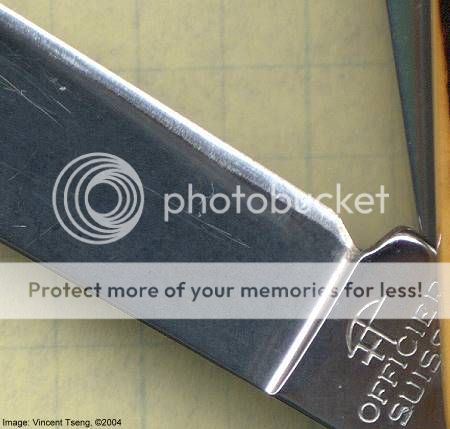
Please take a look at this nearly 7 years old thread:

Convexed Edge (link)

where I show convex edge on a SAK -
which I had been already doing for 10 years back then ......

detail:
Scientist_ConvexDtl1.jpg


There is also now an affordable belt grinder knife sharpener that can easily put a convex edge on almost any knife - please see:

:thumbup: Review - Work Sharp (belt grinder) Knife Sharpener (link)
--
Vincent

http://picasaweb.com/UnknownVincent?showall=true
http://UnknownVincent.Shutterfly.com
http://UnknownVT.Shutterfly.com
http://UnknownVT.multiply.com/photos
 
Yes, I convexed my whittler. I used sandpaper to establish the bevel and my leather belt and compounds on my 1SM to finish the edge and keep it up and splitting atoms and what not :)

My EDC I keep sharp on a flat stone.

For whittling the convex edge helps I think.
 
I convex all my pocket knives. Guess what? I've convexed 90% of them with a hard flat coarse hone. You don't need sandpaper, or anything soft to convex a blade. And you don't need anything different to maintain the convex edge either. I'll bet if jackknife took a real close look at his edges he'd find that they have a shallow convex to them. As I know from reading his posts, he sharpens by hand without any type of jig. Want to know how easy it really is to convex with a flat hard hone? Take any cheap soft butter knife and a really coarse hone. Lay it flat on the hone and then very fast and sloppy scrub back and forth. You will quickly convex the blade. Truth is it is harder to really get a flat bevel freehand than it is to convex freehand. After you have convexed a few you will see it is even easy to ajust to how much of a convex you want to get. I put on a pretty shallow convex to my pocket knives and they pretty much are fully convexed from edge to spine.
 
uhfullconvexback.jpg

uhfullconvex.jpg


I convexed the whole blade on my uncle henry. I tried to keep one side a lot flatter than the other so it's almost like a half-chisel/half-convex.

Just used my water-stone, ground in some very steep relief angles, the started rounding everything by rocking the spine up and down with the motion of the strokes. It's not really hard to figure out if you think about it and I think it might be a little quicker since you can be a little less meticulous when setting the bevel. Well, maybe not that, but having a motion where your wrist can kind of rotate just feels a little more natural than trying to hold it perfectly straight, so it's easy to drag the spine up a little high to get the burr on there and then just blend it in with the rest of the edge and be done, meanwhile with a V-bevel you'd be sitting there paying attention to keeping the bevel face perfectly flush with the stone surface.
 
Back
Top