drilling and tapping

Joined
Feb 16, 2010
Messages
3,668
Is there any reason I can't use my drill press as a tap holder? I've always had trouble holding the T handle perpendicular to the metal. Just attach a handle to the chuck and some rubber bands to pull the handle down and it should be good to go.
 
Sure, why not?
On some things I actually use the drill press. If the material is fairly thin I turn off the press just as the tap enters the piece. It has enough torque left over to do the tapping. On thicker stuff I turn it off before the tap runs clear through. It doesn't take long to get a feel for it.
A Tapmatic would be nice, but they are a little spendy.
Oh yeah, I only do it on holes that that go all the way through.
 
i was taught that you had to back the tap out a 1/4 turn for every full turn in and as such would not recommend tapping with any drill. but that is just what i was taught. i would be interested to hear what others have to say.
 
Being ham-handed I've had better luck just turning the chuck in my drill press by hand than using the T-handle.
 
It sounds like you are planning on using the drill press only as a means to keep everything perpendicular. I don't see any problem doing that. I'm not a big fan of "power tapping" as it seems to greatly increase the chances of breaking a tap, especially on deep, blind holes where chips can escape. You lose the "feel" of hand tapping that tells you when you need to back off.

Often times on the lathe, I will put it in neutral, throw the tap in the tailstock, rotate the chuck by hand until the tap catches, then loosen the Jacobs chuck that is holding the tap, attach a t-handle and finish up.

If you don't own any already, buy a can of Tap-Magic. It's good stuff.
 
There is even a tap wrench for that purpose, sometimes called a machine mount with guide, like this one from McMaster-Carr part number 2550A64. The rod is held loosely in the chuck, it helps keep things lined up, I bought one when I had to do a bunch of 0-80 blind holes in a sculpture I was doing, it really cut down on broken taps. The only time I've broken a tap using that kind of wrench is when I rush and don’t back out to break the chip.

Todd
 
Yes, I plan to just use it to hold the tap perpendicular. I just tried it and it works great. I did 1/2 turn forward, 1/4 back. Now, if I can just figure out how to drill through hardened steel. . . .
 
Well, my opinion is that the auto chuck that disengages the torque of the tap matic really helps to prevent breaking the taps where the mill would just keep forcing it down and probably break the tap off if you are talking about just using the mill chuck to tighten down a tap. That could get expensive fast. If you are referring to running the tap matic in the mill well sure. In fact I prefer doing it that way than in a drill press. It might keep it straight better but it won't prevent breaking it if it binds from a thread burr or bottoms out on you.

I've used the drill press to turn the chuck manually but if you are going to do that just get one of those bench hand tappers like the one Knifekits sells/sold at one time. I say that because they still show it almost. http://www.knifekits.com/vcom/index.php?cPath=49_211

I think Enco and some other places sell these too.

STR
 
Never power tap thick material or you will break the tap and then spend hours getting it back out. Easiest way to tap a good hole is put the tap in the press but only hand tight, no chuck key use. If you can slow your press way down then do so( less than 200 rpm if possible). Start it up, run it down until it bites then let go of the handle, the tap will pull the chuck down until it digs deep enough to spin the chuck on the tap. Stop the machine, remove the chuck then do the rest by hand, once a tap starts straight, it will tap straight every time. That is how a 35 year machinist taught me how to do it, I have never had a bad tap and I have broke 1 tap out of god only knows how many holes. If you have a one speed drill it can be done, just make sure the chuck is only hand tight and your finger is on the stop button.

To drill through hardened steel all you need is a harder drill bit and a slower speed. The rule of drilling, the harder/bigger the hole/material the slower you must go. High speed with hard metal or a bigger bit is death to any drill bit. Slower the better, if you do not have a variable speed drill you should probably just take it to a machine shop. Pay them to do it, save money by not killing 20 drill bits. A few holes from a man with a mill is not going to be more than a few bucks unless you pick a shop full of greedy people.

 
if you can keep it perpendicular, you can use a cordless powerdrill to tap since it stops almost instantly and then use the reverse to back out the tap.
 
I use the drill press to hold the tap and turn the chuck by hand when starting to tap. Once the tap is about halfway in I'll go to the wrench. Popping the belt off the pulley first makes it easier to turn the chuck.
 
i was taught that you had to back the tap out a 1/4 turn for every full turn in and as such would not recommend tapping with any drill. but that is just what i was taught. i would be interested to hear what others have to say.

That's what I learned too, and is correct for hand taps, but there are taps (usually 2-flute) that are made for machine tapping and you just run them straight in and don't reverse until the job is done.
 
similar theory, when I am tapping a hole in the lathe I put the tailstock center into the divot (center) on the top of the tap. Then put a loosely fitting adjustable spanner on the square drive of the tap, supported on the tool post, Then slowly slip the clutch on the lathe, following up with the tailstock, and toolholder as the tap cuts.

The adjustable spanner jaw usually 'gives' before the tap breaks.

Im sure you could just put a center into your drill press chuck, some bungee cord to pull down on the drill press handle and use a small spanner, or open topped tapping wrench to drive the tap.
 
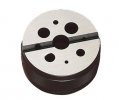
One option not mentioned is the use of a "Bench Block". Essentially a bench block is a block of steel with perfectly perpendicular through holes that are just a bit larger than the major diameter of various thread pitch. Using a bench block is simple in that you place the bench block over the drilled hole you want to tap, place the tap/tap wrench into the clearance hole, and cut threads. The bench block helps to keep the tap perfectly aligned and perpendicular in the hole, allowing proper hand tapping technique while doing so :thumbup:


:cool:
 

Attachments

  • starrett_129_lg.jpg
    starrett_129_lg.jpg
    12.3 KB · Views: 5
Last edited:
Yes, John mentioned bungee cords. I found 4 rubber bands did the trick nicely. I also learned just how dull my drill bits were. 2 new bits from Menards and no problem drilling through the tang or the Ti scales.
 
Back
Top