
Ed Caffrey handsanding technique?

Joined
Jun 4, 2018
Messages
110
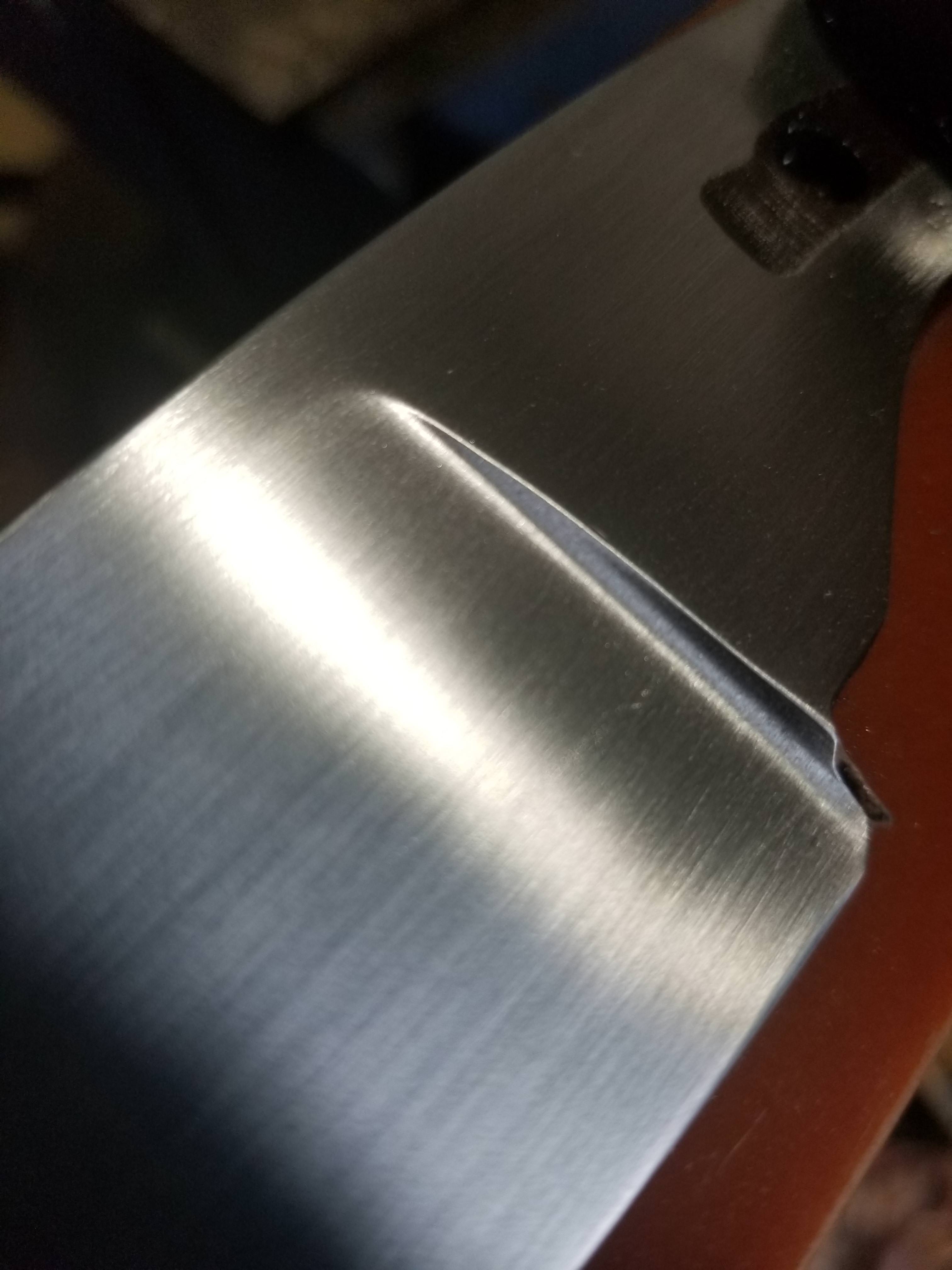
Currently working on a little 2.5" FFG knife and I bit the spine rushing my bevel up to the spine. Decided to take a welding magnet and surface grind some material off, which left me with a funky little flat:
GABns7X.jpg

MfZQksx.jpg


In my research, I came across this tutorial by Ed Caffrey, which piqued my interest. At 4:33 you can see Ed point out his very wavy inconsistent grind line, and simply states that he will just blend it in with hand sanding. Stopping short of the spine seems like it would make grinding FFG knives a lower risk operation, especially when focusing on the plunge lines. I have a hard time visualizing how this technique won't result in some funky reflections when the light hits that area.


Before I run the grinds all the way back up to the spine again, I thought I'd see what the experts here have to say, because I'm thinking about just giving Ed's technique a shot.
 
I think we all do a little blending when hand sanding, some try to do as little as possible and won't use a soft backer or wrapped paper until the very final grits. Others do more. Don't necessarily think one way or the other is right, but while I've definitely hand sanded things I just couldn't seem to get right on the grinder, these days I try to do as much as humanly possible before hand sanding.

So I would go back to the grinder but by no means does that mean you can't do it how he's showing. I just think it's more work in the long run, because if it's a grinding skill thing that prevents it from coming out how you want, hand sanding from there is just taking away practice.

When I first started on here I remember a guy posting something like "it takes me 1 cup of coffee to hand sand a blade, if it takes you longer you need to go back to the grinder." Don't remember who, but at the time I thought pfff yeah that'll never happen. But while I didn't think that was possible for me, I kinda took it to heart and now, while it still may be a little unrealistic for say, clean 1500 grit hamon prep, it's not entirely unreasonable for a blade sized like yours at 600 grit, coming off the grinder at 400 or better with your lines where you want them.
 
I agree with kuraki... The better you get it off the grinder the less you have to do by hand. The more you make knives, the less time you have/want to commit to hand sanding. One thing I learned recently is that getting a nice, even, smooth (~400grit) plunge on the grinder is a god send when it comes time to hand sand. Getting deep, 60 grit scratches out of the corner of the plunge is one of the most patience testing things I've done as a maker.

My guess is that Ed's lines might appear 'wavy', but the bevels are probably reasonably flat. You can get wavy lines by accidentally scuffing past your grind line. This isn't a huge issue, but if you have wavy lines because your flats or bevels have major peaks and valleys, then blending it in is not going to be easy, and as you said, very noticeable in a certain viewing angle. Most guys with the resources have a disc sander that they hit the bevels with before hand sanding, and it will generally remove any major peaks or valleys. The main reason the disc works better is because you have a much larger, flat contact area to flatten things out. A 2in belt on a 10in long knife leaves a lot of room for waves to form in the grinds.
 
I think of hand sanding (especially with 120-320 grit) as a form of blending and truing up flats, more than finish refinement, almost like draw-filing with sand paper.
 
By hand? Interesting opinions, I appreciate them.
Good quality Scythe stone is excellent for this kind of work .Coarse DMT diamond stone are even better and much faster for true flat bevels, and say 800 grit DMT diamond stone will give you almost mirror finish ...............
Try classc sanding with sand paper and flat piece of steel under then try DMT ...surprice , nothing can sanding/be true flat as DMT stone .
 
Last edited:
This is true. On some of the higher carbide steels (like S110V S90V, etc.) I have used diamond hones to true up areas post heat treat and the finish ain't bad. Most of the time I do my finishing prior to heat treat, so no need for Diamond. Surprisingly the wet/dry paper from Harbor Freight seems to actually work well (the Silicone Carbide stuff).
 
Good quality Scythe stone is excellent for this kind of work .Coarse DMT diamond stone are even better and much faster for true flat bevels, and say 800 grit DMT diamond stone will give you almost mirror finish ...............
Try classc sanding with sand paper and flat piece of steel under then try DMT ...surprice , nothing can sanding/be true flat as DMT stone .

I was going to adhere some sandpaper to the granite surface plate and give that a shot, I hadn't considered a doamond stone though. Are you finishing on the diamond stone after heat treat I assume?
 
......
Most guys with the resources have a disc sander that they hit the bevels with before hand sanding, and it will generally remove any major peaks or valleys. The main reason the disc works better is because you have a much larger, flat contact area to flatten things out. A 2in belt on a 10in long knife leaves a lot of room for waves to form in the grinds.

I do a long of belt grinding at angles or even full vertical. This allows you to get flat on a 2 inch wide belt. I guess this is the primary reason I haven't seen fit to get a disk yet. It works well once you learn the ins and outs, and it won't work on certain blade styles, but likely a disk won't either.
 
I do a long of belt grinding at angles or even full vertical. This allows you to get flat on a 2 inch wide belt. I guess this is the primary reason I haven't seen fit to get a disk yet. It works well once you learn the ins and outs, and it won't work on certain blade styles, but likely a disk won't either.

I grind on a lot of belts as well. I also know how to grind vertically... But what do you do when you have a saber grind and forged finish flats with a deep plunge? Not much you can do other than grind perpendicular to the belt. I have a LOT of practice and can get a really flat surface grinding perpendicular... But it would be much easier on a disc, take half the time, and end up with better results. Unfortunately, a disc sander is kind of low on my priority list and I just bought a forge press... So I won't be getting one anytime soon. I just mentioned it because in an environment where the cost of time is high, a disc sander is the direction the pros take. For the newer smiths and makers, the good ol' stick with 100grit paper can flatten things out just as well.
 
I think we all do a little blending when hand sanding, some try to do as little as possible and won't use a soft backer or wrapped paper until the very final grits. Others do more. Don't necessarily think one way or the other is right, but while I've definitely hand sanded things I just couldn't seem to get right on the grinder, these days I try to do as much as humanly possible before hand sanding.

So I would go back to the grinder but by no means does that mean you can't do it how he's showing. I just think it's more work in the long run, because if it's a grinding skill thing that prevents it from coming out how you want, hand sanding from there is just taking away practice.

When I first started on here I remember a guy posting something like "it takes me 1 cup of coffee to hand sand a blade, if it takes you longer you need to go back to the grinder." Don't remember who, but at the time I thought pfff yeah that'll never happen. But while I didn't think that was possible for me, I kinda took it to heart and now, while it still may be a little unrealistic for say, clean 1500 grit hamon prep, it's not entirely unreasonable for a blade sized like yours at 600 grit, coming off the grinder at 400 or better with your lines where you want them.

Haha, that's funny, it was Karl Andersen who said it.

That has stuck with me as well over the years and has helped the way I look at finishing. I haven't quite got to the point of being able to finish by the end of a cup of coffee (although I drink my coffee before I go out ;) ), but it has helped me keep proper technique in mind while grinding.
This vid from 2012 is where I first came across it . I would recommend this video, even the entire series, to anybody looking to pick up some great insight into bladesmithing /knife making.


~Paul
My Youtube Channel
... (It's been a few years since my last upload)
 
Yeah as far as cleaning up the flats I take the bevel as far up the spine as possible. Then the finish grit should be the same on both riccasso and bevel.
A tip thats saved alit of time is the disc grinder. I use the 6in one from my 2x42. Take it up to whatever finish you want. Just gotta make sure it's a clean consistent finish. Then if you end at say 320 go to your hand sanding station with 320 on a hard backer and get an even scratch pattern. Then do the soft backer straight pulls. So you should only have 2 grits to do.
JGsaVWC.jpg
 
I grind on a lot of belts as well. I also know how to grind vertically... But what do you do when you have a saber grind and forged finish flats with a deep plunge? Not much you can do other than grind perpendicular to the belt. I have a LOT of practice and can get a really flat surface grinding perpendicular... But it would be much easier on a disc, take half the time, and end up with better results. Unfortunately, a disc sander is kind of low on my priority list and I just bought a forge press... So I won't be getting one anytime soon. I just mentioned it because in an environment where the cost of time is high, a disc sander is the direction the pros take. For the newer smiths and makers, the good ol' stick with 100grit paper can flatten things out just as well.

It's a good point, and applicable to smiths for sure. I'm a stock removal guy, no forging, so it works for me.
Does anyone else think plunges are overrated? I rarely do them. Sometimes they look cool, but often as not I don't care for them. I try to design them out of my work.
I think this style is a result in me cutting my teeth on kitchen cutlery.

The one frequent exception for me is my hollow on convex grind. It leaves a plunge of sorts, but a disk grinder will be no help on this design.
The lengthwise grinding still comes into play on these though, so the belt grinder is still applicable. I grind flat to nearly finish, then convex.
I do mostly convex grinds, even on my hunting knifes. It may be a mild convex, but it won't lend itself to cleaning up on a disk.
I use a hard backer to ensure everything is still straight/flat after convexing, but then a leather backer to smooth and blend the convex surface.

That said, I don't want to argue that disks are unnecessary: it never hurts to have tooling. The right tool for the job can't be overstated.
 
Back
Top