"Ethnic"? Traditionals

silenthunterstudios

Slipjoint Addict
Joined
Feb 2, 2005
Messages
20,039
I would like to see pics and information about ethnic traditionals, outside the USA. Fixed and folding knives.

Navajas, douk-douks, Opinels, Tommi puukkos etc. There are countless models I am missing, probably as many as the slipjoints that are yet to be listed in one spot.

European, Asian, African, what have you. Let's see what's out there.
 
Tactical Knives magazine had an article a few issues back where one of the writers, I think it was Steven Dick, traveled to some of the cutlery centers in Spain and he picked up a bunch of navajas. Good read if you can track it down. Not sure if it's available in full online or not.
 
Here is a Russian fixed blade with traditional birch bark handle. Super comfy and very, very light weight.

zlatsheath2.jpg
 
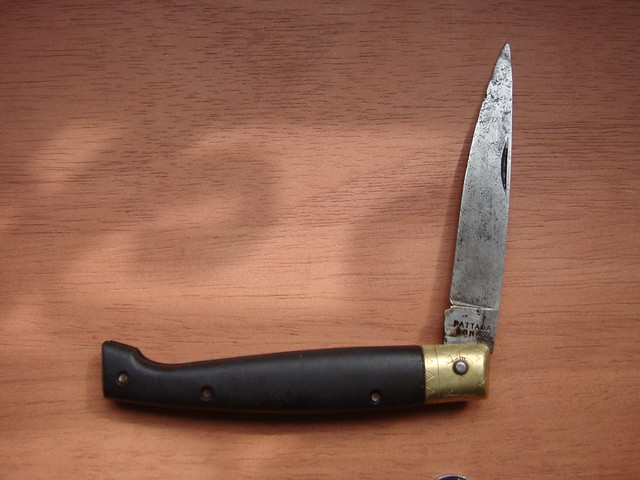
Just give me a few days to get back home to my laptop, then I will do what I can to satisfy ur curiosity, at least for Sardinian knives. Don't know if they're 'ethnic' enough, but sure enough they're traditionals, and are pretty different from US knives.
Meanwhile, about a month ago I started a thread about a small knife expo/museum in Pattada and posted some pics...u can start from that :rolleyes:
Fausto
:cool:
 
Higonokami, 75mm, San Mai Blue Paper Steel, Japanese Knife with a Vinegar Patina, it's A friction folder, and you can pick one of these up for under $20 Shipped

photo-7.jpg
 
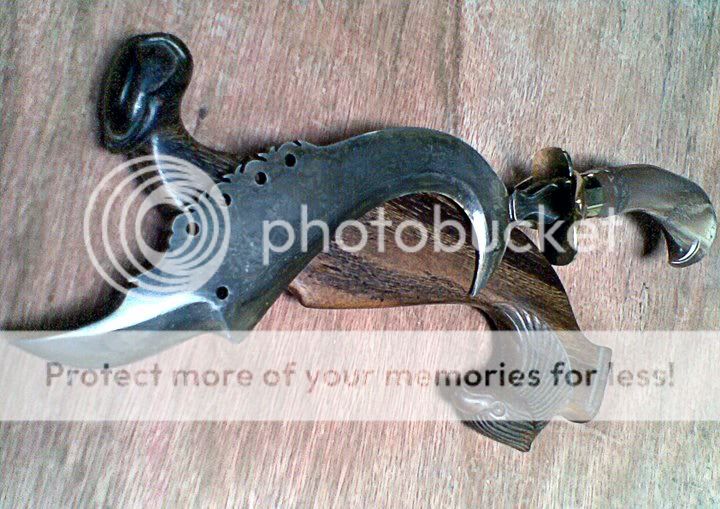
Here is one I have that for the life of me, I don't know what it is. I had to have it though.

Ethnic2.jpg
[/IMG]

Ethnic1.jpg
[/IMG]

Ethnic.jpg
[/IMG]
 
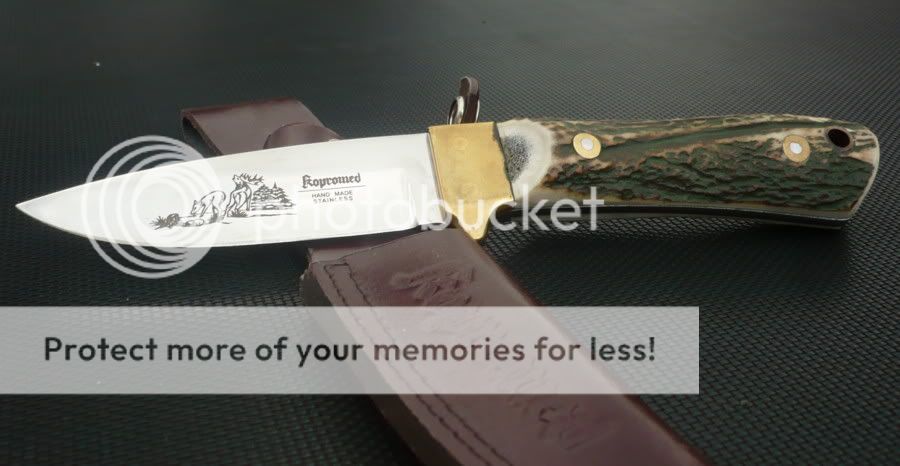
This may count, but I don't know anything about it.
294344_246911382009922_100000731875005_799951_21547_n.jpg

299849_246911592009901_100000731875005_799952_172671_n.jpg

297409_246911798676547_100000731875005_799953_4915006_n.jpg
That's a nice puukko you have there; a traditional Scandinavian knife. That one's Finnish, and is made by Iisakki Jarvenpaa. As to the age, I couldn't say, but Jarvenpaa has been in business for decades. Yours is kinda fancy. :cool:
 
Thanks for the reply. In my post I said I didn't know anything about it, which is basically true except that the knife is from the mid 1950's. At least that's when my dad won it as a prize in a muzzle loading rifle shoot. I couldn't decipher the writing on the blade, but can now make out "Iisakki Jarvenpaa". I did a google search on "Iisakki Jarvenpaa". Got a little more information and hope to find more now that I know the maker. Thanks again. Bob
 
This Hungarian pattern is called the "shepherd’s pocketknife” (juhász bicska):

http://www.tarjanyikesek.bolthalo.hu/showimage.php?pid=1086&mode=fullsized

This one is the so called “fish pocketknife” (halas bicska), first made by the famous Hungarian knifemaker József Sziráky in the late 19th century:

http://www.tarjanyikesek.bolthalo.hu/showimage.php?pid=1067&mode=fullsized

This is the so called "Náder pocketknife” (Náder bicska), named after another 19th Century Hungarian knifemaker who’s signature knife was this pattern:

http://www.tarjanyikesek.bolthalo.hu/showimage.php?pid=1066&mode=fullsized

Another variant:

http://www.nethirlap.hu/forum/userimgs/nhgalcB8aaJ.jpg

A typical Hungarian pattern from Eastern Hungary, the so called “curved headed pocketknife” (fejes görbe bicska):

http://www.tarjanyikesek.bolthalo.hu/showimage.php?pid=1083&mode=fullsized

It is likely a 19th century pattern. I have read people claiming it is derived from the handles of some 17th century Hungarian sabers, but I think this is just a marketing ploy. I have never seen a saber from that period which looked even closely similar.

BRL chose this pattern to show in his book. That specific knife pictured in the BRL guide is a crudely made example. The nicest variations I have seen were made in the shop of Imre Polyák

http://www.polyak-keses.hu/bicska/images/aDSCN1140.jpg

http://www.accentknives.com/images/homeknifepic.gif

and Ferenc Kocsis:

http://img9.indafoto.hu/8/5/112895_...800349_3002382d99c30172106d214a6f006b32_s.jpg

img.index.hu/imgfrm/9/1/0/5/THM_0008799105.jpg

If you google the Hungarian names in the parentheses you will find many nicer renditions of these patterns.
 
Last edited:
Thanks for those Hungarian traditionals. My Dad is from Hungary, and I'm interested to see some of his heritage. He left Hungary with nothing but the clothes on his back in 1956 and even that had a Russian bayonet hole through it.
 
Daniel, you are welcome. There are quite a few more Hungarian slipjoint patterns, still made today by knifemakers. In the last 20 years there is a revived interest in those, with several young makers establishing themselves as talented craftsmen (e.g. Ferenc Kocsis).

It appears that most (if not all) of these patterns arose in the 19th century, certainly influenced by German and British/American patterns. Most Hungarian slipjoint makers at that time worked in a kind of guild system. Many of them were of ethnic German origin. The technology of the slipjoint production, according to a documentary film about the Revesz knifemaker dynasty has originated from Solingen (maybe some of the 19th century knifemakers were apprentices in Solingen).
 
Back
Top