
-
The BladeForums.com 2024 Traditional Knife is available! Price is $250 ea (shipped within CONUS).
Order here: https://www.bladeforums.com/help/2024-traditional/
You are using an out of date browser. It may not display this or other websites correctly.
You should upgrade or use an alternative browser.
You should upgrade or use an alternative browser.
Fallkniven or Bark River?
- Thread starter SMCW
- Start date

Esav Benyamin
MidniteSuperMod
- Joined
- Apr 6, 2000
- Messages
- 90,915
Welcome to Bladeforums!
Standard answer: both
The F1 is a heavier blade, a survival knife. The Bravo 1 is more finesse, a slicer.
Both are still good general purpose. It may come down to personal preference.
Standard answer: both
The F1 is a heavier blade, a survival knife. The Bravo 1 is more finesse, a slicer.
Both are still good general purpose. It may come down to personal preference.

Pilot1
Gold Member
- Joined
- Sep 24, 2005
- Messages
- 2,113
I have both the F1 and Bravo-1. (Actually have two Bravo-1's).
IMHO, they are very different knives. I like the stainless of the F1, and its a good, versatile woods/survival knife. Mine lives in my flight bag, but doesn't get used much, hence why I like the stainless. It is a SMALL, compact knife, with a 3.8 inch blade.
The Bravo-1 while only a bit longer is a much larger knife. Its thicker, with a wider, slightly longer blade at 4.25 inches. It feels much bigger than the F1 and gives me more all around confidence for the woods. I carry this knife on day hikes as well as backpacking/camping.
IMHO, they are very different knives. I like the stainless of the F1, and its a good, versatile woods/survival knife. Mine lives in my flight bag, but doesn't get used much, hence why I like the stainless. It is a SMALL, compact knife, with a 3.8 inch blade.
The Bravo-1 while only a bit longer is a much larger knife. Its thicker, with a wider, slightly longer blade at 4.25 inches. It feels much bigger than the F1 and gives me more all around confidence for the woods. I carry this knife on day hikes as well as backpacking/camping.

- Joined
- Mar 20, 2010
- Messages
- 96
I don't think you'll get too many saying a bad word about either blade. Both great utility blades. I prefer the Fallkniven because I like the stainless VG10.
For me, the BR Bravo's handle just didn't sit well in my hand. Having said that, the standard thermorun on the F1 is ok, but I've had a couple of mine rehandled. Seems to give me the best of both worlds:
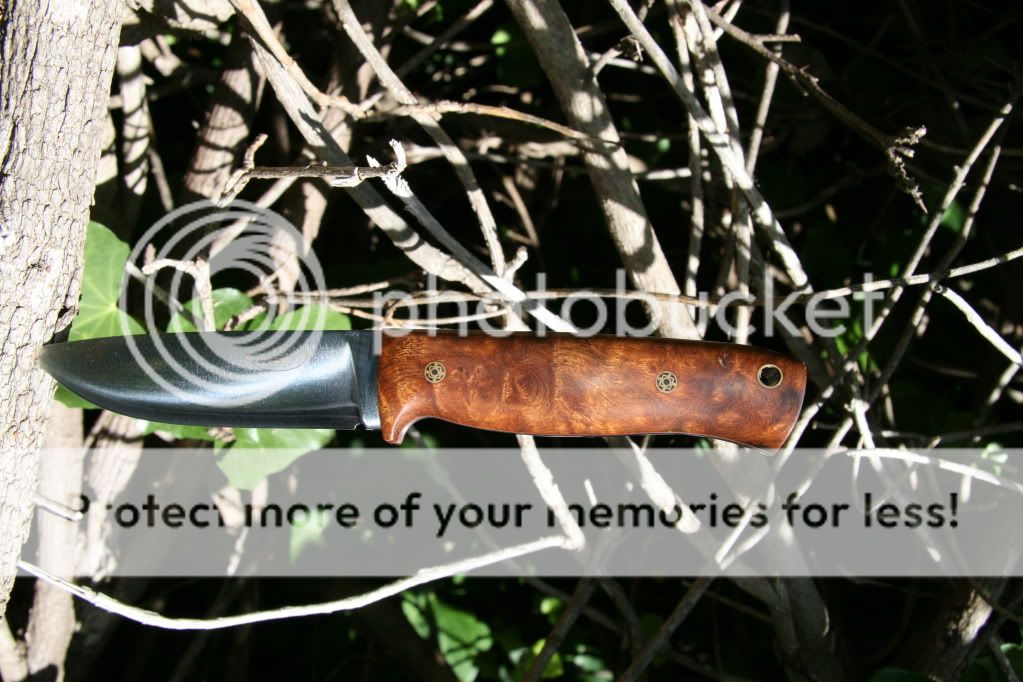
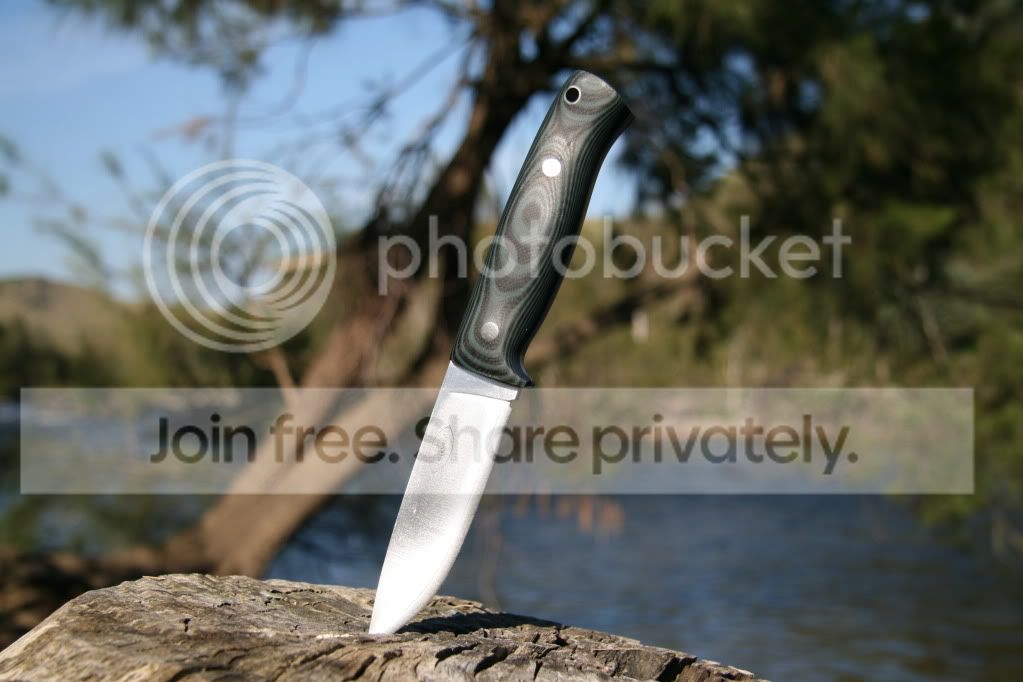
For me, the BR Bravo's handle just didn't sit well in my hand. Having said that, the standard thermorun on the F1 is ok, but I've had a couple of mine rehandled. Seems to give me the best of both worlds:

- Joined
- Mar 25, 2010
- Messages
- 707
I also have both and the F1 is indeed a great knife. I had the thermorun handled version and a Bark River wooden handled version (Barkniven). The Barkie handle definitely adds weight and carry size but for me improves it no end.
As others have already said the Bravo1 feels like a tank in comparison. I have the A2 version and it is without a doubt my most robust knife. I typically carry and use smaller knives but if I had to take just one it'd be the B1 every time. Moreover, I think the Barkies represent much better value which may be a consideration.
I guess it depends on your intended uses. If lighter carry and rust resistance is an issue the F1 may be your better choice but if you want a super-solid, terrifically comfortable knife then the B1 would likely edge it (it does for me anyway!)
You can decide wit confidence because both are strong, effective and durable knives. Essentially you can't make a wrong decision here. That said if I was a betting man I'd wager that you'll end up with both at some point!
Finallymy B1 is rampless and I definitely prefer it that way...
Ben
As others have already said the Bravo1 feels like a tank in comparison. I have the A2 version and it is without a doubt my most robust knife. I typically carry and use smaller knives but if I had to take just one it'd be the B1 every time. Moreover, I think the Barkies represent much better value which may be a consideration.
I guess it depends on your intended uses. If lighter carry and rust resistance is an issue the F1 may be your better choice but if you want a super-solid, terrifically comfortable knife then the B1 would likely edge it (it does for me anyway!)
You can decide wit confidence because both are strong, effective and durable knives. Essentially you can't make a wrong decision here. That said if I was a betting man I'd wager that you'll end up with both at some point!
Finallymy B1 is rampless and I definitely prefer it that way...
Ben

james terrio
Sharpest Knife in the Light Socket
- Joined
- Apr 15, 2010
- Messages
- 22,618
I've only held one BRKT Bravo-1. It's on my bench now, it came in for new CF scales and a piggy-back sheath to carry a PSK. It's made of CPM-154 (excellent steel), evenly-ground and solidly-built. The profile and length of blade is very smart, and it would be extremely handy if it was made from thinner stock.
But I gotta say, this thing is a brick. As in, it's way too thick and way too heavy and not keen enough to cut worth a hoot. I don't know if this particular knife is a proto* or what... but cheese and rice... it is overbuilt to the point of being just plain dumb.
ETA: I wouldn't have any hesitation about batonning it. *shrug*
*EDIT: not a proto. marked "1st Production Run".
But I gotta say, this thing is a brick. As in, it's way too thick and way too heavy and not keen enough to cut worth a hoot. I don't know if this particular knife is a proto* or what... but cheese and rice... it is overbuilt to the point of being just plain dumb.
ETA: I wouldn't have any hesitation about batonning it. *shrug*
*EDIT: not a proto. marked "1st Production Run".
Last edited:

- Joined
- Feb 11, 2012
- Messages
- 494
If you're looking for a hunting knife that's going to do a lot of cutting you might want to check out the slightly more pricey Fällknivens http://www.fallkniven.com/en/shop/category/23/fixed-blades/hunting-knives. They are pretty wicked.

- Joined
- Mar 23, 2012
- Messages
- 2,177
I've only held one BRKT Bravo-1. It's on my bench now, it came in for new CF scales and a piggy-back sheath to carry a PSK. It's made of CPM-154 (excellent steel), evenly-ground and solidly-built. The profile and length of blade is very smart, and it would be extremely handy if it was made from thinner stock.
But I gotta say, this thing is a brick. As in, it's way too thick and way too heavy and not keen enough to cut worth a hoot. I don't know if this particular knife is a proto or what... but cheese and rice... it is overbuilt to the point of being just plain dumb.
ETA: I wouldn't have any hesitation about batonning it. *shrug*
Gotta love it when people say it true rather than go with the crowd. Personally, I've been eyeballing your knives since I first saw them. Just waiting for something that suits me.
I have both the F1 and Bravo-1. (Actually have two Bravo-1's).
IMHO, they are very different knives. I like the stainless of the F1, and its a good, versatile woods/survival knife. Mine lives in my flight bag, but doesn't get used much, hence why I like the stainless. It is a SMALL, compact knife, with a 3.8 inch blade.
The Bravo-1 while only a bit longer is a much larger knife. Its thicker, with a wider, slightly longer blade at 4.25 inches. It feels much bigger than the F1 and gives me more all around confidence for the woods. I carry this knife on day hikes as well as backpacking/camping.
+ 1, have owned and used both.
The BRK&T is a beast and the F-1 a smaller blade.
Both have a use,depends on your intended use ?.
- Joined
- Mar 25, 2010
- Messages
- 707
...I gotta say, this thing is a brick. As in, it's way too thick and way too heavy and not keen enough to cut worth a hoot. I don't know if this particular knife is a proto or what... but cheese and rice... it is overbuilt to the point of being just plain dumb.
You know, I have huge respect for anyone who has the experience and ability to make their own tools and if that is sufficiently skillful to add to, or to earn an income then that's brilliant. However, making blanket statements risks overlooking the actual application of such tools no matter what your background or ability.
I too share similar thoughts about 'over-built' products, especially knives (never more so than with folders!) but unless you've actually used one which has a decent edge on it how can you really 'know' that it is "overbuilt to the point of being just plan dumb"?
These knives work. Moreover they work in a variety of situations - admittedly with an emphasis on robustness, but they still work and for me in my actual experience, they work well.
Mine will work for field dressing, basic woodcraft (basic due to my ability, not the knife's limitations) and sure it'll batton if that is your thing but to potentially write these knives off based on looking at them and handling one is frankly ridiculous.
Ben

- Joined
- Dec 31, 2011
- Messages
- 292
You know, I have huge respect for anyone who has the experience and ability to make their own tools and if that is sufficiently skillful to add to, or to earn an income then that's brilliant. However, making blanket statements risks overlooking the actual application of such tools no matter what your background or ability.
I too share similar thoughts about 'over-built' products, especially knives (never more so than with folders!) but unless you've actually used one which has a decent edge on it how can you really 'know' that it is "overbuilt to the point of being just plan dumb"?
These knives work. Moreover they work in a variety of situations - admittedly with an emphasis on robustness, but they still work and for me in my actual experience, they work well.
Mine will work for field dressing, basic woodcraft (basic due to my ability, not the knife's limitations) and sure it'll batton if that is your thing but to potentially write these knives off based on looking at them and handling one is frankly ridiculous.
Ben
I'm trying to understand convex. How to use it? How to sharpen it? I just got a BRKT Essential EDC and and love the style and form factor but my initial experience with the blade is similar to Frank's comments above. It seems that its dull and thick and hard to sharpen. What I read is that its not and I just need to go thru the convex learning curve. I love the appearence of the Essential and the sheath etc. so I just sharpened on a mouse pad with 2000 grit and have a strop coming with the various compounds and I'm going to give convex a real fair try. Up till now I have been a real FFG man.
I've only held one BRKT Bravo-1. It's on my bench now, it came in for new CF scales and a piggy-back sheath to carry a PSK. It's made of CPM-154 (excellent steel), evenly-ground and solidly-built. The profile and length of blade is very smart, and it would be extremely handy if it was made from thinner stock.
But I gotta say, this thing is a brick. ...
I'm not sure where people have gotten the impression that the Bravos are bushcraft/woods slicer/cutters. They weren't designed to be. They were designed as hard use/tactical (whatever "tactical" means) knives.
If Bark River didn't make a ton of models designed specifically for general or particular outdoors tasks, I could see taking the Bravo into the woods. But they do make a ton of models designed specifically for general or particular outdoors tasks.
Of course, if the OP is looking for a hard use sharpened prybar my post is academic. Certainly would be helpful if we knew what he wanted to use the knife for....

- Joined
- Sep 17, 2009
- Messages
- 1,102
Ive owned both, now I only own the F1.
Ill be honest, the Bravo is much more of a looker. The handles are beautiful and they feel great in hand.
But... When you are really out in the woods and its cold and its raining and your hands are kind of numb you really appreciate the F1. The fugly thermorun handle does not get cold, it has great traction when your hands are wet or bloody, and the thinner handle profile excels with gloves.
Just my take from putting some significant mileage on both.
Ill be honest, the Bravo is much more of a looker. The handles are beautiful and they feel great in hand.
But... When you are really out in the woods and its cold and its raining and your hands are kind of numb you really appreciate the F1. The fugly thermorun handle does not get cold, it has great traction when your hands are wet or bloody, and the thinner handle profile excels with gloves.
Just my take from putting some significant mileage on both.
- Joined
- Mar 25, 2010
- Messages
- 707
Hey George,
Yours seems to be a slightly different point but for sure a bevel edge tends to 'feel' sharper when you test it but convex edges tend to be more robust due the additional steel behind the edge and they sure can cut. I'm pretty sure James Terrio knows that because a) he's an experienced knifemaker and b) he put convex edges on some of his knives too BUT please don't let me put words in his mouth - I'm sure he'll give his take on this if/when it suits him.
The reality is that most edges we put on are at least slightly convexed if you sharpen them freehand. It is definitely worth persevering with the new sharpening technique and as everyone always says less pressure = sharper edge (especially with the mousemat option)...
Enjoy your Essential, I don't have one but is sure looks handy...
Ben
Yours seems to be a slightly different point but for sure a bevel edge tends to 'feel' sharper when you test it but convex edges tend to be more robust due the additional steel behind the edge and they sure can cut. I'm pretty sure James Terrio knows that because a) he's an experienced knifemaker and b) he put convex edges on some of his knives too BUT please don't let me put words in his mouth - I'm sure he'll give his take on this if/when it suits him.
The reality is that most edges we put on are at least slightly convexed if you sharpen them freehand. It is definitely worth persevering with the new sharpening technique and as everyone always says less pressure = sharper edge (especially with the mousemat option)...
Enjoy your Essential, I don't have one but is sure looks handy...
Ben


chiral.grolim
Universal Kydex Sheath Extension
- Joined
- Dec 2, 2008
- Messages
- 6,422
Mike Stewart touted them as hard-use tactical knives, but few people would put them into a "tactical environment", the handle is too slick and round for that purpose, and the grinds on many were way too thin to stand up to such use, so fans switched to calling them "slicers" which they do quite well with those thin grinds... but the stock is so thick that it reduces performance on deep cuts into tough material (e.g. hardwood) and the thumb-ramp is too severe/sharp for a multitude of grips, and the knife is rather short so...I'm not sure where people have gotten the impression that the Bravos are bushcraft/woods slicer/cutters. They weren't designed to be. They were designed as hard use/tactical (whatever "tactical" means) knives.
If Bark River didn't make a ton of models designed specifically for general or particular outdoors tasks, I could see taking the Bravo into the woods. But they do make a ton of models designed specifically for general or particular outdoors tasks.
Of course, if the OP is looking for a hard use sharpened prybar my post is academic. Certainly would be helpful if we knew what he wanted to use the knife for....
Hunting & general use it is! *shrug*
I have a Bravo 1 (A2), never owned an F1. I'd consider the Bravo 1 an expensive but decent "starter" blade for general outdoor use, one that can be made to handle a multitude of tasks depending on your skill set. It's pretty too. Not my favorite knife, but I like it and feel no qualms about loaning it out to friends/family.
My $0.02.
Mike Stewart touted them as hard-use tactical knives, but few people would put them into a "tactical environment", the handle is too slick and round for that purpose, and the grinds on many were way too thin to stand up to such use, so fans switched to calling them "slicers" which they do quite well with those thin grinds... but the stock is so thick that it reduces performance on deep cuts into tough material (e.g. hardwood) and the thumb-ramp is too severe/sharp for a multitude of grips, and the knife is rather short so...
Hunting & general use it is! *shrug*
Interesting post! :thumbup: I suppose there's a difference between intended design and actual function!
If, in practice, these Bravos are functioning as slicers....I'd suppose I'd lean towards getting a Bark River intended slicer instead, like an Aurora, NorthStar, or Liten Bror.Again though...I suppose SMCW hasn't said what the intended application of his new knife is going to be. Maybe he wants a "ground too thin, slick handled hard use tactical" knife!
- Joined
- Dec 31, 2011
- Messages
- 292
Mike Stewart touted them as hard-use tactical knives, but few people would put them into a "tactical environment", the handle is too slick and round for that purpose, and the grinds on many were way too thin to stand up to such use, so fans switched to calling them "slicers" which they do quite well with those thin grinds... but the stock is so thick that it reduces performance on deep cuts into tough material (e.g. hardwood) and the thumb-ramp is too severe/sharp for a multitude of grips, and the knife is rather short so...
Hunting & general use it is! *shrug*
I thought the Bravo 1 was designed using feed back from marine force recon after some blind tests of other bark river models and was specifically targeted towards tactical use?
Hey George,
Yours seems to be a slightly different point but for sure a bevel edge tends to 'feel' sharper when you test it but convex edges tend to be more robust due the additional steel behind the edge and they sure can cut. I'm pretty sure James Terrio knows that because a) he's an experienced knifemaker and b) he put convex edges on some of his knives too BUT please don't let me put words in his mouth - I'm sure he'll give his take on this if/when it suits him.
The reality is that most edges we put on are at least slightly convexed if you sharpen them freehand. It is definitely worth persevering with the new sharpening technique and as everyone always says less pressure = sharper edge (especially with the mousemat option)...
I am going to persevere the better strop and compunds are on the way!
Enjoy your Essential, I don't have one but is sure looks handy...
Ben,
If you like the size of the Essential EDC and the look of the bravo 1. Have you seen this yet!!!! The new Pocket Bravo
Specs:
Overall Length: 4.9 Inches
Blade Length: 2.250 Inches
Blade Steel: 154CM @ 60-61
Blade Thickness: .130 Inch
Weight : 1.375 Ounces
Last edited: