Fast wound care - no stitches

Joined
Jul 31, 2006
Messages
24
I'm sure somewhere in this forum it is mentioned (probably a lot) but I haven't run into it yet.

When you are out in the woods or wherever that a wound that may require stitches is..well...likely or at least good and possible - carry a tube of super glue! It works GREAT to close wounds and will degrade as the wound heals. If the wound is large enough - get it closed professionally if you like - in order to minimize the scar - but, in a pinch - super glue closes wounds quite well!
 
I've got one for ya, if you have a wound, rub some Cayenne pepper to stop the bleeding. You would think it would burn but it doesn't. :D
 
Tis true about Super Glue. In fact Super Glue was invented by/for the military for first aid in the field. It was developed for the same reasons as what Draco states.

Kind of funny how the military helps expedite the development of some of the strangest things....

And I won't even get into WD-40 or Velcro.

DM
 
Probably a silly question, but I thought you weren't supposed to close wounds in the field?


I hope that is true, the one thing I ignore when it comes to survival kits, is the first aid kit.

The only first aid I prepare for is fever and dehydration (fever is aspirin which helps for pain)

Anything can serve as a temporary, ugly wound cover.
 
braddy said:
Anything can serve as a temporary, ugly wound cover.
Sure, anything can serve as a temporary wound 'cover', but if you're bleeding, you may want to stop it. Leaves aren't good blood absorbers, so you may want to invest in some non-woven gauze 4x4s, a few roller gauze or a role of cloth tape, and some butterfly closures. Maybe toss in a 5x9 dressing or two, just in case. Bandaging materials tend to be very light weight.

The company I work for carries a hemostatic gauze that really helps stop bleeding. When applied to a bleeding wound, it turns into a gel and helps accelerate clot formation. It even worked on arterial bleeds. The stuff is sort of expensive, but it would be worth having, especially if you're going to be miles away from an ER or EMS service. The gauze is also 100% absorbable into the body. Cool stuff.

As an EMT, carrying wound care stuff is almost automatic. I have a very small kit in my EDC bag that covers the basics and isn't bulky. I'll post up pics later this morning.

Prepare for the worst, and hope for the best. You never know what may happen, as careful as you may be.

And to help you assess things in the field Use this simple formula: Air goes in and out, and blood goes round and round. Any deviation from that is a bad thing.
 
The "superglue was developed as a wound closure device for the military" is BS. Superglue (cyanoacrylates) were developed accidentally while developing an optically clear polymer to replace glass in aircraft canopies back in WW2. The glue has been available in the commercial sector since about the 1950s. It started seeing limited medical use in the 1960's. It fell out of favor for several reasons - the original cyanoacrylates degraded into toxic metabolites, and had some significant heat (detrimental to wound healing) while curing. The bond was also not very flexible, making repairs in areas of stress difficult. These problems led to the development of butyl cyanoacrylate (AKA Vetbond) which decreased some of the problems, and later octyl cyanoacrylate (AKA Dermabond), which reduced them further.

Superglue will bond skin - that's pretty well known. It's far from ideal, and in a field environment, could be dangerous (up to and including, fatal - search for necrotizing fasciitis). Skin glues in the medical sector are typically limited to small, clean-edged wounds, in areas of low tension. Wounds that extend into or through the subcutaneous layer still require sutures to close the deeper layers.
 
I knew it had something to do w/ aircraft parts :).

It was still an accidental (or incidental, if you will) discovery - they were trying to make an optically clear polymer (be it bomb sights or canopies) - they discovered that the stuff worked great as a glue - they didn;t start out to make a glue (from the reports I have read).
 
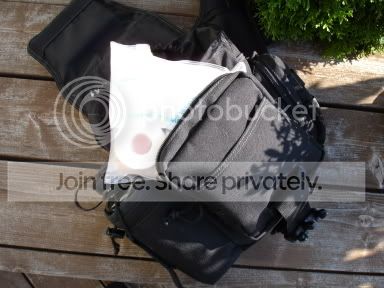
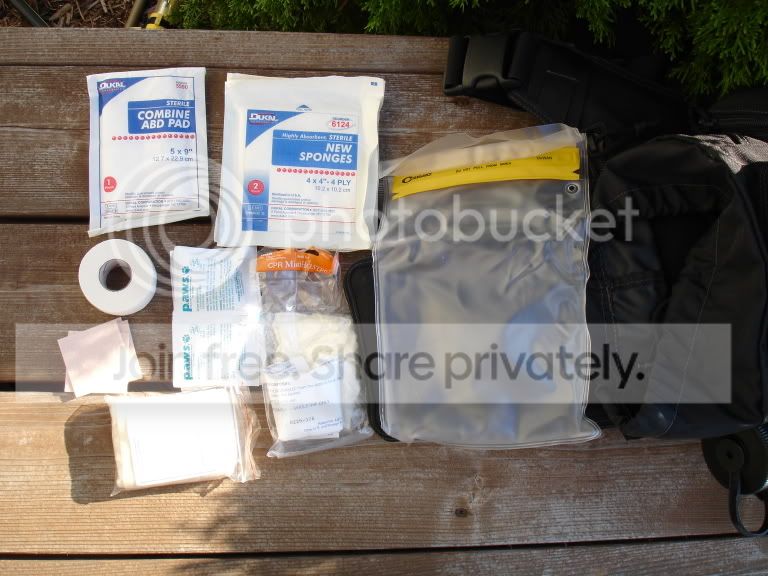
Here's what I tote around with me. It fits into the front zippered pocket of my Maxpedition Jumbo Versapack with some room to spare:
EDCFA02.jpg

EDCFA01.jpg

Kit contents:

3 sterile non-woven 4x4 sponges
1 sterile 5x9 dressing
1 1" roll of cloth tape (many uses)
1 triangle bandage (also many uses)
4 2x2 adhesive moleskin
6 Personal Antimicrobial Wipes
1 CPR barrier device
1 pr of exam gloves
All in an inexpensive but decently durable Coghlan's waterproof pouch.

Need to add:
A few antiseptic towellettes
A few unit dose 3-in-1 antibiotic ointment packets
Butterfly closres (tape will work, too)


I have a larger, more comprehensive kit I keep in my backpack, and an even larger and more comprehensive first responder-type jump kit I keep in the car.
 
Boys I twice cut myself in the past year . Once on a brokem arrow and once on a broken glass .

They were bad enough that I couldn,t repair them myself . One was a deep narrow cut and the other was long but fairly shallow .

The nurse put a good pressure bandage on the deep one . 3 flippingh hours later and the doctor comes in and opens up the partially well healed cut to inject a pain killer . He hurt me worse with the needle . He caused nerve damage and sewed up a cut that was healing on its own .

The second cut was admministered by another doctor who slapped on some crazy glue . Gave me a pain killer pill and all sorts of free bandages .(unheard of to give free things away) . He then gave me a prescription for these awesome painkillers which last over eight hours . (You are warned not to drive .(The next morning. )

There was no real need for the painkillers which I think are called pseudoll .
I call them stupid dolls as that is how they make me feel . I keep them for when my back is really bothering me . It doesn,t really kill the pain . You just don,t care . L:O:L

It just goes to show ya that a little bit of crazy glue is a lot better than a cure worse than the problem .
 
Rather than jamming the glue into a wound, apply pressure to stop the bleeding and use the glue to basically secure a bandaid to pull the edges together. Glue in the wound itself will basically prevent the edges from healing together.

-Cliff
 
I have used super glue in the past to close up some moderatly nasty wounds and it works well but cliff is right, I close the wound up with pressure and then apply the glue to the skin surface, just to hold the skin together, not the flesh.

I also use it on blisters on my feet from time to time. Poke a hole to drain and then fill that sucker up with the glue, press out the excess and your good to go.

Just be careful not to glue your good fingers to the wound, that just sucks.
 
Electrical tape, goes on easy, comes off easy. First tape of choice, otherwise any tape will do in a pinch. Be sure to place a pad of toilet paper or kleenex on the cut before placing the paper.

For big gashes use clothes wraped around the wound with tape and get to the hospital fast.

For the minor things like bleeding chapped lips in winter time I like super glue. Place a drop on the bleeding chap and let it set. It leave a nice manmade scab over the cracked lip and allows it to heal. Just make sure you don't close your lips before the glue sets or else your mouth will be shut for good.......... And that may be a good thing for some people anyways.:D
 
I have found pressure to be the best fix with the nasty cuts either I or my wife have experienced. She was washing a pint glass with a sponge inside when is broke and cut her hand about 4 cm long in the web of her hand. If anyone has seen Japanese medical quality they wouldnt be surprised that I dealt with it myself. I got a good compress on it and it took about a week to fix, but it stopped bleeding very well considering its depth. Now she just has a thin scar, nothing like the Frankenstein deal she would have had from the local butche...erm Hospital.

Maybe, working out a system that will allow you one handed to apply a compression bandage isnt such a bad idea. I love the sound of those hemo bandages though, that is pretty nifty.
 
DevilMan said:
Tis true about Super Glue. In fact Super Glue was invented by/for the military for first aid in the field. It was developed for the same reasons as what Draco states.

Kind of funny how the military helps expedite the development of some of the strangest things....

And I won't even get into WD-40 or Velcro.

DM

All discovered on a wrecked alien spaceship found somewhere in New Mexico.

Actually a roll of 1" firstaid tape and crazy glue ride in the car firstaid kit.
 
There have been alot of threads relatively recently on the topic. Several have had good input from practicing MDs and EMTs. It's worth doing a search for them.

Pat
 
In the basic survival kit there are some items that are pretty much universally agreed upon. In a survival situation, you must rely on what you have on hand.

This is from memory of various First Aid classes I've attended over the years.
Don't take this as gospel! It's just a rough idea of what you'd be doing.
If you really want the 100% correct way to do things, take some First Aid classes, check with the local Red Cross they can point you in the right direction.

In order of severity:

small cut- (1 inch or less in length, no depth) Good old bandaid you keep in your field kit should do quite nicely!(sorry for stating the obvious and removing the McGyver factor).

medium cuts-(greater than 1 inch in length and/or some significant depth, maybe a puncture) apply pressure & elevate for a few minutes. check to see that bleeding stops. If no gauze, use a small piece of cloth (cut a small clean square out of shirt or something). Use that black electrical tape or Duct tape you have wrapped around your [insert favorite flashlite or film vial].
I swear by black electrical tape! Especially for fingers, knuckles, thumbs, etc. The flexibility of the electrical tape allows you to move that finger or thumb, while still keeping the wound closed. It's the main "cut closer" in my workshop.
"I don't have time to bleed"

Larger cuts , gashes, decent sized bleeders. These are usually accompanied by gasps, and someone saying "Oh that looks deep!" You can even end up with a second patient, upon seeing the wound, they faint and hit their head on a rock.
Elevate the body part, apply pressure, do not bandage until you think you see the bleeding starting to clot/subside , otherwise you may seal up an arterial bleed, and not know it right a way.
Once you see the bleeding curtailing, (if you don't have gauze) cut a larger piece of cloth, go for the duct tape you wrapped around your [insert favorite tubular item] to affix the dressing.
If it is a leg or an arm, do the "wrap around" , tie the cloth knot over the bleeder so that pressure from the knot will continue to work. If on the torso, use that duct tape and continue to apply pressure, until such time the patient can apply pressure on their own. Check it frequently, to make sure it doesn't start to flow again. If you carry sutures and also have a clue, throw a couple a butterflies in there to help it stay closed. If not, you can use Duct tape strips across the clean&dry gash, forming "X"s along it's length, with a little tension pulling the skin flaps together, then wrap with gauze, cloth, etc.

The Real Big stuff: Life threatening bleeds. Gunshot wound, 4 inch deep cut by a machete, deep animal bite, etc.
Elevate the part or the body.
If it's visibly squirting or flowing more as the heart beats, you have literally minutes or less to do something. Tourniquettes have a real bad reputation, but, for something this major, if it's on an arm and a leg, you may have to make that decision, but you are also making the decision for an amputation, most likely. in the case of a totally mangled foot, that is only hanging on by a peice of skin, the decision is made for you, otherwise, you will be forced to make the tough decision, especially if help is many hours or days away. Unless someone is an ex-corpsman, EMT, RN or MD, you are probably not going to have the training to find the "bleeder" and clamp it off. Looks easy on TV, but it's nothing for us novices who may have a First Aid Card as our main medical credentials. The victim is more likely to die while you futz around trying to pretend you stayed in a Holiday Inn Express last night.
If it's not flowing or squirting as the heart beats, first be thankful, and quickly get some major pressure applied and keep elevated. Have someone cut and roll a piece of cloth into a fist sized piece, resembling a rolled up ace bandage, then apply it directly to the wound with plenty of pressure. it can take an hour for a big ol gash to slow or stop bleeding altogether. Take turns applying pressure if there are several people there. Later you can tie the roll in place, so that it still keeps pressure on the big ol gash.
These serious ones will also force the decision to send a runner, even if it's 10 miles to the nearest civilization, because it would be ill advised to try to walk the victim out any time soon.

OK, back to the run-o-the-mill minor cuts.
In a survival situation, I'd suggest the good old bandaid, followed by electrical tape if its a little too big for bandaid, or followed by duct tape.

Oh, and by the way, try to clean the wound, if at all possible.
Even if you simply rinse it with some clean water, it's better than leaving it dirty.

I can think of many other uses for SuperGlue, but in 99% of the cases, not when trying to close a wound in a survival situation.

Disclaimer: Go take a First Aid class, don't rely on my "off the cuff" descriptions, above. I was just trying to generally frame-up the types of things you could be faced with and the general way they would be dealt with in a survival situation. All cases are unique, and require their own course of action.

 
geekswithguns said:
2 words: steri strips...


Three more words,

Tincture of benzoin

Use it on the periphery of the wound (don't get it in the wound it will sting like hell). That will help adhere the steri strips.

Generally speaking crazy glue is a bad idea. And has it has been already pointed out it was never created for first aid use originally though there is some use for it on small wounds now. I.E. liquid bandage, Dermabond. With larger wounds you are sealing in the infection that is almost sure to come without proper cleaning and debridement which can't be done in the field. If the infection cannot get out it will go in towards the bone or create a huge pus filled pocket that would need to be drained or cause a systemic infection that you will die from. Be aware that the size of the wound is not an indicator of how bad the infection will be.

You might tack the edges of the wound with superglue leaving spaces for the wound to drain if necesarry but the steri strips are a better idea. Also most of the superglues create a lot of heat when exposed to water (which the wound has in abundance) and hardning which causes even more tissue damage.

The other thing to remember is that almost all suturing is cosmetic unless we are talking that ligaments or tendons are involved so you may be able to get away without sutures most times if you don't care what the scar might look like. If tendons/ligaments etc are involved get thee to a physician.


KR
EMT-D
Wilderness EMT
 
Back
Top